
A Rare Glimpse Into the Teenage Phase of Planetary Development
Thanks to data from NASA’s Transiting Exoplanet Survey Satellite (TESS), an international collaboration of astronomers has identified four exoplanets, worlds beyond our solar system, orbiting a pair of related young stars called TOI 2076 and TOI 1807.
These worlds may provide scientists with a glimpse of a little-understood stage of planetary evolution.
“The planets in both systems are in a transitional, or teenage, phase of their life cycle,” said Christina Hedges, an astronomer at the Bay Area Environmental Research Institute in Moffett Field and NASA’s Ames Research Center in Silicon Valley, both in California. “They’re not newborns, but they’re also not settled down. Learning more about planets in this teen stage will ultimately help us understand older planets in other systems.”
A paper describing the findings, led by Hedges, was published in The Astronomical Journal.
Stellar siblings over 130 light-years away host two systems of teenage planets. Watch to learn how NASA’s Transiting Exoplanet Survey Satellite discovered these young worlds and what they might tell us about the evolution of planetary systems everywhere, including our own. Credit: NASA’s Goddard Space Flight Center/Chris Smith (KBRwyle)
TOI 2076 and TOI 1807 reside over 130 light-years away with some 30 light-years between them, which places the stars in the northern constellations of Boötes and Canes Venatici, respectively. Both are K-type stars, dwarf stars more orange than our Sun, and around 200 million years old, or less than 5% of the Sun’s age. In 2017, using data from ESA’s (the European Space Agency’s) Gaia satellite, scientists showed that the stars are traveling through space in the same direction.
Astronomers think the stars are too far apart to be orbiting each other, but their shared motion suggests they are related, born from the same cloud of gas.
Hyperactive Young Stars Reveal Early Solar Conditions
Both TOI 2076 and TOI 1807 experience stellar flares that are much more energetic and occur much more frequently than those produced by our own Sun.
“The stars produce perhaps 10 times more UV light than they will when they reach the Sun’s age,” said co-author George Zhou, an astrophysicist at the University of Southern Queensland in Australia. “Since the Sun may have been equally as active at one time, these two systems could provide us with a window into the early conditions of the solar system.”
TESS monitors large swaths of the sky for nearly a month at a time. This long gaze allows the satellite to find exoplanets by measuring small dips in stellar brightness caused when a planet crosses in front of, or transits, its star.
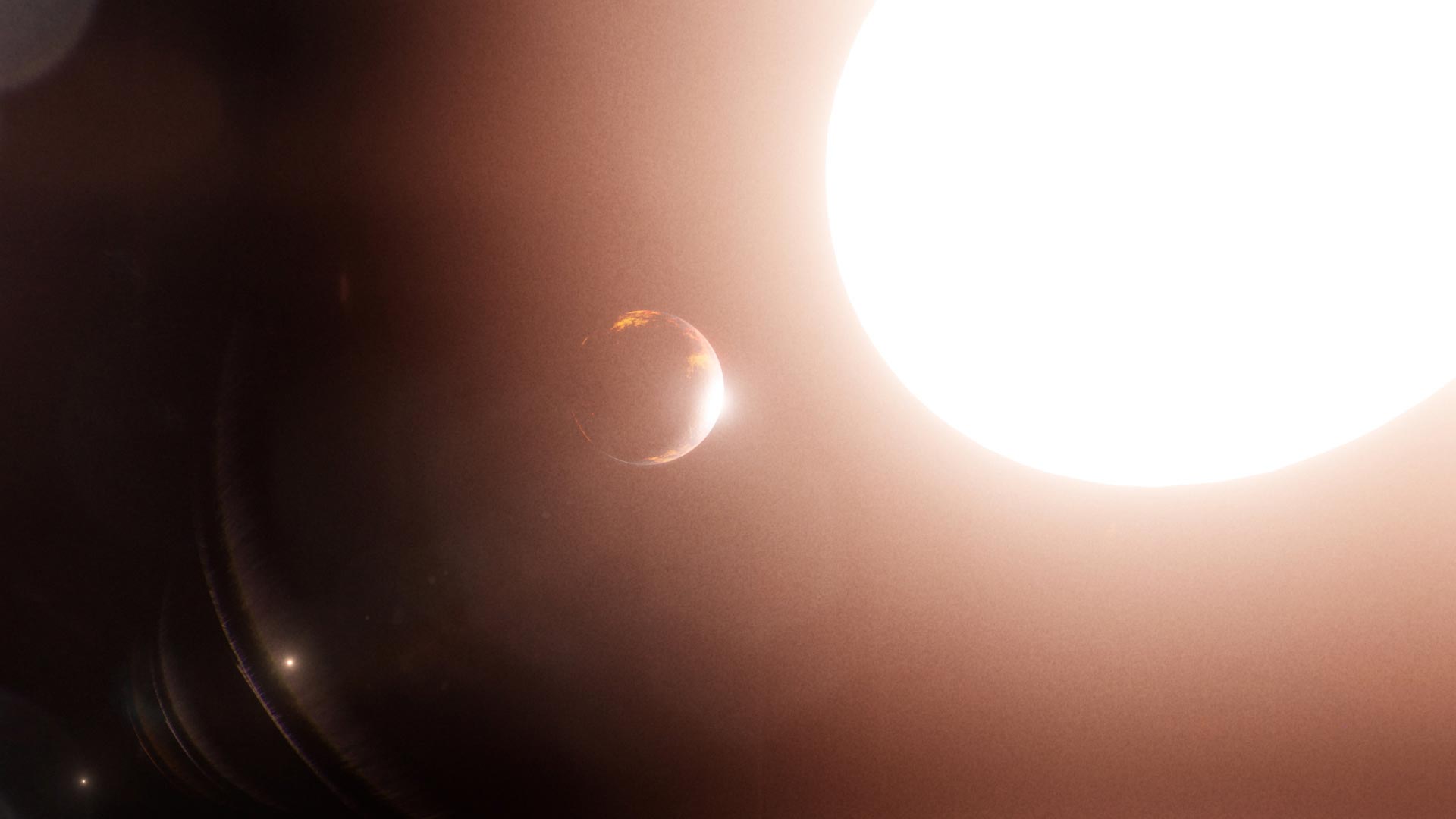
Planet TOI 1807 b is about twice Earth’s size and orbits a young dwarf, as shown in this illustration. It completes one orbit every 13 hours. Credit: NASA’s Goddard Space Flight Center/Chris Smith (KBRwyle)
Alex Hughes initially brought TOI 2076 to astronomers’ attention after spotting a transit in the TESS data while working on an undergraduate project at Loughborough University in England, and he has since graduated with a bachelor’s degree in physics. Hedges’ team eventually discovered three mini-Neptunes, worlds between the diameters of Earth and Neptune, orbiting the star. Innermost planet TOI 2076 b is about three times Earth’s size and circles its star every 10 days. Outer worlds TOI 2076 c and d are both a little over four times larger than Earth, with orbits exceeding 17 days.
TOI 1807 hosts only one known planet, TOI 1807 b, which is about twice Earth’s size and orbits the star in just 13 hours. Exoplanets with such short orbits are rare. TOI 1807 b is the youngest example yet discovered of one of these so-called ultra-short period planets.
Scientists are currently working to measure the planets’ masses, but interference from the hyperactive young stars could make this challenging.
Midpoint of Planetary Evolution
According to theoretical models, planets initially have thick atmospheres left over from their formation in disks of gas and dust around infant stars. In some cases, planets lose their initial atmospheres due to stellar radiation, leaving behind rocky cores. Some of those worlds go on to develop secondary atmospheres through planetary processes like volcanic activity.
The ages of the TOI 2076 and TOI 1807 systems suggest that their planets may be somewhere in the middle of this atmospheric evolution. TOI 2076 b receives 400 times more UV light from its star than Earth does from the Sun – and TOI 1807 b gets around 22,000 times more.
If scientists can discover the planets’ masses, the information could help them determine if missions like NASA’s Hubble and upcoming James Webb space telescopes can study the planets’ atmospheres – if they have them.
The team is particularly interested in TOI 1807 b because it’s an ultra-short-period planet. Theoretical models suggest it should be difficult for worlds to form so close to their stars, but they can form farther out and then migrate inward. Because it would have had to both form and migrate in just 200 million years, TOI 1807 b will help scientists further understand the life cycles of these types of planets. If it doesn’t have a very thick atmosphere and its mass is mostly rock, the planet’s proximity to its star could potentially mean its surface is covered in oceans or lakes of molten lava.
A New Window Into Planetary Evolution
“Many objects we study in astronomy evolve on such long timescales that a human being can’t see changes month to month or year to year,” said co-author Trevor David, a research fellow at the Flatiron Institute’s Center for Computational Astrophysics in New York. “If you want to see how planets evolve, your best bet is to find many planets of different ages and then ask how they’re different. The TESS discovery of the TOI 2076 and TOI 1807 systems advances our understanding of the teenage exoplanet stage.”
Reference: “TOI-2076 and TOI-1807: Two Young, Comoving Planetary Systems within 50 pc Identified by TESS that are Ideal Candidates for Further Follow Up” by Christina Hedges, Alex Hughes, George Zhou, Trevor J. David, Juliette Becker, Steven Giacalone, Andrew Vanderburg, Joseph E. Rodriguez, Allyson Bieryla, Christopher Wirth, Shaun Atherton, Tara Fetherolf, Karen A. Collins, Adrian M. Price-Whelan, Megan Bedell, Samuel N. Quinn, Tianjun Gan, George R. Ricker, David W. Latham, Roland K. Vanderspek, Sara Seager, Joshua N. Winn, Jon M. Jenkins, John F. Kielkopf, Richard P. Schwarz, Courtney D. Dressing, Erica J. Gonzales, Ian J. M. Crossfield, Elisabeth C. Matthews, Eric L. N. Jensen, Elise Furlan, Crystal L. Gnilka, Steve B. Howell, Kathryn V. Lester, Nicholas J. Scott, Dax L. Feliz, Michael B. Lund, Robert J. Siverd, Daniel J. Stevens, N. Narita, A. Fukui, F. Murgas, Enric Palle, Phil J. Sutton, Keivan G. Stassun, Luke G. Bouma, Michael Vezie, Jesus Noel Villaseñor, Elisa V. Quintana and Jeffrey C. Smith, 12 July 2021, The Astronomical Journal.
DOI: 10.3847/1538-3881/ac06cd
TESS is a NASA Astrophysics Explorer mission led and operated by MIT in Cambridge, Massachusetts, and managed by NASA’s Goddard Space Flight Center. Additional partners include Northrop Grumman, based in Falls Church, Virginia; NASA’s Ames Research Center in California’s Silicon Valley; the Center for Astrophysics | Harvard & Smithsonian in Cambridge, Massachusetts; MIT’s Lincoln Laboratory; and the Space Telescope Science Institute in Baltimore. More than a dozen universities, research institutes, and observatories worldwide are participants in the mission.
Never miss a breakthrough: Join the SciTechDaily newsletter.
Follow us on Google and Google News.
3 Comments
LAST 2 DECADES I WORKING DAY AND NIGHT I NEVER EARNINGS A SINGLE CENTS. IF I HELP YOU TO WORKING HOW MUCH MONEY YOU CAN PAY FOR FOR ME BE SIDE SOLAR SYSTEM I CAN HELP YOU WITH EVERYTHING WHAT YOU WANT TO KNOW I’M NOT JOKE TAKE MY WORDS SERIOUSLY IS ALL ABOUT SCIENCE AND TECHNOLOGY AND MANY MORE INVOLVED IN EARTH. THANK YOU.
Space only exist in the minds of liars who are tricking the masses with CGI fakery. And fish eyed lenses. Programming and indoctrination never ends
? Transit observations are not “CGI”, and the irrelevant note about fish-eyed lenses – not used in telescopes – make you sound like a ‘flat planet’ pseudoscientist.