
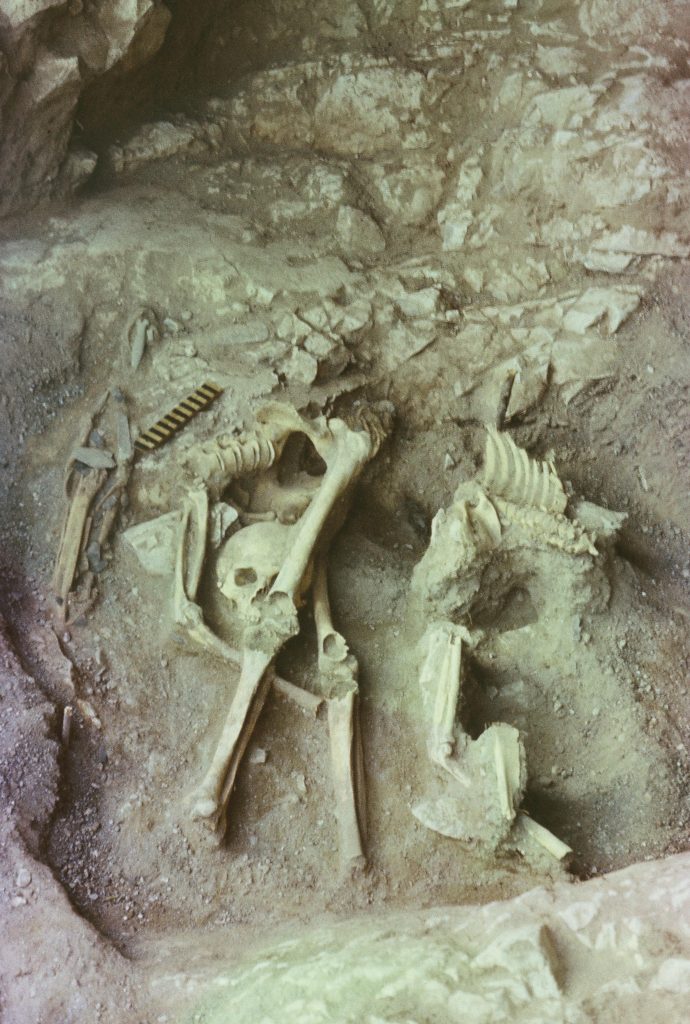
Ancient genomes from North Asia reveal highly mobile and interconnected populations, with gene flow from North America and Japan.
The migration of individuals from North Asia to North America across the Bering Sea is a well-established event in early human history. Despite this, the genetic composition of the people who inhabited North Asia during this time period has remained elusive due to a scarce number of ancient genomes obtained from this region. However, in a recent report published in Current Biology, researchers reveal genomes from ten individuals, some up to 7,500 years old, which shed light on this gap and demonstrate gene flow in the reverse direction, from North America to North Asia.
The researchers’ analysis uncovers a previously undocumented group of early Holocene Siberian people who lived in the Neolithic Altai-Sayan region, located in close proximity to the intersection of Russia, China, Mongolia, and Kazakhstan. The genetic data reveals that they were descendants of both paleo-Siberian and Ancient North Eurasian (ANE) individuals.
“We describe a previously unknown hunter-gatherer population in the Altai as early as 7,500 years old, which is a mixture between two distinct groups that lived in Siberia during the last Ice Age,” says Cosimo Posth at the University of Tübingen, Germany, and senior author of the study. “The Altai hunter-gatherer group contributed to many contemporaneous and subsequent populations across North Asia, showing how great the mobility of those foraging communities was.”
Posth notes that the Altai region is known in the media as the location where a new archaic hominin group, the Denisovans, was discovered. But the region also has importance in human history as a crossroad for population movements between northern Siberia, Central Asia, and East Asia over millennia.
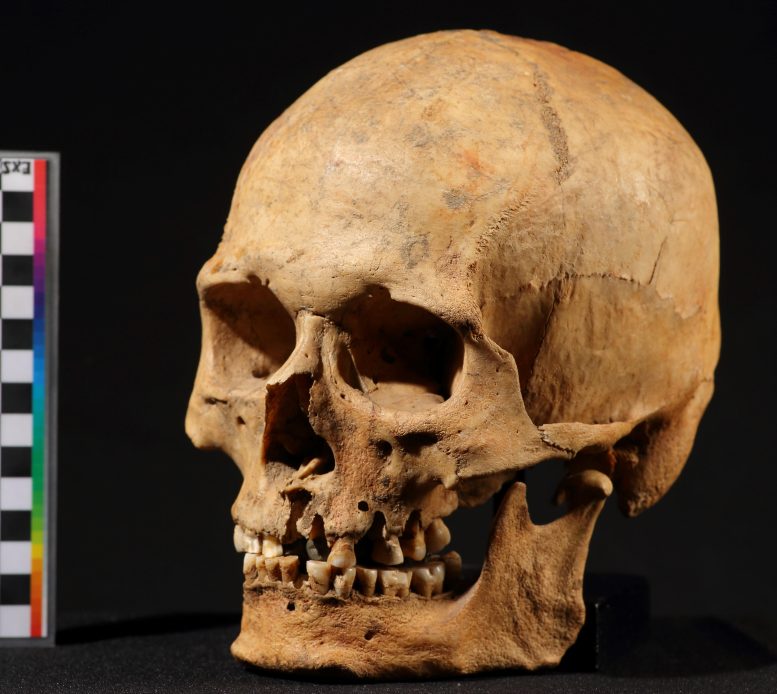
Posth and colleagues report that the unique gene pool they uncovered may represent an optimal source for the inferred ANE-related population that contributed to Bronze Age groups from North and Inner Asia, such as Lake Baikal hunter-gatherers, Okunevo-associated pastoralists, and Tarim Basin mummies. They uncovered Ancient Northeast Asian (ANA) ancestry as well—which had initially been described in Neolithic hunter-gatherers from the Russian Far East—in another Neolithic Altai-Sayan individual associated with distinct cultural features.
The findings reveal the spread of ANA ancestry about 1,500 kilometers farther to the west than previously observed. In the Russian Far East, they also identified 7,000-year-old individuals with Jomon-associated ancestry, indicating links with hunter-gatherer groups from the Japanese Archipelago.
Gene Flow Between North America and Siberia
The data also are consistent with multiple phases of gene flow from North America to northeastern Asia over the last 5,000 years, reaching the Kamchatka Peninsula and central Siberia. The researchers note that the findings highlight a largely interconnected population throughout North Asia from the early Holocene onwards.
“The finding that surprised me the most is from an individual dated to a similar period as the other Altai hunter-gatherers but with a completely different genetic profile, showing genetic affinities to populations located in the Russian Far East,” says Ke Wang at Fudan University, China, and lead author of the study. “Interestingly, the Nizhnetytkesken individual was found in a cave containing rich burial goods with a religious costume and objects interpreted as a possible representation of shamanism.”
Wang says the finding implies that individuals with very different profiles and backgrounds were living in the same region around the same time.
“It is not clear if the Nizhnetytkesken individual came from far away or the population from which he derived was located close by,” she says. “However, his grave goods appear different than other local archeological contexts implying mobility of both culturally and genetically diverse individuals into the Altai region.”
The genetic data from the Altai show that North Asia harbored highly connected groups as early as 10,000 years ago, across long geographic distances. “This suggests that human migrations and admixtures were the norm and not the exception also for ancient hunter-gatherer societies,” Posth says.
Reference: “Middle Holocene Siberian genomes reveal highly connected gene pools throughout North Asia” by Ke Wang, He Yu, Rita Radzevičiūtė, Yuriy F. Kiryushin, Alexey A. Tishkin, Yaroslav V. Frolov, Nadezhda F. Stepanova, Kirill Yu. Kiryushin, Artur L. Kungurov, Svetlana V. Shnaider, Svetlana S. Tur, Mikhail P. Tiunov, Alisa V. Zubova, Maria Pevzner, Timur Karimov, Alexandra Buzhilova, Viviane Slon, Choongwon Jeong, Johannes Krause and Cosimo Posth, 12 January 2023, Current Biology.
DOI: 10.1016/j.cub.2022.11.062
The study was funded by the Max Planck Society, Alon Fellowship, Russian Science Foundation, Russian Foundation for Basic Research, National Research Foundation of Korea (NRF), Ministry of Science and Higher Education of the Russian Federation, and Altai State University.
Never miss a breakthrough: Join the SciTechDaily newsletter.
Follow us on Google and Google News.