
Close Menu
    Facebook X (Twitter) Instagram
    SciTechDaily
    • Biology
    • Chemistry
    • Earth
    • Health
    • Physics
    • Science
    • Space
    • Technology
    Facebook X (Twitter) Pinterest YouTube RSS
    SciTechDaily
    Home»Space»Impending Stellar “Death” Revealed – NASA’s Webb Telescope Captures Prelude to Supernova
    Space

    Impending Stellar “Death” Revealed – NASA’s Webb Telescope Captures Prelude to Supernova

    By Space Telescope Science InstituteMarch 15, 2023No Comments5 Mins Read
    Facebook Twitter Pinterest Telegram LinkedIn WhatsApp Email Reddit
    Share
    Facebook Twitter LinkedIn Pinterest Telegram Email Reddit
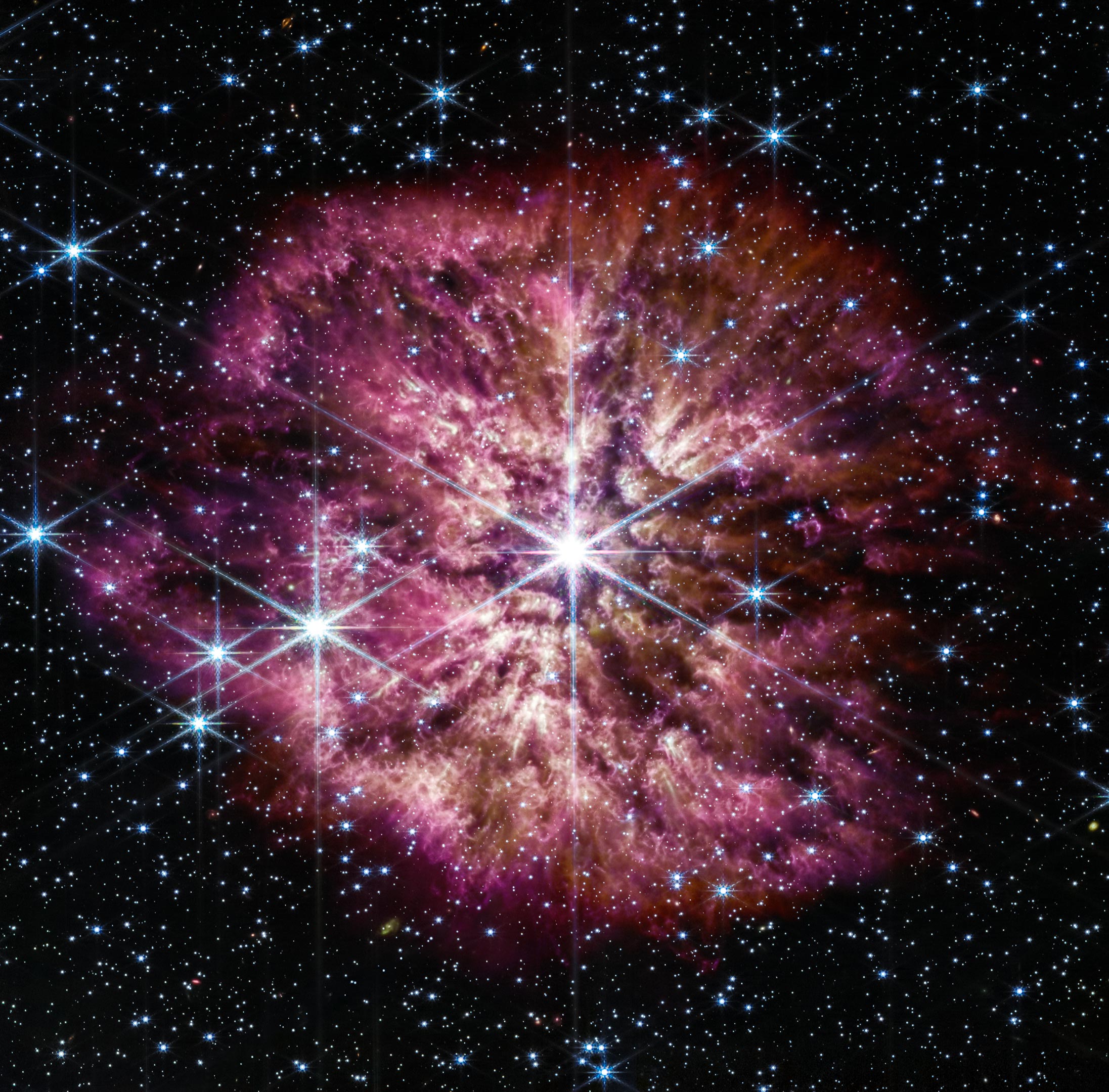
    WR 124 (Webb NIRCam and MIRI Composite Image)
    The luminous, hot star Wolf-Rayet 124 (WR 124) is prominent at the center of the James Webb Space Telescope’s composite image combining near-infrared and mid-infrared wavelengths of light from Webb’s Near-Infrared Camera and Mid-Infrared Instrument. Credit: NASA, ESA, CSA, STScI, Webb ERO Production Team

    Wolf-Rayet 124: A Star in Transition

    Wolf-Rayet stars are a rare prelude to the famous final act of massive stars: the supernova. In one of its first observations, NASA’s James Webb Space Telescope captured the Wolf-Rayet star WR 124 in unprecedented detail. A distinctive halo of gas and dust frames the star and glows in the infrared light detected by Webb, displaying knotty structure and a history of episodic ejections. Despite being the scene of an impending stellar “death,” astronomers also look to Wolf-Rayet stars for insight into new beginnings. Cosmic dust is forming in the turbulent nebulas surrounding these types of stars, which is composed of the heavy-element building blocks of the modern universe, including life on Earth.

    WR 124 (Webb MIRI Image)
    Wolf-Rayet stars are known to be efficient dust producers, and the Mid-Infrared Instrument on NASA’s James Webb Space Telescope shows this to great effect. Cooler cosmic dust glows at the longer mid-infrared wavelengths, displaying the structure of WR 124’s nebula. Credit: NASA, ESA, CSA, STScI, Webb ERO Production Team

    NASA’s Webb Space Telescope Captures Rarely-Seen Prelude to Supernova

    The rare sight of a Wolf-Rayet star – among the most luminous, most massive, and most briefly-detectable stars known – was one of the first observations made by NASA’s James Webb Space Telescope in June 2022. Webb shows the star, WR 124, in unprecedented detail with its powerful infrared instruments. The star is 15,000 light-years away in the constellation Sagittarius.

    Massive stars race through their lifecycles, and only some of them go through a brief Wolf-Rayet phase before going supernova, making Webb’s detailed observations of this rare phase valuable to astronomers. Wolf-Rayet stars are in the process of casting off their outer layers, resulting in their characteristic halos of gas and dust. The star WR 124 is 30 times the mass of the Sun and has shed 10 Suns’ worth of material—so far. As the ejected gas moves away from the star and cools, cosmic dust forms and glows in the infrared light detectable by Webb.

    Destiny of Dust Infographic
    (Click image for full infographic.) A tiny dust grain has many potential paths—and destinies—in the universe. Which would you choose? Where could it lead you? Explore some of the possibilities and consequences with this infographic, and discover important roles that dust can play—from sheltering forming stars to providing a platform for the development of organic molecules that make up life as we know it. Credit: NASA, ESA, CSA, Joyce Kang (STScI)

    The origin of cosmic dust that can survive a supernova blast and contribute to the universe’s overall “dust budget” is of great interest to astronomers for multiple reasons. Dust is integral (see infographic above) to the workings of the universe: It shelters forming stars, gathers together to help form planets, and serves as a platform for molecules to form and clump together—including the building blocks of life on Earth. Despite the many essential roles that dust plays, there is still more dust in the universe than astronomers’ current dust-formation theories can explain. The universe is operating with a dust budget surplus.

    Webb opens up new possibilities for studying details in cosmic dust, which is best observed in infrared wavelengths of light. Webb’s Near-Infrared Camera (NIRCam) balances the brightness of WR 124’s stellar core and the knotty details in the fainter surrounding gas. The telescope’s Mid-Infrared Instrument (MIRI) reveals the clumpy structure of the gas and dust nebula of the ejected material now surrounding the star. Before Webb, dust-loving astronomers simply did not have enough detailed information to explore questions of dust production in environments like WR 124, and whether the dust grains were large and bountiful enough to survive the supernova and become a significant contribution to the overall dust budget. Now those questions can be investigated with real data.
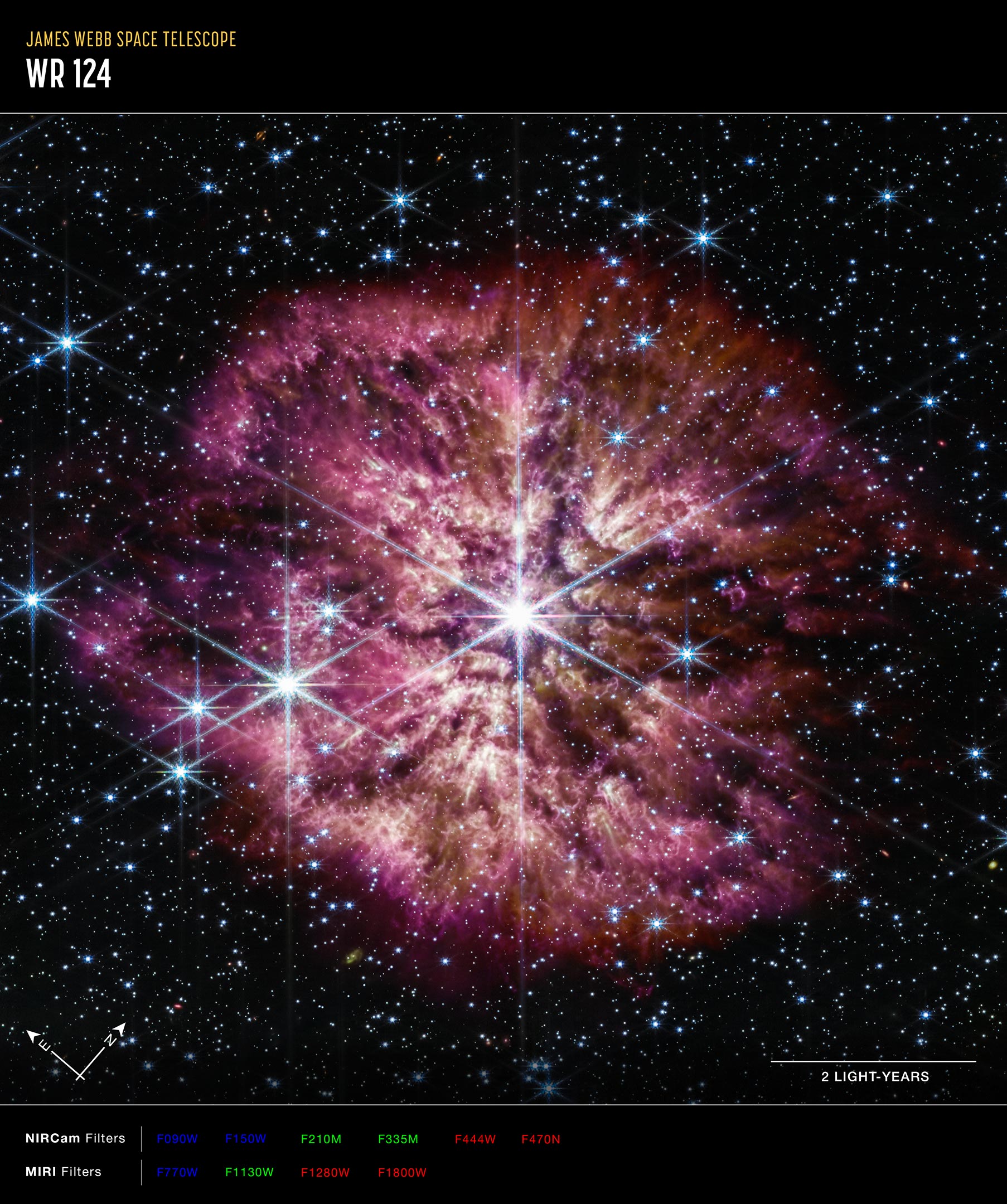
    WR 124 (Webb NIRCam and MIRI Compass Image)
    This composite image of star WR 124 captured by the James Webb Space Telescope’s Near-Infrared Camera and Mid-Infrared Instrument includes arrows, scale bar, and color key for reference.
    The north and east compass arrows show the orientation of the image on the sky. Note that the relationship between north and east on the sky (as seen from below) is flipped relative to direction arrows on a map of the ground (as seen from above).
    The scale bar is labeled in light-years, which is the distance that light travels in one Earth-year. One light-year is equal to about 5.88 trillion miles or 9.46 trillion kilometers.
    The color key at the bottom of the image shows which instrument filters were used and which visible-light color they have been assigned to create the image.
    Credit: NASA, ESA, CSA, STScI, Webb ERO Production Team

    Stars like WR 124 also serve as an analog to help astronomers understand a crucial period in the early history of the universe. Similar dying stars first seeded the young universe with heavy elements forged in their cores – elements that are now common in the current era, including on Earth.

    Webb’s detailed image of WR 124 preserves forever a brief, turbulent time of transformation, and promises future discoveries that will reveal the long-shrouded mysteries of cosmic dust.

    The James Webb Space Telescope holds the distinction of being the foremost space science observatory ever built. Its primary objectives encompass uncovering enigmas within our solar system, exploring remote worlds orbiting other stars, and delving into the enigmatic structures and origins of our Universe and our position within it. This international endeavor is spearheaded by NASA in collaboration with the ESA (European Space Agency) and CSA (Canadian Space Agency).

    Never miss a breakthrough: Join the SciTechDaily newsletter.
    Follow us on Google and Google News.

    Astronomy Astrophysics James Webb Space Telescope NASA NASA Goddard Space Flight Center Popular Space Telescope Science Institute Wolf-Rayet Star
    Share. Facebook Twitter Pinterest LinkedIn Email Reddit

    Related Articles

    Super-Earth Surprise: Webb Finds Atmosphere on Rocky Exoplanet For the First Time

    Webb Space Telescope Reveals Extreme Starburst Galaxy’s Hidden Secrets

    Webb Telescope’s Startling Reveal: Many Early Galaxies Looked Like Pool Noodles and Surfboards

    Webb’s Infrared Eye Uncovers Bizarre “Cat’s Tail” Dust Structure in Beta Pictoris

    NASA’s Webb Telescope Discovers Record-Breaking Miniature Brown Dwarf

    Hidden Wonders: Webb Space Telescope Detects Unexplained Structures in Heart of Milky Way

    Webb’s Window Into Cosmic Birth: Ice Pebble Drift Sparks Planetary Life

    Galactic Collision Captured in Stunning Detail: NASA’s Webb & Hubble Unite To Create Most Colorful View of Universe

    Cosmic Alchemy: Webb’s First Glimpse Into Heavy Element Creation

    Leave A Reply Cancel Reply

    • Facebook
    • Twitter
    • Pinterest
    • YouTube

    Don't Miss a Discovery

    Subscribe for the Latest in Science & Tech!

    Trending News

    Scientists Warn That This Common Pet Fish Can Wreck Entire Ecosystems

    Scientists Make Breakthrough in Turning Plastic Trash Into Clean Fuel Using Sunlight

    This Popular Supplement May Interfere With Cancer Treatment, Scientists Warn

    Scientists Finally Solved One of Water’s Biggest Mysteries

    Could This New Weight-Loss Pill Disrupt the Entire Market? Here’s What You Should Know About Orforglipron

    Earth’s Crust Is Tearing Open in Africa, and It Could Form a New Ocean

    Breakthrough Bowel Cancer Trial Leaves Patients Cancer-Free for Nearly 3 Years

    Natural Compound Shows Powerful Potential Against Rheumatoid Arthritis

    Follow SciTechDaily
    • Facebook
    • Twitter
    • YouTube
    • Pinterest
    • Newsletter
    • RSS
    SciTech News
    • Biology News
    • Chemistry News
    • Earth News
    • Health News
    • Physics News
    • Science News
    • Space News
    • Technology News
    Recent Posts
    • Kratom Use Explodes in the US, With Life-Changing Consequences
    • Scientists Uncover Fatal Weakness in “Zombie Cells” Linked to Cancer
    • World-First Study Reveals Human Hearts Can Regenerate After a Heart Attack
    • Why Your Dreams Feel So Real Sometimes and So Strange Other Times
    • Scientists Debunk 100-Year-Old Belief About Brain Cells, Rewriting Textbooks
    Copyright © 1998 - 2026 SciTechDaily. All Rights Reserved.
    • Science News
    • About
    • Contact
    • Editorial Board
    • Privacy Policy
    • Terms of Use

    Type above and press Enter to search. Press Esc to cancel.