
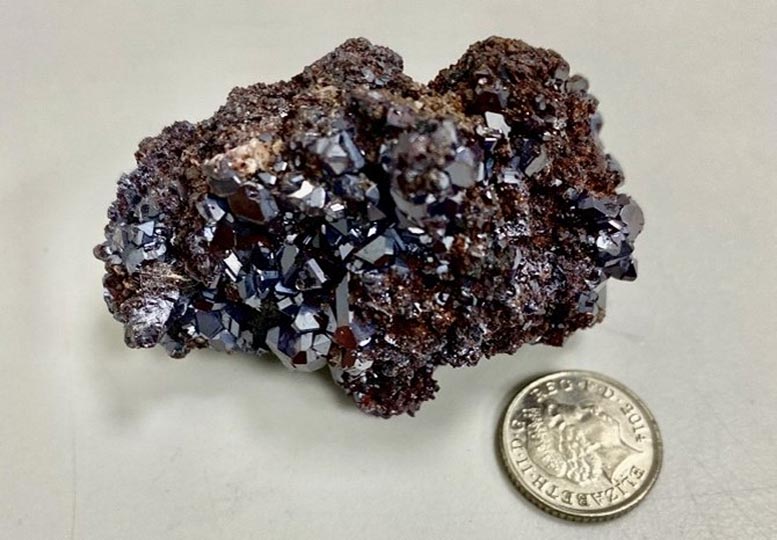
Using a gemstone, researchers created Rydberg polaritons, bringing quantum computing one step closer by enabling quantum simulators.
A special form of light made using an ancient Namibian gemstone could be the key to new light-based quantum computers, which could solve long-held scientific mysteries, according to new research led by the University of St Andrews.
The research, conducted in collaboration with scientists at Harvard University in the US, Macquarie University in Australia, and Aarhus University in Denmark and published in Nature Materials, used a naturally mined cuprous oxide (Cu2O) gemstone from Namibia to produce Rydberg polaritons, the largest hybrid particles of light and matter ever created.
Quantum Simulators: A New Frontier
Rydberg polaritons switch continually from light to matter and back again. In Rydberg polaritons, light and matter are like two sides of a coin, and the matter side is what makes polaritons interact with each other.
This interaction is crucial because this is what allows the creation of quantum simulators, a special type of quantum computer, where information is stored in quantum bits. These quantum bits, unlike the binary bits in classical computers that can only be 0 or 1, can take any value between 0 and 1. They can therefore store much more information and perform several processes simultaneously.
This capability could allow quantum simulators to solve important mysteries of physics, chemistry, and biology, for example, how to make high-temperature superconductors for highspeed trains, how cheaper fertilizers could be made potentially solving global hunger, or how proteins fold making it easier to produce more effective drugs.
Project lead Dr. Hamid Ohadi, of the School of Physics and Astronomy at the University of St Andrews, said: “Making a quantum simulator with light is the holy grail of science. We have taken a huge leap towards this by creating Rydberg polaritons, the key ingredient of it.”
Creating Rydberg Polaritons Using Cuprous Oxide
To create Rydberg polaritons, the researchers trapped light between two highly reflective mirrors. A cuprous oxide crystal from a stone mined in Namibia was then thinned and polished to a 30-micrometer thick slab (thinner than a strand of human hair) and sandwiched between the two mirrors to make Rydberg polaritons 100 times larger than ever demonstrated before.
One of the leading authors Dr. Sai Kiran Rajendran, of the School of Physics and Astronomy at the University of St Andrews, said: “Purchasing the stone on eBay was easy. The challenge was to make Rydberg polaritons that exist in an extremely narrow color range.”
The team is currently further refining these methods in order to explore the possibility of making quantum circuits, which are the next ingredient for quantum simulators.
Reference: “Rydberg exciton–polaritons in a Cu2O microcavity” by Konstantinos Orfanakis, Sai Kiran Rajendran, Valentin Walther, Thomas Volz, Thomas Pohl and Hamid Ohadi, 14 April 2022, Nature Materials.
DOI: 10.1038/s41563-022-01230-4
The research was funded by UK Engineering and Physical Sciences Research Council (EPSRC).
Never miss a breakthrough: Join the SciTechDaily newsletter.
Follow us on Google and Google News.
2 Comments
Basalt rock dust is the ultimate fertilizer made by nature itself, exactly suitable to maintain and nurture all plant life and all life that consumes plant life.
All life on this planet naturally evolved to utilize and thrive on the vast mineral array within the weathered-down dust from basalt and even some other igneous rocks, igneous rocks being of course the original rock comprising most of this planet. Such rock dust takes 20,000 years to produce by natural weathering, and is quickly washed away or blown away with modern farming methods. However, quarry waste from basalt quarries used to provide road chippings and masonry blocks etc. can provide this in abundance readily to provide all that is constantly being lost if the choice is made to use it.
Such natural igneous rock dust contains all nutrients required by any living being including a large number of microminerals essential to true health that are absent from commercially produced fertilizers like NPK mixes.
Basalt rock covers much of the Earth’s surface and undersea regions in huge abundance, it is not something that is in any way difficult to access or supply, but certain commercial interests would prefer that basalt rock dust remains unrecognized and unutilized to replenish depleted soils. Soils enriched with basalt rock dust using around 1-2 kilos per square meter every year or two have been shown in numerous studies to improve agricultural output by weight by 200% to 800%, world hunger problem genuinely solved, no GMO plants necessary, and plants grown with basalt rock dust do not require chemical fertilizers or other agricultural chemicals, as they are vastly more hardy against all types of bacterial, viral, fungal, nematode and insect attacks, allowing more organic methods of farming to be used. The complete mineral array of such crops makes any animal or human consuming them far more disease-resistant, and more able to survive happily on a more vegetarian diet, again contributing to genuinely solving the world hunger problem.
Mineral-rich igneous basalt rock dust contains the mineral complex that nature supplies in exact accordance with the true requirements of all living beings, the microminerals contained in it being definitely required by all living beings, however, chemical agricultural fertilizers like NPK just pump crops up fast, largely with water, so such crops end up with a mineral content several times lower on average than that found even in most organic crops grown even without basalt rock dust supplementation, and thus, minerals and microminerals essential for our health are largely absent from most produce that is commercially available today, and when plants cannot get the right minerals and microminerals, they cannot produce the normal amounts of vitamins that they should normally produce either, and certain chemicals used in farming today vastly limit mineral constant and even uptake of minerals in the human body as well.
People need to be aware of this in order to be more able to make an educated choice as to how their agricultural systems are to be run, it is vital for the well-being of all humans, their plants and their livestock.
“… an ancient Namibian gemstone could be the key to new light-based quantum computers …”
It is much too soft to be a practical gemstone for personal adornment. It is much better known as an ore of copper, cuprite. It is not unique to Namibia.
https://www.mindat.org/min-1172.html