
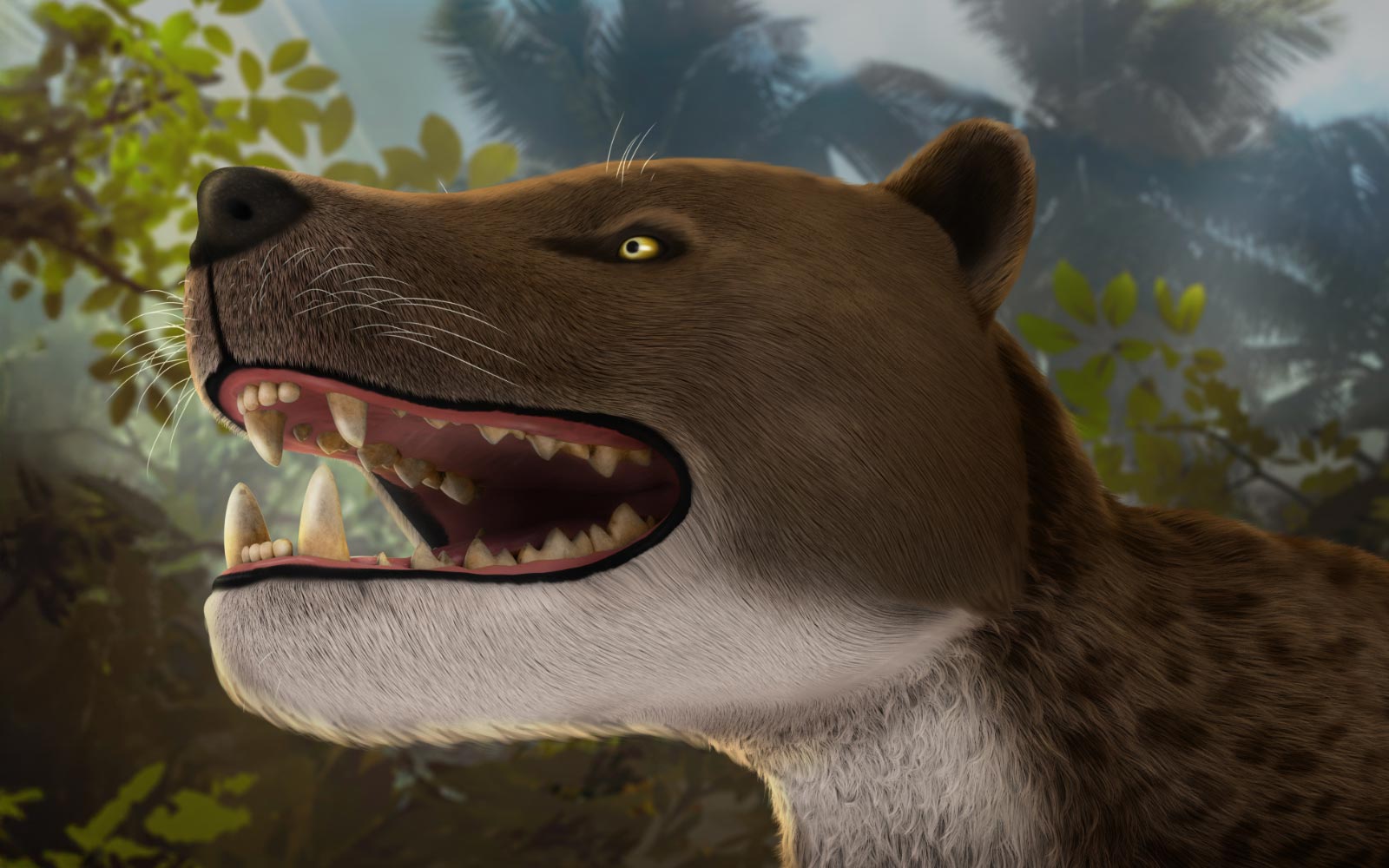
Hidden beneath Egypt’s desert sands, scientists uncovered a nearly complete skull of Bastetodon, a 30-million-year-old carnivore that once ruled the ancient landscape.
This leopard-sized predator, with its fearsome bite, hunted early elephants, hippos, and primates in the lush forests of Fayum—now an arid wasteland.
A Remarkable Fossil Discovery in the Egyptian Desert
A remarkable discovery in the Egyptian desert has led scientists to identify a new species of Hyaenodonta, an ancient group of apex predators that roamed the Earth 30 million years ago. The find—a nearly complete skull—is a rare and significant breakthrough in understanding prehistoric carnivores.
The newly named Bastetodon was a leopard-sized mammal with sharp teeth and powerful jaw muscles, indicating a formidable bite. As one of the dominant predators of its time, it likely sat at the top of the food chain when early primates, the ancestors of modern humans, were beginning to evolve.
Research published today (February 17) in the Journal of Vertebrate Paleontology details how Bastetodon would have hunted primates, early hippos, elephants, and hyraxes in the once-lush forests of Fayum, Egypt—now an arid desert.

An Unexpected and Extraordinary Find
Lead author and paleontologist Shorouq Al-Ashqar, from Mansoura University and the American University in Cairo, described the moment of discovery: “For days, the team meticulously excavated layers of rock dating back around 30 million years.
“Just as we were about to conclude our work, a team member spotted something remarkable—a set of large teeth sticking out of the ground. His excited shout brought the team together, marking the beginning of an extraordinary discovery: a nearly complete skull of an ancient apex carnivore, a dream for any vertebrate paleontologist.”
Bastetodon belongs to a species in an extinct group of carnivorous mammals called hyaenodonts. Hyaenodonts evolved long before modern-day carnivores such as cats, dogs, and hyenas. These predators with hyena-like teeth hunted in African ecosystems after the extinction of the dinosaurs.

A Name Inspired by Egyptian Mythology
The team – who go under the title ‘Sallam Lab’ – named the specimen after the cat-headed ancient Egyptian goddess Bastet, who symbolized protection, pleasure, and good health. The name acknowledges the region where the specimen was found, famous for its fossils and Ancient Egyptian artifacts. The name is also a nod to the short, cat-like snout and teeth of this fearsome, leopard-sized carnivore (“-odon” means “tooth”).
Its skull was unearthed on Sallam Lab’s expedition to the Fayum Depression, an area where digs reveal an important time window into about 15 million years of evolutionary history of mammals in Africa. This timespan not only captures the transition from the Eocene’s global warming to the Oligocene’s global cooling, but also reveals how these climate shifts played a crucial role in shaping ecosystems that we still see today.
Reevaluating a 120-Year-Old Discovery
Beyond just a new ancient creature discovery, the finding of Bastetodon has already allowed the research team to reevaluate a group of lion-sized hyaenodonts that was discovered in the rocks of the Fayum over 120 years ago.
In their paper, the team also constructed the genus Sekhmetops to describe this century-old material and to honor Sekhmet, the lion-headed goddess of wrath and war in ancient Egyptian mythology (“-ops” means “face”). In 1904, Sekhmetops was placed within a European group of hyaenodonts. The team demonstrated Bastetodon and Sekhmetops both belonged to a group of hyaenodonts that actually originated in Africa. In ancient Egypt, Bastet was often associated with Sekhmet, making the two genera scientifically and symbolically connected.
The study demonstrates the relatives of Bastetodon and Sekhmetops spread from Africa in multiple waves, eventually making it to Asia, Europe, India, and North America. By 18 million years ago, some relatives of these hyaenodonts were among the largest mammalian meat-eaters to ever walk the planet.
However, cataclysmic changes in global climate and tectonic changes in Africa opened the continent to the relatives of modern cats, dogs, and hyenas. As environments and prey changed, the specialized, carnivorous hyaenodonts diminished in diversity, finally going extinct and leaving our primate relatives to face a new set of antagonists.
“The discovery of Bastetodon is a significant achievement in understanding the diversity and evolution of hyaenodonts and their global distribution,” Shorouq adds.
“We are eager to continue our research to unravel the intricate relationships between these ancient predators and their environments over time and across continents.”
Concluding, co-author Dr. Matt Borths, Curator of Fossils at the Duke Lemur Center Museum of Natural History at Duke University in Durham, North Carolina, says: “The Fayum is one of the most important fossil areas in Africa. Without it, we would know very little about the origins of African ecosystems and the evolution of African mammals like elephants, primates, and hyaenodonts. Paleontologists have been working in the Fayum for over a century, but the Sallam Lab demonstrated there is more to discover in this remarkable region.”
Reference: “Cranial anatomy of the hypercarnivore Bastetodon syrtos gen. nov. (Hyaenodonta, Hyainailourinae) and a reevaluation of Pterodon in Africa” by Shorouq F. Al-Ashqar, Matthew Borths, Heba El-Desouky, Steven Heritage, Mohamed Abed, Erik R. Seiffert, Sanaa El-Sayed and Hesham M. Sallam, 16 February 2025, Journal of Vertebrate Paleontology.
DOI: 10.1080/02724634.2024.2442472
Never miss a breakthrough: Join the SciTechDaily newsletter.
Follow us on Google and Google News.
3 Comments
The small, rounded ears of the artist’s reconstruction suggest a cold-weather adaptation. Is there any evidence for a boreal forest environment?
It’s cheetah, that bred with a dog and a mouse. Scientist call it “unbelievable” 😂😂
Really? 30,000,000 years old 😂😂 if all it takes is throwing numbers around and making “hypothetical” and “pathetic theory’s” then I guess we could all be “scientists”, why waist time getting a degree? Just as bad as a meteorologist 😂😂😂😂