
Researchers hunt for a 12-billion-year-old signal that marks the end of the post-Big Bang “dark age.”
Astronomers are closing in on a signal that has been traveling across the Universe for 12 billion years, bringing them nearer to understanding the life and death of the very earliest stars.
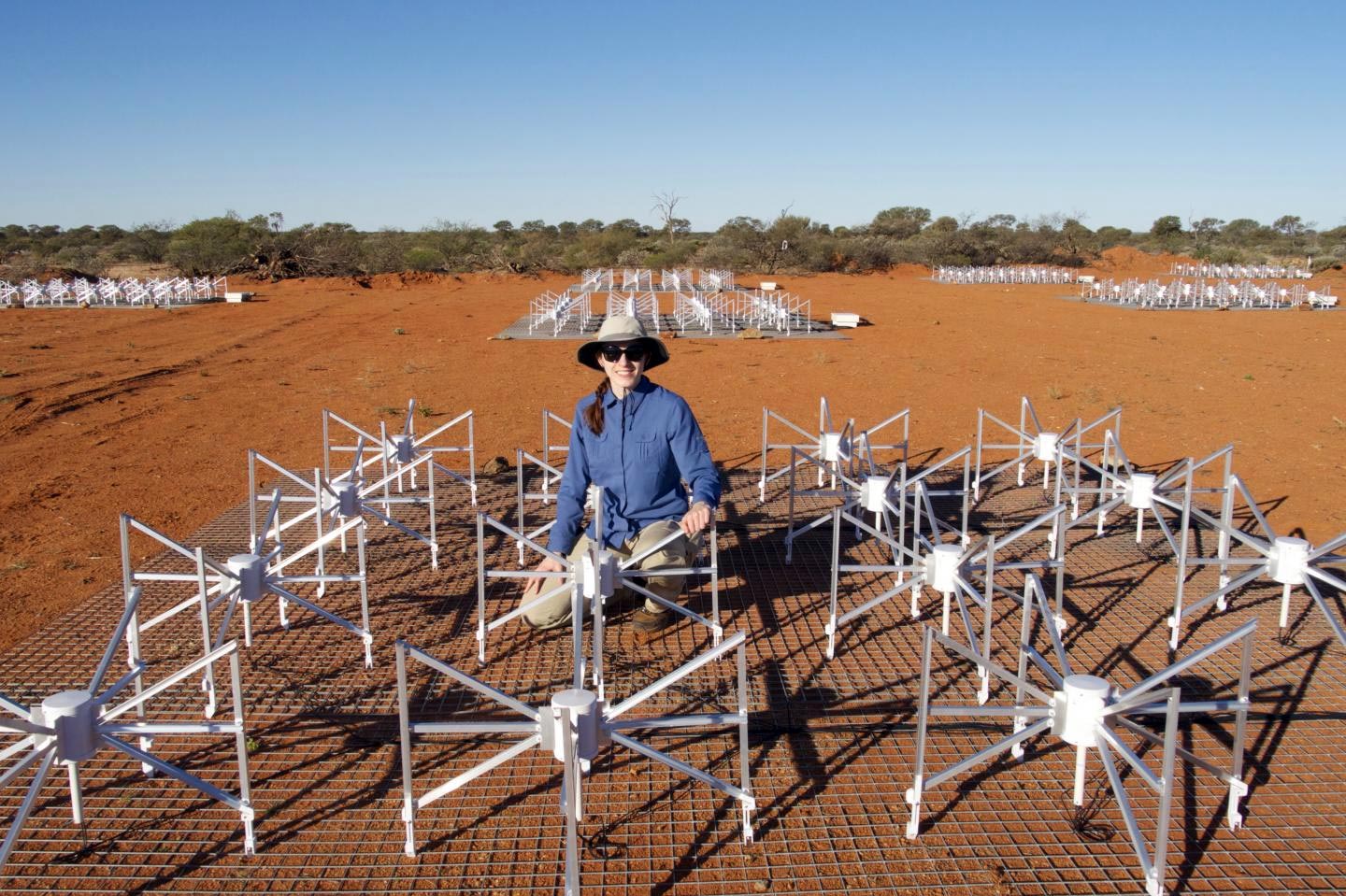
In a paper on the preprint site arXiv and soon to be published in the Astrophysical Journal, a team led by Dr. Nichole Barry from Australia’s University of Melbourne and the ARC Center of Excellence for All Sky Astrophysics in 3 Dimensions (ASTRO 3D) reports a 10-fold improvement on data gathered by the Murchison Widefield Array (MWA) – a collection of 4096 dipole antennas set in the remote hinterland of Western Australia.
The MWA, which started operating in 2013, was built specifically to detect electromagnetic radiation emitted by neutral hydrogen – a gas that comprised most of the infant Universe in the period when the soup of disconnected protons and neutrons spawned by the Big Bang started to cool down.
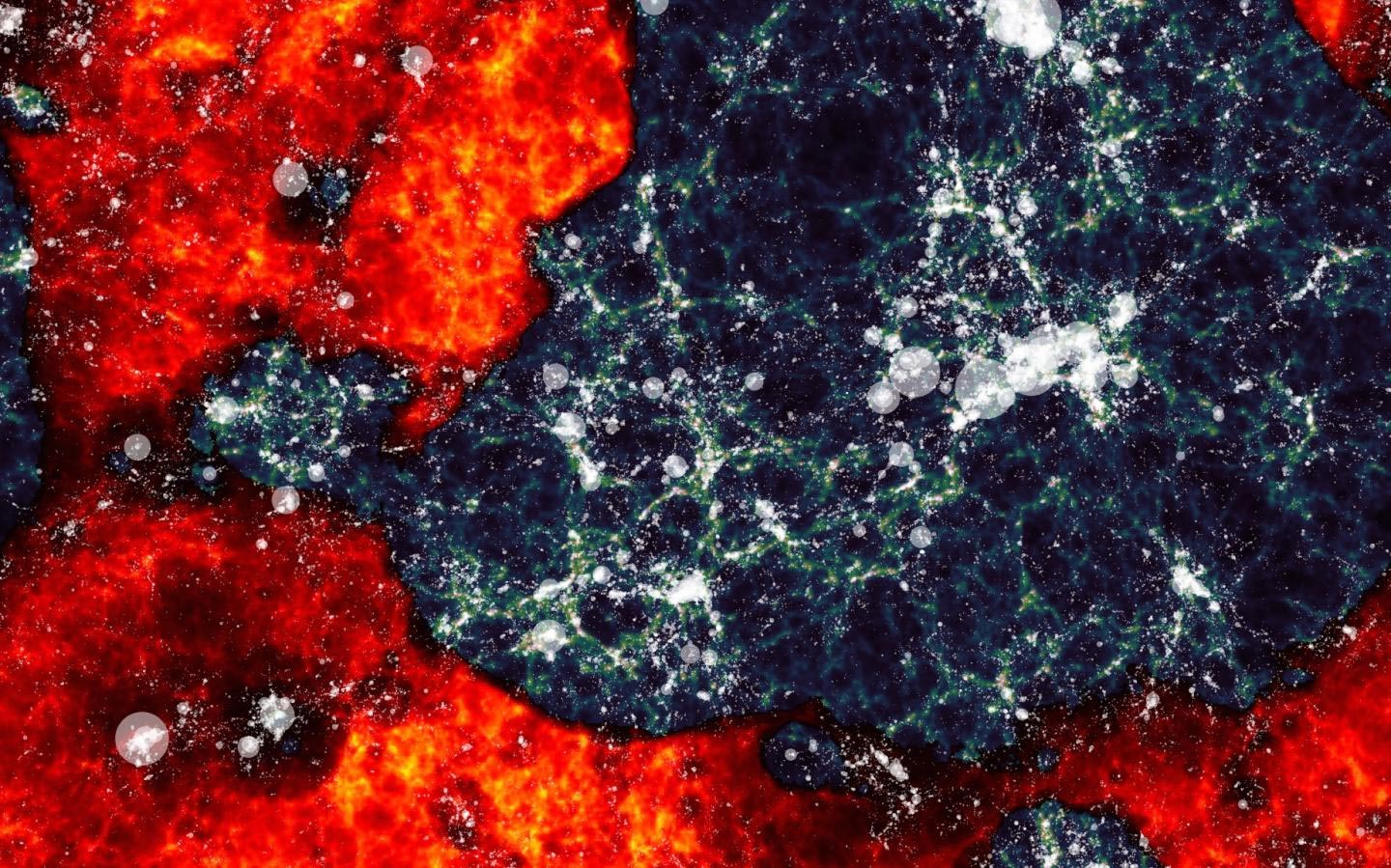
Eventually, these hydrogen atoms began to clump together to form stars – the very first ones to exist – initiating a major phase in the evolution of the Universe, known as the Epoch of Reionisation, or EoR.
“Defining the evolution of the EoR is extremely important for our understanding of astrophysics and cosmology,” explains Dr. Barry.
“So far, though, no one has been able to observe it. These results take us a lot closer to that goal.”
The neutral hydrogen that dominated space and time before and in the early period of the EoR radiated at a wavelength of approximately 21 centimeters. Stretched now to somewhere above two meters because of the expansion of the Universe, the signal persists – and detecting it remains the theoretically best way to probe conditions in the early days of the Cosmos.
However, doing so is fiendishly difficult.
“The signal that we’re looking for is more than 12 billion years old,” explains ASTRO-3D member and co-author Associate Professor Cathryn Trott, from the International Center for Radio Astronomy Research at Curtin University in Western Australia.
In this simulation of the Epoch of Reionization, neutral hydrogen, in red, is gradually ionized by the first stars, shown in white. The video was made by the University of Melbourne’s Dark-ages Reionization And Galaxy Observables from Numerical Simulations (DRAGONS) program. Credit: Paul Geil and Simon Mutch
“It is exceptionally weak and there are a lot of other galaxies in between it and us. They get in the way and make it very difficult to extract the information we’re after.”
In other words, the signals recorded by the MWA – and other EoR-hunting devices such as the Hydrogen Epoch of Reionisation Array in South Africa and the Low Frequency Array in The Netherlands – are extremely messy.
Using 21 hours of raw data Dr. Barry, co-lead author Mike Wilensky, from the University of Washington in the US, and colleagues explored new techniques to refine the analysis and exclude consistent sources of signal contamination, including ultra-faint interference generated by radio broadcasts on Earth.
The result was a level of precision that significantly reduced the range in which the EoR may have begun, pulling in constraints by almost an order of magnitude.
“We can’t really say that this paper gets us closer to precisely dating the start or finish of the EoR, but it does rule out some of the more extreme models,” says Professor Trott.
“That it happened very rapidly is now ruled out. That the conditions were very cold is now also ruled out.”
Dr. Barry said the results represented not only a step forward in the global quest to explore the infant Universe, but also established a framework for further research.
“We have about 3000 hours of data from MWA,” she explains, “and for our purposes, some of it is more useful than others. This approach will let us identify which bits are most promising, and analyze it better than we ever could before.”
Reference: “Improving the EoR Power Spectrum Results from MWA Season 1 Observations” by N. Barry, M. Wilensky, C. M. Trott, B. Pindor, A. P. Beardsley, B. J. Hazelton, I. S. Sullivan, M. F. Morales, J. C. Pober, J. Line, B. Greig, R. Byrne, A. Lanman, W. Li, C. H. Jordan, R. C. Joseph, B. McKinley, M. Rahimi, S. Yoshiura, J. D. Bowman, B. M. Gaensler, J. N. Hewitt, D. C. Jacobs, D. A. Mitchell, N. Udaya Shankar, S. K. Sethi, R. Subrahmanyan, S. J. Tingay, R. L. Webster and J. S. B. Wyithe, 7 October 2019, The Astrophysical Journal.
DOI: 10.3847/1538-4357/ab40a8
The research was conducted by multiple ASTRO-3D researchers based at the University of Melbourne, Curtin University, the CSIRO’s Astronomy and Space Science division in Epping, NSW, and the University of Washington.
They worked in collaboration with scientists from Arizona State University, Brown University, and MIT in the USA, Kumamoto University in Japan and Raman Research Institute in India.
Never miss a breakthrough: Join the SciTechDaily newsletter.
Follow us on Google and Google News.