
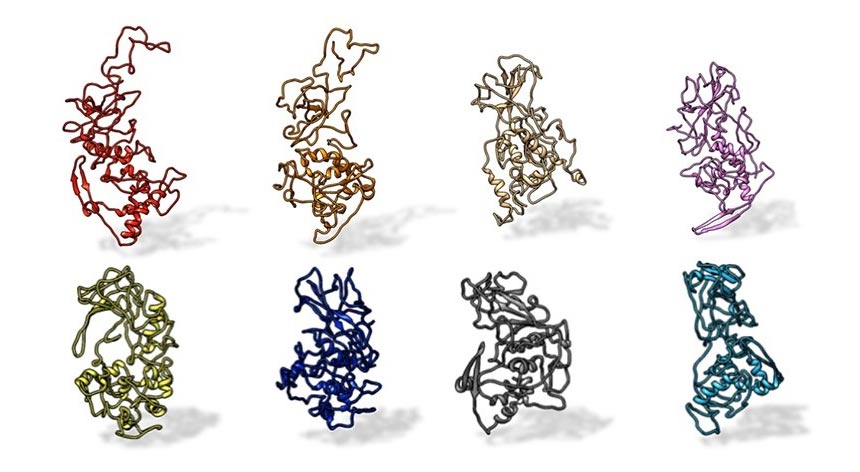
The structural revelation could have implications as a therapeutic target in all SARS-CoV-2 variants.
A tiny protein of SARS-CoV-2, the coronavirus that gives rise to COVID-19, may have big implications for future treatments, according to a team of Penn State researchers.
Using a novel toolkit of approaches, the scientists uncovered the first full structure of the Nucleocapsid (N) protein and discovered how antibodies from COVID-19 patients interact with that protein. They also determined that the structure appears similar across many coronaviruses, including recent COVID-19 variants — making it an ideal target for advanced treatments and vaccines. They reported their results in Nanoscale.
Conserved Structure Offers Broad Therapeutic Potential
“We discovered new features about the N protein structure that could have large implications in antibody testing and the long-term effects of all SARS-related pandemic viruses,” said Deb Kelly, professor of biomedical engineering (BME), Huck Chair in Molecular Biophysics and director of the Penn State Center for Structural Oncology, who led the research. “Since it appears that the N protein is conserved across the variants of SARS-CoV-2 and SARS-CoV-1, therapeutics designed to target the N protein could potentially help knock out the harsher or lasting symptoms some people experience.”
Most of the diagnostic tests and available vaccines for COVID-19 were designed based on a larger SARS-CoV-2 protein — the Spike protein — where the virus attaches to healthy cells to begin the invasion process.
The Pfizer/BioNTech and Moderna vaccines were designed to help recipients produce antibodies that protect against the Spike protein. However, Kelly said, the Spike protein can easily mutate, resulting in the variants that have emerged in the United Kingdom, South Africa, Brazil, and across the United States.
The N Protein: A Stable and Strong Immune Trigger
Unlike the outer Spike protein, the N protein is encased in the virus, protected from environmental pressures that cause the Spike protein to change. In the blood, however, the N protein floats freely after it is released from infected cells. The free-roaming protein causes a strong immune response, leading to the production of protective antibodies. Most antibody-testing kits look for the N protein to determine if a person was previously infected with the virus — as opposed to diagnostic tests that look for the Spike protein to determine if a person is currently infected.
“Everyone is looking at the Spike protein, and there are fewer studies being performed on the N protein,” said Michael Casasanta, first author on the paper and a postdoctoral fellow in the Kelly laboratory. “There was this gap. We saw an opportunity — we had the ideas and the resources to see what the N protein looks like.”
Initially, the researchers examined the N protein sequences from humans, as well as different animals thought to be potential sources of the pandemic, such as bats, civets, and pangolins. They all looked similar but distinctly different, according to Casasanta.
“The sequences can predict the structure of each of these N proteins, but you can’t get all the information from a prediction — you need to see the actual 3D structure,” Casasanta said. “We converged the technology to see a new thing in a new way.”
The researchers used an electron microscope to image both the N protein and the site on the N protein where antibodies bind, using serum from COVID-19 patients, and developed a 3D computer model of the structure. They found that the antibody binding site remained the same across every sample, making it a potential target to treat people with any of the known COVID-19 variants.
Reducing Inflammation via N Protein Targeting
“If a therapeutic can be designed to target the N protein binding site, it might help reduce the inflammation and other lasting immune responses to COVID-19, especially in COVID long haulers,” Kelly said, referring to people who experience COVID-19 symptoms for six weeks or longer.
The team procured purified N proteins, meaning the samples only contained N proteins, from RayBiotech Life and applied them to microchips developed in partnership with Protochips Inc. The microchips are made of silicon nitride, as opposed to a more traditional porous carbon, and they contain thin wells with special coatings that attract the N proteins to their surface. Once prepared, the samples were flash frozen and examined through cryo-electron microscopy.
Kelly credited her team’s unique combination of microchips, thinner ice samples and Penn State’s advanced electron microscopes outfitted with state-of-the-art detectors, customized from the company Direct Electron, for delivering the highest-resolution visualization of low-weight molecules from SARS-CoV-2 so far.
“The technology combined resulted in a unique finding,” Kelly said. “Before, it was like trying to look at something frozen in the middle of the lake. Now, we’re looking at it through an ice cube. We can see smaller entities with many more details and higher accuracy.”
Reference: “Microchip-based structure determination of low-molecular weight proteins using cryo-electron microscopy” by Michael A. Casasanta, G. M. Jonaid, Liam Kaylor, William Y. Luqiu, Maria J. Solares, Mariah L. Schroen, William J. Dearnaley, Jarad Wilson, Madeline J. Dukes and Deborah F. Kelly, 1 April 2021, Nanoscale.
DOI: 10.1039/D1NR00388G
Casasanta and Kelly are both also affiliated with Penn State’s Materials Research Institute (MRI). Co-authors include G.M. Jonaid, BME and Bioinformatics and Genomics Graduate Program in Penn State’s Huck Institutes of the Life Sciences; Liam Kaylor and Maria J. Solares, BME and Molecular, Cellular, and Integrative Biosciences Graduate Program in the Huck Institutes of the Life Sciences; William Y. Luqiu, MRI and Department of Electrical and Computer Engineering at Duke University; Mariah Schroen, MRI; William J. Dearnaley, BME and MRI; Jared Wilson, RayBiotech Life; and Madeline J. Dukes, Protochips Inc.
The National Cancer Institute of the National Institutes of Health and the Center for Structural Oncology in the Huck Institutes of the Life Sciences at Penn State funded this work.
Never miss a breakthrough: Join the SciTechDaily newsletter.
Follow us on Google and Google News.
2 Comments
The virus is fake
So can we get a vaccine based on inactive n protein now, as opposed to being stuck with the fleeting spike or the mRNA hack?