
Preliminary findings from the research have been published in the monograph Between the Land and the Sea: On Villae Maritimae in the Roman West, edited by Scienze e Lettere, Rome, 2024.
Excavations at the Sant Gregori site in Burriana have uncovered evidence that this coastal villa was dedicated to viticulture. Researchers, led by the Mediterranean Archaeology Partnership Programme at Universitat Jaume I of Castelló (UJI) in collaboration with the Archaeological Museum of Burriana, have identified wine production facilities (cella vinaria) and agricultural areas for vine cultivation (fundus). Given the importance of these discoveries, the Burriana City Council and the Archaeological Museum are collaborating to integrate these elements into the site’s musealization and enhancement plans.
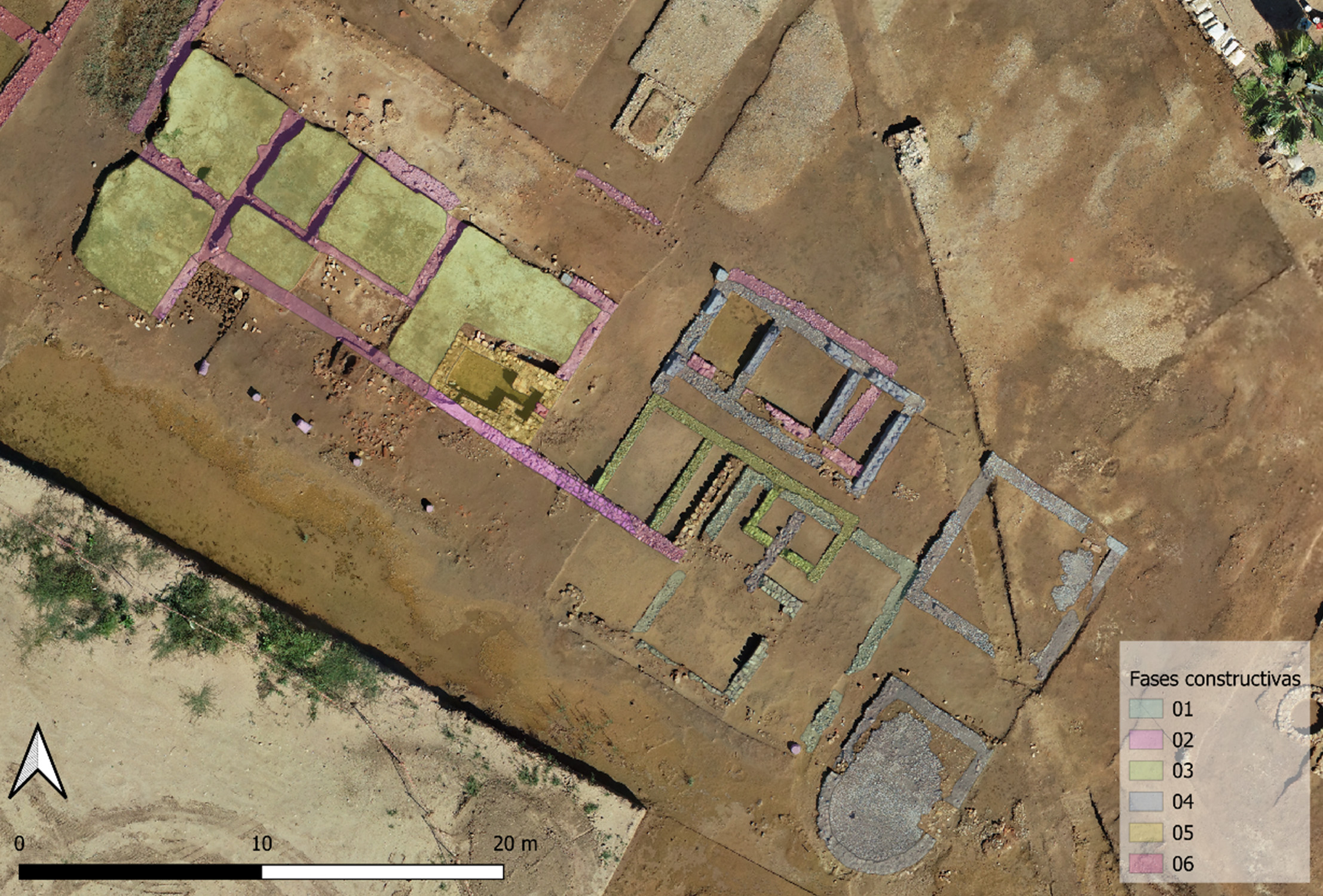
While no pressing rooms (torculares) have been found so far, storage areas and additional adjacent spaces, possibly for work and living quarters, have been uncovered. These buildings are isolated and follow an east-west orientation, protecting them from northern humidity and excessive southern sunlight. Archaeological evidence of vineyard cultivation has also been identified, specifically planting trenches (a type of planting referred to as sulcus by Columella and Pliny), associated with structures related to winemaking, such as remnants of a large storage facility.
Unique Features of the Sant Gregori Vineyards
In Roman Hispania, remains of storage facilities are relatively common, but planting trenches with evidence of vine cultivation have been found in only a few locations, such as the Galician coast, Badajoz, the Bay of Cádiz, and Huelva. At Sant Gregori, ten parallel trenches in excellent condition have been documented, aligned northeast-southwest. These trenches form continuous rows, allowing for the planting of multiple vines within them. Their average width ranges from 1.1 to 1.3 meters, with 2.5 to 3 meters between rows.
One intriguing aspect is the location of the Sant Gregori vineyard—an open, sunny area near a swampy zone (palus). Ancient writers Columella and Pliny noted that, in antiquity, the Pontine Marshes and the wetlands of Ravenna in Italy produced thriving vineyards thanks to drainage operations. Preliminary findings from the research have been published in the monograph Between the Land and the Sea: On Villae Maritimae in the Roman West, edited by Scienze e Lettere (Rome) in 2024.
Characteristics of the Sant Gregori Villa
The Sant Gregori villa is situated approximately 75 meters from Burriana’s coastline, making it a maritime villa. Its constructions date from the turn of the era to the 4th century CE. Spanning over 15,000 m², the site includes various spaces such as production structures, storage facilities, heated rooms for baths, and residential areas. Its size exceeds the average of coastal villas excavated in the Roman province of Tarraconensis, which typically surpasses 10,000 m².
In Roman times, the area where the villa was located was linked to the Roman municipality of Saguntum. Findings from various archaeological excavations indicate that large agricultural estates were planned on the flatlands, focusing on vine cultivation and wine production. In Saguntum, wine commerce reportedly became significant during Emperor Augustus’s reign and continued until at least the 2nd century CE. Latin literature from the 2nd century CE, particularly texts by Fronto and Juvenal, suggests that Saguntine wine was fairly popular in Rome during this period.
In late October, around twenty students from the universities of Castelló, València, Potsdam, and Macerata participated in the third edition of the International Course on Archaeology and Ancient Mediterranean Cultures. They carried out fieldwork at the Sant Gregori villa, an activity organized by the Mediterranean Archaeology Partnership Programme of the UJI in collaboration with the Archaeological Museum of Burriana and the universities of Potsdam (Germany) and Macerata (Italy).
At the Museum’s laboratories, students had the opportunity to examine materials excavated at the archaeological site and observe the documentation process leading up to restoration and display. Additionally, they participated directly in validating the augmented reality application ARChaeoUrn, developed within the ArchaeoPills project (Face to Face with Practical Archaeological Training in Higher Education), funded by the Erasmus+ program. This tool guides users through the steps of excavating a funerary urn, revealing cremated bones and burial goods within.
Never miss a breakthrough: Join the SciTechDaily newsletter.
Follow us on Google and Google News.