
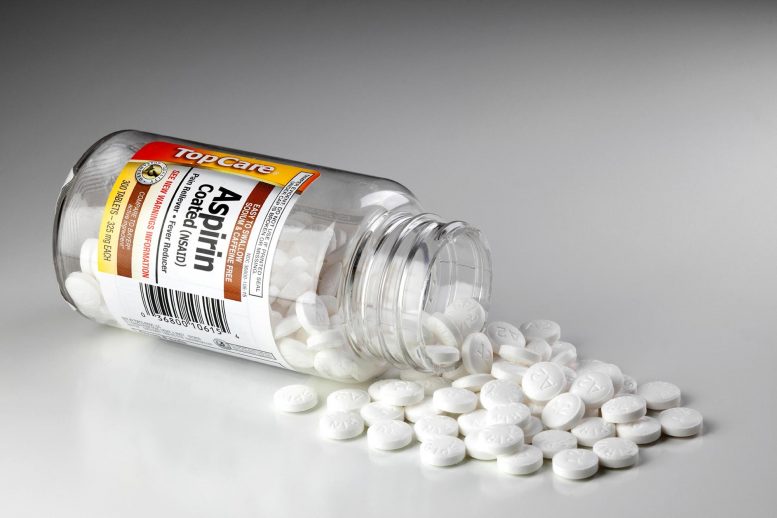
Researchers from the George Washington University found that aspirin may have lung-protective effects and reduce the need for mechanical ventilation, ICU admission and in-hospital mortality in hospitalized COVID-19 patients.
George Washington University researchers found low dose aspirin may reduce the need for mechanical ventilation, ICU admission, and in-hospital mortality in hospitalized COVID-19 patients. Final results indicating the lung protective effects of aspirin were published today in Anesthesia & Analgesia.
“As we learned about the connection between blood clots and COVID-19, we knew that aspirin – used to prevent stroke and heart attack – could be important for COVID-19 patients,” Jonathan Chow, MD, assistant professor of anesthesiology and critical care medicine and director of the Critical Care Anesthesiology Fellowship at the GW School of Medicine and Health Sciences, said. “Our research found an association between low-dose aspirin and decreased severity of COVID-19 and death.”
Over 400 patients admitted from March to July 2020 to hospitals around the United States, including those at GW Hospital, the University of Maryland Medical Center, Wake Forest Baptist Medical Center, and Northeast Georgia Health System, were included in the study. After adjusting for demographics and comorbidities, aspirin use was associated with a decreased risk of mechanical ventilation (44% reduction), ICU admission (43% reduction), and in-hospital mortality (47% reduction). There were no differences in major bleeding or overt thrombosis between aspirin users and non-aspirin users.
Preliminary findings were first published as a preprint in fall 2020. Since then, other studies have confirmed the impact aspirin can have on both preventing infection and reducing the risk of severe COVID-19 and death. Chow hopes that this study leads to more research on whether a causal relationship exists between aspirin use and reduced lung injury in COVID-19 patients.
“Aspirin is low cost, easily accessible and millions are already using it to treat their health conditions,” said Chow. “Finding this association is a huge win for those looking to reduce risk from some of the most devastating effects of COVID-19.”
Reference: “Aspirin Use Is Associated With Decreased Mechanical Ventilation, Intensive Care Unit Admission, and In-Hospital Mortality in Hospitalized Patients With Coronavirus Disease 2019” by Chow, Jonathan H. MD; Khanna, Ashish K. MD, FCCP, FCCM; Kethireddy, Shravan MD; Yamane, David MD; Levine, Andrea MD; Jackson, Amanda M. MD; McCurdy, Michael T. MD; Tabatabai, Ali MD; Kumar, Gagan MD; Park, Paul MD; Benjenk, Ivy RN, MPH; Menaker, Jay MD; Ahmed, Nayab MD; Glidewell, Evan MD; Presutto, Elizabeth MD; Cain, Shannon MD; Haridasa, Naeha BS; Field, Wesley MD; Fowler, Jacob G. BS; Trinh, Duy MD; Johnson, Kathleen N. BS; Kaur, Aman DO; Lee, Amanda BS; Sebastian, Kyle MD; Ulrich, Allison MD; Peña, Salvador MD, PhD; Carpenter, Ross MD; Sudhakar, Shruti MD; Uppal, Pushpinder MD; Fedeles, Benjamin T. MD, Capt, USAF, MC; Sachs, Aaron MD; Dahbour, Layth MD; Teeter, William MD; Tanaka, Kenichi MD; Galvagno, Samuel M. DO, PhD; Herr, Daniel L. MD; Scalea, Thomas M. MD and Mazzeffi, Michael A. MD, MPH, 21 October 2020, Anesthesia & Analgesia.
DOI: 10.1213/ANE.0000000000005292
DOI: 10.1213/ANE.0000000000005292
In addition to Chow, study authors include David Yamane, MD, assistant professor of emergency medicine and anesthesiology and critical care medicine at the GW School of Medicine and Health Sciences; Ivy Benjenk, RN, MPH, lead research coordinator for the Department of Anesthesiology and Critical Care Medicine at GW Hospital; and Shannon Cain, MD, third-year resident in the Department of Emergency Medicine at the GW School of Medicine and Health Sciences; as well as researchers from the University of Maryland Medical Center, Wake Forest Baptist Medical Center and Northeast Georgia Health System.
Never miss a breakthrough: Join the SciTechDaily newsletter.
Follow us on Google and Google News.
6 Comments
Why not test out EPA/DHA fish oil (2000mg/1000mg)? Smaller likelihood of hemorrhagic stroke
Why use as illustration for a study on the benefit of low-dose aspirin (IQR 81 mg) the image of a bottle with regular dose aspirin tablets (325 mg)? Leaving aside proper reporting practice, don’t you think –at a time when some frightened people even ingested bleach trying to prevent getting COVID in 2020– that showing the image of a low-dose aspirin bottle may avoid in some people an unnecessary 4 times higher ingestion of a drug that is not without non-trivial side effects?
I agree that the quality of the reporting could be improved.
The first paragraph contains the sentence, “… low dose aspirin may reduce the need for mechanical ventilation, ICU admission and in-hospital mortality …” could be read as reducing the need for in-hospital mortality. Sloppy writing!
It is much worse than just “sloppy writing” to use only the vague term “low dose aspirin” without specifying the actual dosage. While one might assume that 81 mg is meant, it is indefensible for a “scientific article” to not quantify the medication.
It is very disheartening to observe the prevalence of such incompetence in so many authors as well as the editors who allow such flawed writing to be published.
The report (and perhaps the study), seems very incomplete in that nothing is said about the length of time the aspirin had been taken. Many people take 80mg of aspirin daily for heart and other reasons. I would expect that the history of aspirin intake of this cohort would have a significant effect of these results.
Learn all the facts about many early home COVID treatments; read the new book Pandemic Blunder:
Bold New Book Pandemic Blunder Shows How Government Caused Preventable Covid Deaths
A huge amount of data and information not covered by mainstream media are in Pandemic Blunder that tells the story of how over 300,000 Americans have died from COVID-19 unnecessarily because the government has blocked early home treatment and prevention. With over 500,000 COVID deaths, learning about safe and effective early home treatment/prevention more important than ever.
About the Book:Pandemic Blunder contains considerable medical information and data to support a number of proven safe, cheap generic medicines and protocols that knock out the coronavirus when given early. Read about the pioneering, courageous doctors who have been using innovative approaches to prevent their COVID patients from needing hospital care and facing death. The book includes many expert opinions from doctors who support the view that 70 to 80 percent of COVID deaths could have been prevented—and still can be.
Don’t be victimized by disinformation and propaganda from leftist media. Learn how corrupt forces are aiming to make billions of dollars from expensive medicines and vaccines, and how hundreds of thousands of deaths could have—and should have—been prevented!
https://www.amazon.com/Pandemic-Blunder-Public-Blocked-Treatment/dp/197723822X/ref=nav_signin?dchild=1&keywords=Pandemic+Blunder&qid=1612289098&sr=8-1&&
Podcasts with author:
https://youtu.be/33cI_HcG_40
https://soundcloud.com/user-694711047/the-media-and-fauci-blocked-successful-covid-19-treatments-guest-joel-hirschhorn
https://www.podomatic.com/podcasts/rvtheory6/episodes/2021-03-17T06_14_07-07_00
About the Author: Dr. Joel S. Hirschhorn has a long history of working on health issues. As a full professor at the University of Wisconsin, Madison, he directed a medical research program between the colleges of engineering and medicine. As a senior official at the Congressional Office of Technology Assessment and the National Governors Association, he directed major studies on health-related subjects and he testified at over 50 US Senate and House hearings. He has authored hundreds of articles in journals and on websites, plus op-ed articles in major newspapers. Dr. Hirschhorn has served as an executive volunteer at a major hospital for more than 10 years and is an advisor to several organizations promoting patient-centered care. He is a member of the Association of American Physicians and Surgeons, and America’s Frontline Doctors.
PANDEMIC BLUNDER – FAUCI AND PUBLIC HEALTH BLOCKED EARLY HOME COVID TREATMENT Synopsis
Pandemic blunder is defined as the failure of the United States public health system and federal agencies to support and promote early home/outpatient treatment for the COVID-19 pandemic disease. Considerable medical information and data convincingly show that when given early a number of proven safe, cheap generic medicines and protocols knock out the coronavirus. Early means within the first few days of getting symptoms or a positive test. Some pioneering and courageous doctors have been using innovative approaches to prevent their covid patients from needing hospital care and facing death. Many expert views of doctors and data support the view that 70 percent to 80 percent of covid deaths could have been prevented – and still can for future victims of the disease. Learn how hundreds of thousands of deaths could have and should have been prevented.
This book does more than describe the pandemic blunder, it can help Americans protect their lives by not being victimized by disinformation and propaganda from leftist media. Pandemic management has failed because of corrupt forces aiming to make billions of dollars from expensive medicines and vaccines. There has been a widespread dereliction of duty on the part of many local, state, and federal government officials.