
Close Menu
    Facebook X (Twitter) Instagram
    SciTechDaily
    • Biology
    • Chemistry
    • Earth
    • Health
    • Physics
    • Science
    • Space
    • Technology
    Facebook X (Twitter) Pinterest YouTube RSS
    SciTechDaily
    Home»Space»Asteroid 1999 FN53 to Flyby Earth on Thursday
    Space

    Asteroid 1999 FN53 to Flyby Earth on Thursday

    By DC Agle, Jet Propulsion LaboratoryMay 14, 2015No Comments2 Mins Read
    Facebook Twitter Pinterest Telegram LinkedIn WhatsApp Email Reddit
    Share
    Facebook Twitter LinkedIn Pinterest Telegram Email Reddit
    Asteroid 1999 FN53
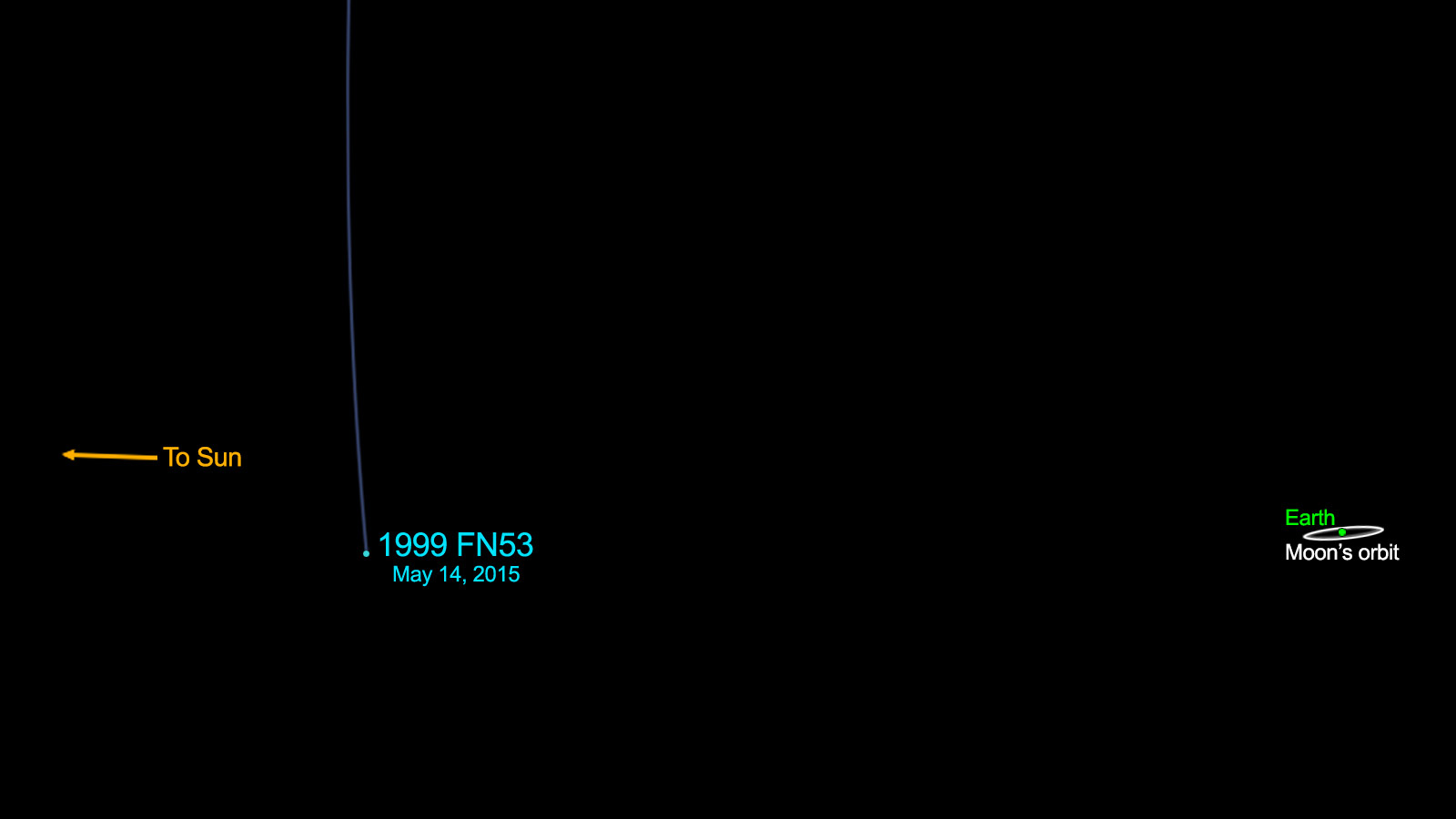
    This graphic depicts the passage of asteroid 1999 FN53, which will come no closer than 26 times the distance from Earth to the moon on May 14, 2015. Credit: NASA/JPL-Caltech

    Asteroid 1999 FN53 will safely flyby Earth on May 14 at a distance of no less than 6.3 million miles.

    An asteroid, designated 1999 FN53, will safely pass more than 26 times the distance of Earth to the moon on May 14. To put it another way, at its closest point, the asteroid will get no closer than 6.3 million miles away (10 million kilometers). It will not get closer than that for well over 100 years. And even then, (119 years from now) it will be so far away it will not affect our planet in any way, shape, or form. 1999 FN53 is approximately 3,000 feet (1 kilometer) across.

    “This is a flyby in the loosest sense of the term,” said Paul Chodas, manager of NASA’s Near-Earth Object Program Office, at the Jet Propulsion Laboratory in Pasadena, California. “We can compute the motion of this asteroid for the next 3,000 years and it will never be a threat to Earth. This is a relatively unremarkable asteroid, and its distant flyby of Earth tomorrow is equally unremarkable.”

    NASA detects, tracks, and characterizes asteroids and comets using both ground- and space-based telescopes. Elements of the Near-Earth Object Program, often referred to as “Spaceguard,” discover these objects, characterize a subset of them, and identify their close approaches to determine if any could be potentially hazardous to our planet. NASA’s Near-Earth Object Program is part of the agency’s asteroid initiative, which includes sending a robotic spacecraft to capture a boulder from the surface of a near-Earth asteroid and move it into a stable orbit around the moon for exploration by astronauts, all in support of advancing the nation’s journey to Mars.

    JPL manages the Near-Earth Object Program Office for NASA’s Science Mission Directorate in Washington. JPL is a division of the California Institute of Technology in Pasadena.

    Never miss a breakthrough: Join the SciTechDaily newsletter.
    Follow us on Google and Google News.

    Asteroid Astronomy NASA
    Share. Facebook Twitter Pinterest LinkedIn Email Reddit

    Related Articles

    NASA’s Heat-Seeking Space Telescope Is Almost Ready to Spot Killer Asteroids

    Chunk of Moon Rock? NASA Tracks Asteroid 2024 PT5 During Close Earth Flyby

    Asteroid Apophis Will Make a Record Setting Close Approach to Earth

    4.5 km Asteroid Tumbles Past Earth

    New Images of Near-Earth Asteroid 2007 PA8

    NASA’s Dawn Gets a Close Up View of the Canuleia Crater on Vesta

    NASA’s WISE Uncovers New Clues on Jovian Trojans

    Orbits of a Near-Earth Asteroid and a Potentially Hazardous Asteroid

    Near Miss Asteroid – An Opportunity To Test a Rapid Response Program

    Leave A Reply Cancel Reply

    • Facebook
    • Twitter
    • Pinterest
    • YouTube

    Don't Miss a Discovery

    Subscribe for the Latest in Science & Tech!

    Trending News

    Scientists Discover Bizarre 100-Million-Year-Old Insect With Giant Claws

    Scientists Discover “Good” Gut Microbes That Could Protect Against Autism and ADHD

    Scientists Reveal That Eating Almonds Every Day Could Transform Your Gut, Metabolism, and Appetite

    Scientists May Have Solved Two of Fusion Energy’s Biggest Problems at Once

    Scientists Discover Hidden “Switch” That Burns Fat and Could Treat Bone Disease

    After 50 Years of Mystery, Researchers Identify New Human Blood Group

    Beyond Pain Relief: Scientists Discover a Protein That Could Stop Osteoarthritis in Its Tracks

    Scientists Discover Why Alcohol Prevents the Liver From Healing, Even After You Quit

    Follow SciTechDaily
    • Facebook
    • Twitter
    • YouTube
    • Pinterest
    • Newsletter
    • RSS
    SciTech News
    • Biology News
    • Chemistry News
    • Earth News
    • Health News
    • Physics News
    • Science News
    • Space News
    • Technology News
    Recent Posts
    • Scientists Discover “Immature” Brain Cells That May Defy Alzheimer’s
    • Children of Centenarians Share One Surprising Habit That May Boost Longevity
    • Scientists Discover Cheap, Natural Remedy for High Blood Pressure
    • Archaeologists Discover Prehistoric Mountain Cave Packed With Mysterious Green Mineral
    • This Common Houseplant Is Secretly Using Advanced Geometry
    Copyright © 1998 - 2026 SciTechDaily. All Rights Reserved.
    • Science News
    • About
    • Contact
    • Editorial Board
    • Privacy Policy
    • Terms of Use

    Type above and press Enter to search. Press Esc to cancel.