
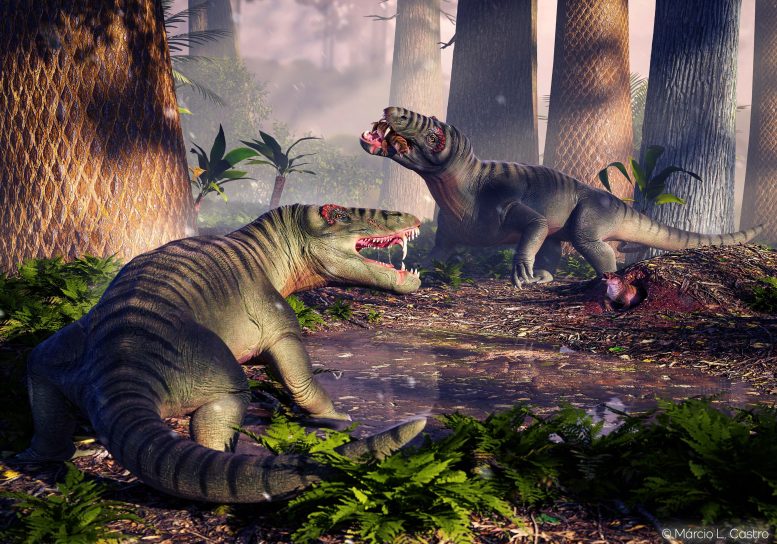
A giant Permian predator, Pampaphoneus biccai, was unearthed in Brazil, revealing new insights into prehistoric ecosystems.
Dinosaurs are often celebrated as the most gigantic and formidable predators in the annals of natural history. However, 40 million years before their reign, Pampaphoneus biccai was the undisputed apex predator of South America, reigning as the biggest and most bloodthirsty meat eater of its era.
In a new study published in the Zoological Journal of the Linnean Society, an international team of researchers revealed the astounding discovery of a 265-million-year-old, exquisitely preserved fossil species, Pampaphoneus biccai, found in the rural area of São Gabriel, Southern Brazil.
The stunning fossil includes a complete skull and some skeletal bones, such as ribs and arm bones. Pampaphoneus, which belongs to the early therapsid clade called dinocephalians, lived just before the largest extinction event in the history of Earth that eliminated 86% of all animal species worldwide.
Before the extinction event, dinocephalians were one of the major groups of large terrestrial animals that thrived on land. They were medium to large-sized creatures with both carnivorous and herbivorous representatives. Dinocephalians had thick cranial bones, which led to the group’s name which translates to “terrible head” in Greek. While well-known in South Africa and Russia, these animals are rare in other parts of the world. Pampaphoneus biccai is the only known species in Brazil.
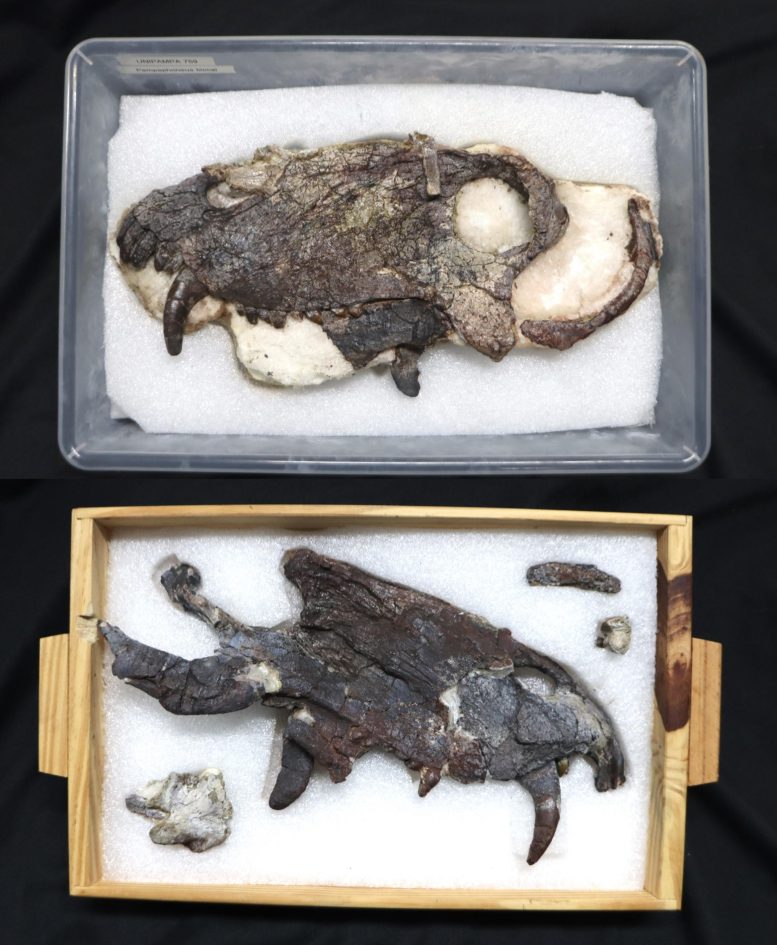
“The fossil was found in middle Permian rocks, in an area where bones are not so common, but always hold pleasant surprises,” said lead author Mateus A. Costa Santos, a graduate student in the Paleontology Laboratory at the Federal University of Pampa (UNIPAMPA). “Finding a new Pampaphoneus skull after so long was extremely important for increasing our knowledge about the animal, which was previously difficult to differentiate from its Russian relatives.”
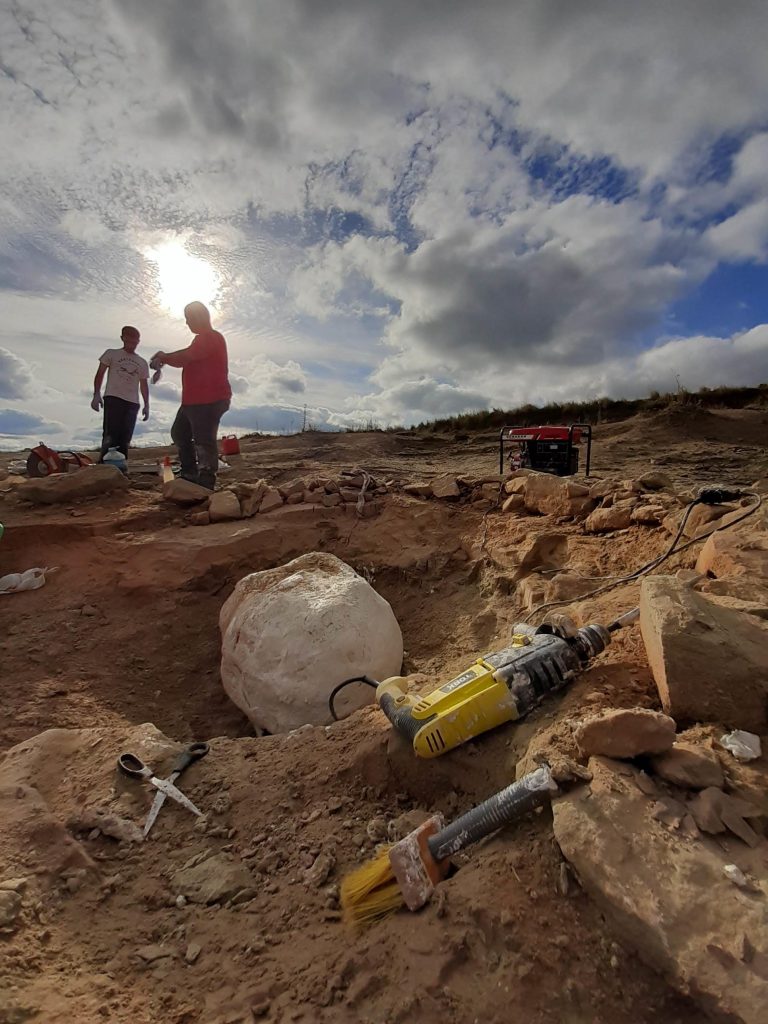
Paleontologists from UNIPAMPA and Universidade Federal do Rio Grande do Sul (UFRGS) collected the fossil over one month of daily, backbreaking fieldwork. Due to the pandemic, it took an additional three years for the fossil to be cleaned and thoroughly studied. Co-author Professor Stephanie E. Pierce, in the Department of Organismic and Evolutionary Biology and Curator of Vertebrate Paleontology and Mammalogy in the Museum of Comparative Zoology at Harvard, participated in the study of the animal as part of her current work with senior author and head of lab Professor Felipe Pinheiro, UNIPAMPA, on the Permo-Triassic fossil record of Brazil.
A Window into Prehistoric Ecosystems
“This animal was a gnarly-looking beast, and it must have evoked sheer dread in anything that crossed its path,” said Pierce. “Its discovery is key to providing a glimpse into the community structure of terrestrial ecosystems just prior to the biggest mass extinction of all time. A spectacular find that demonstrates the global importance of Brazil’s fossil record.”
The new specimen is only the second Pampaphoneus skull ever discovered in South America. It is also larger than the first and provides unprecedented information about its morphology due to the exceptional preservation of its bones.
The Largest Terrestrial Predator of Its Time
“Pampaphoneus played the same ecological role as modern big cats,” said Pinheiro. “It was the largest terrestrial predator we know of from the Permian in South America. The animal had large, sharp canine teeth adapted for capturing prey. Its dentition and cranial architecture suggest that its bite was strong enough to chew bones, much like modern-day hyenas.”
Although Pampaphoneus’ skull is the largest ever found intact at almost 40cm, research suggests a previously unidentified fossil represents a potential third individual that was up to two times larger than the new find. While the latter is only known from a fragment of its jaw, it does have sufficient characteristics to identify it as Pampaphoneus.
Researchers estimate that the largest Pampaphoneus individuals could reach nearly three meters in length and weigh around 400kg. It was a skilled predator capable of feeding on small to medium-sized animals. In the same locality where the fossil was found, some of its potential prey have also been identified, such as the small dicynodont Rastodon and the giant amphibian Konzhukovia.
The new Pampaphoneus specimen, along with the other animals found in this region, demonstrate the paleontological potential of the Pampa region for significant fossil discoveries.
Reference: “Cranial osteology of the Brazilian dinocephalian Pampaphoneus biccai (Anteosauridae: Syodontinae)” by Mateus A Costa Santos, Voltaire D Paes Neto, Cesar L Schultz, Juan Cisneros, Stephanie E Pierce and Felipe L Pinheiro, 10 September 2023, Zoological Journal of the Linnean Society.
DOI: 10.1093/zoolinnean/zlad071
The work was funded by the Coordenação de Aperfeiçoamento de Pessoal de Nível Superior-Brasil (CAPES), the Conselho Nacional de Desenvolvimento Científico e Tecnológico (CNPq), the Harvard Lemann Brazil Research Fund.
Never miss a breakthrough: Join the SciTechDaily newsletter.
Follow us on Google and Google News.