
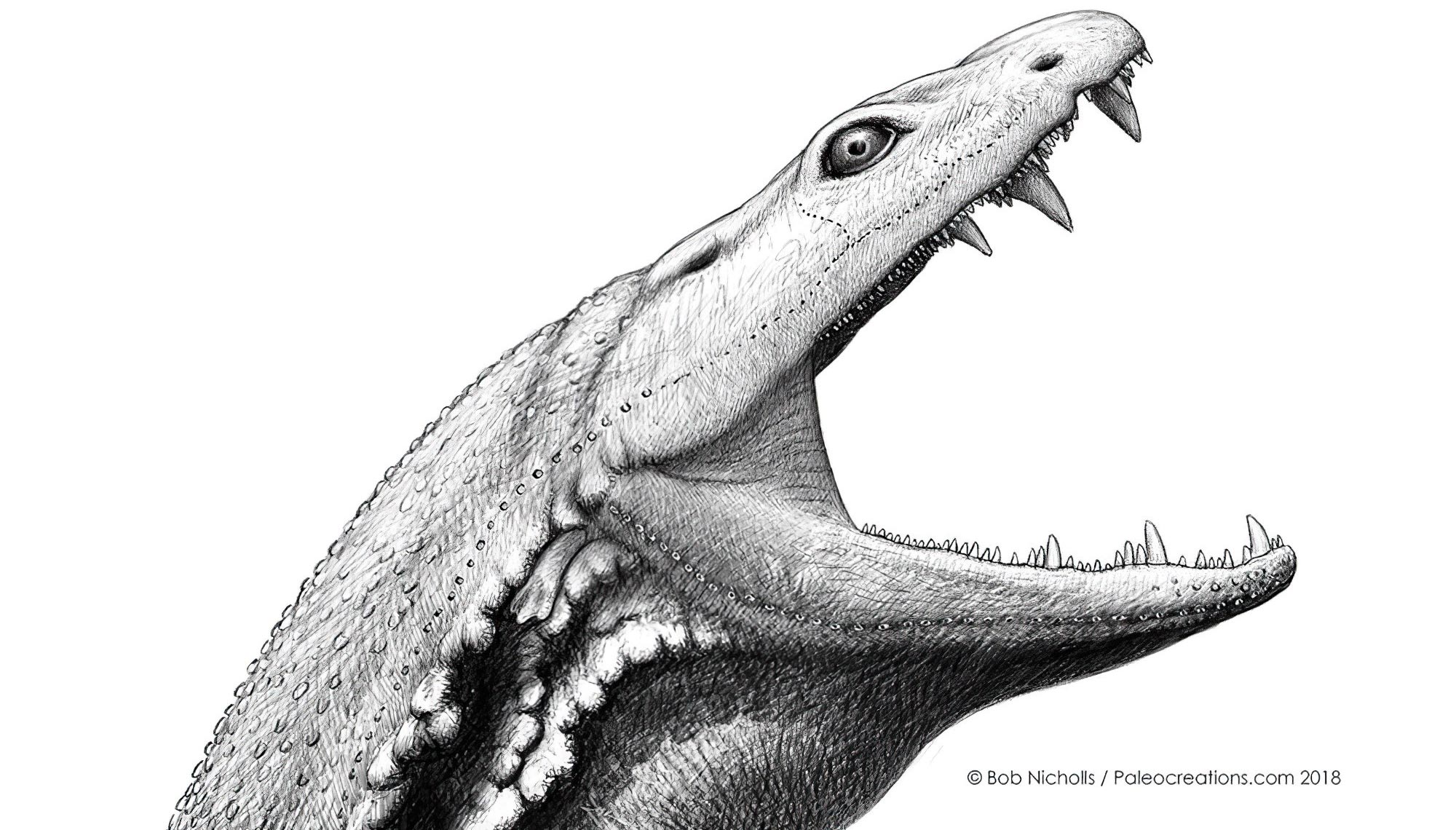
Researchers have digitally reconstructed the skull of Crassigyrinus scoticus, a 330-million-year-old species, revealing a shape similar to a modern crocodile rather than the previously assumed tall skull. The discovery sheds light on the behavior of this ancient predator, which lived in coal swamps and likely hunted like modern crocodiles.
- Digital reconstructions of broken fossils have revealed more about the life of an ancient crocodile-like predator.
- With huge teeth, big eyes, and a range of sensory adaptations, Crassigyrinus scoticus was well-suited to hunting prey in Carboniferous swamps over 300 million years ago.
Meet the “tadpole from hell,” or to give the species its full name, Crassigyrinus scoticus.
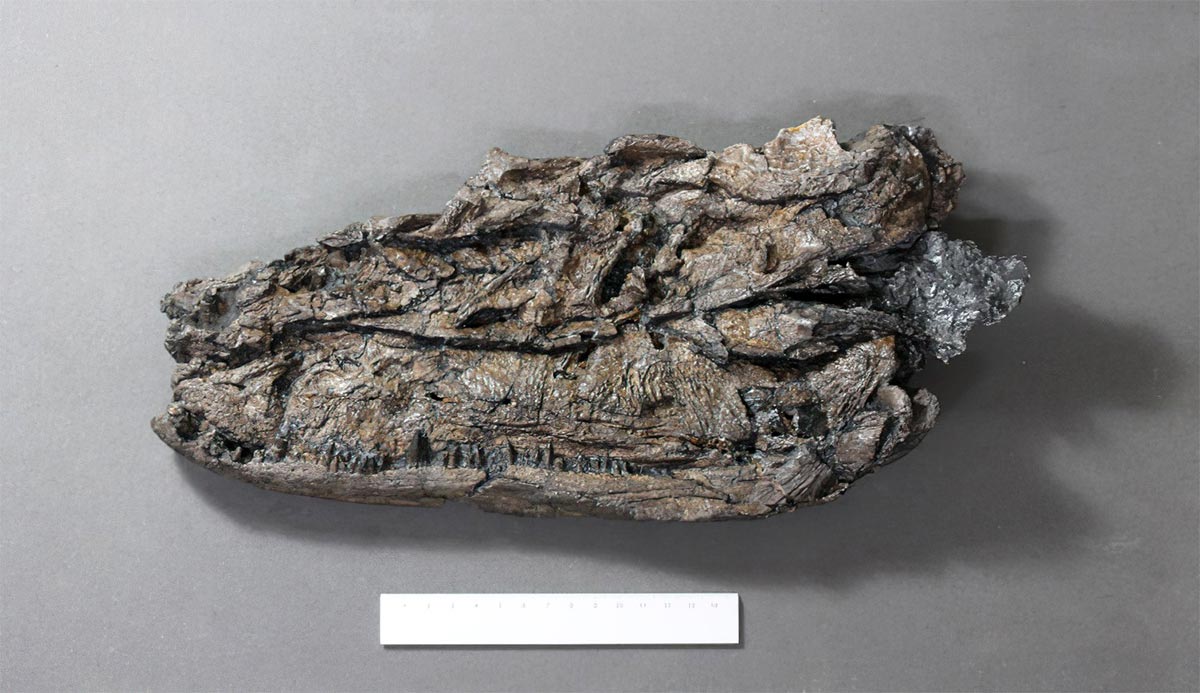
As a relative of some of the first animals to walk on land, scientists have been trying to understand this 330 million-year-old species for almost a century. However, with all known fossils of the Carboniferous carnivore severely crushed, this has been particularly difficult.
Advances in CT scanning and 3D visualization mean that a team of researchers has now been able to piece the fragments back together for the first time, revealing what Crassigyrinus‘s skull would have looked like.
Dr. Laura Porro of University College London (UCL), the lead author of the new study, says, “This animal has previously been reconstructed with a very tall skull, similar to a Moray eel, based on the type specimen in Edinburgh which has been flattened from side-to-side.”
“However, when I tried to mimic that shape with the digital surface from CT scans, it just didn’t work. There was no chance that an animal with such wide a palate and such a narrow skull roof could have had a head like that.”
“Instead, it would have had a skull similar in shape to a modern crocodile, with its huge teeth and powerful jaws allowing it to eat practically anything which crossed its path.”
The paper, published on May 2 in the Journal of Vertebrate Palaeontology, is dedicated to co-author Professor Jenny Clack, a pioneering paleontologist who revolutionized our understanding of early tetrapod evolution, and who passed away in 2020.
“It is bittersweet to finally see this paper published,” Laura says. “Jenny Clack worked on it as her PhD, and I’m glad she was able to see the final reconstructions of Crassigyrinus. She was so inspirational, and I would have loved to continue working with her for years to come.”
How To Rebuild a Flattened Fossil
Crassigyrinus is a stem tetrapod, a group of four-limbed animals that were among the first to make the transition from water onto land. Unlike its relatives, however, Crassigyrinus was an aquatic animal, either because its ancestors returned from land to the water or because they never made the transition to land in the first place.
Instead, it lived in coal swamps located in what is now Scotland and parts of North America, which provided the conditions for its preservation after death.
“These animals were preserved in fine-grained rock that provides great contrast when CT scanning,” Laura explains. “Unfortunately, it doesn’t provide much structural integrity, so as more material piled up on top of Crassigyrinus it squashed the fossils down.”
This means that while some of the known specimens are quite complete, they are all broken and deformed. The bones are shattered into many pieces, flattened, and laid on top of each other, which in the past has led to a variety of different reconstructions.
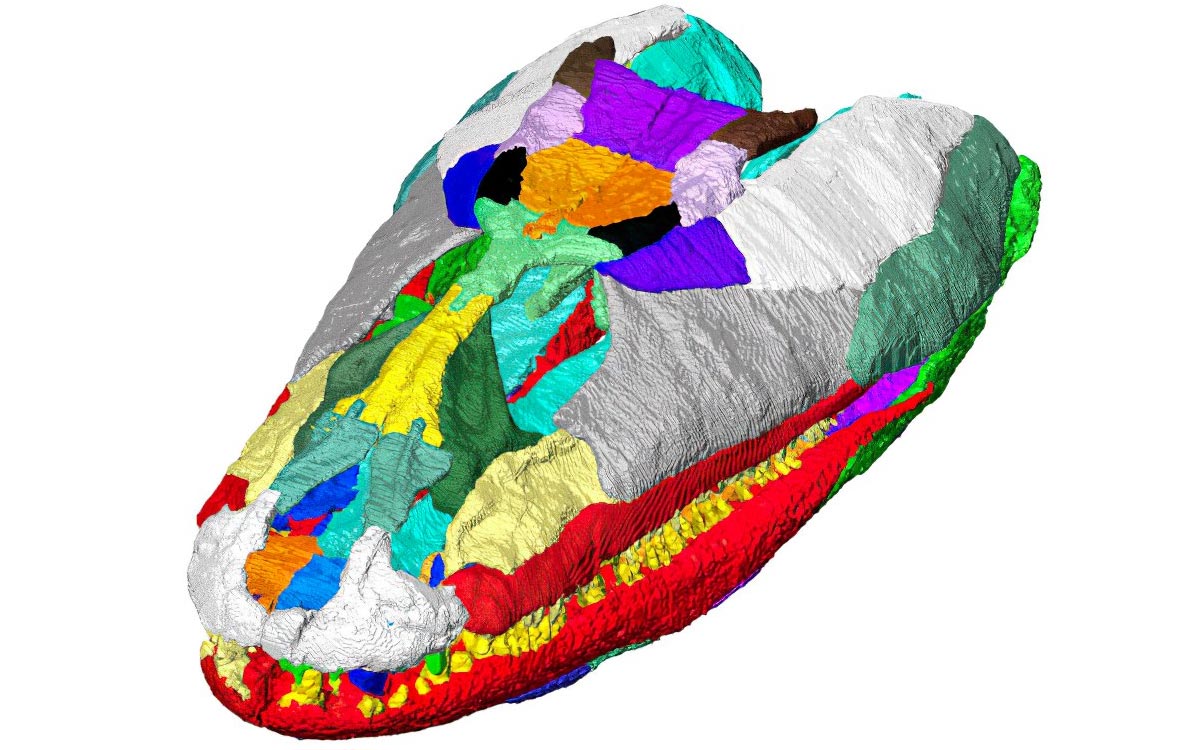
Bone fragments from multiple specimens were used to interpret how the skull would have looked. Credit: © Porro et al.
To try and rebuild this squashed specimen, the team used CT scans from four Crassigyrinus specimens, including three at the Museum. Between these fossils, all the bones of the skull were present allowing them to start rebuilding the tetrapod’s skull.
“Once we had identified all of the bones, it was a bit like a 3D-jigsaw puzzle,” Laura says. “I normally start with the remains of the braincase, because that’s going to be the core of the skull, and then assemble the palate around it.”
‘This gives me a base from which I can start building upwards, using overlapping areas of bone known as sutures which provide hints about how the skull bones fitted together. As the bones were broken, rather than bent, we could reconstruct the specimen with a good degree of confidence.
The resulting shallower skull shape agrees with a recent re-evaluation of the rest of Crassigyrinus‘ body, which found that it was a relatively flat-bodied animal with very short limbs. Together, these reconstructions can reveal more about how Crassigyrinus lived.
What Has Been Discovered About Crassigyrinus?
With a name meaning ‘thick tadpole’, Crassigyrinus doesn’t exactly inspire fear. However, in its day, it would have been a fearsome predator.
“In life, Crassigyrinus would have been around two to three meters long, which was quite big for the time,” Laura says. “It would probably have behaved in a way similar to modern crocodiles, lurking below the surface of the water and using its powerful bite to grab prey.”
The shape of Crassigyrinus‘ skull contains a number of ridges which would have helped to strengthen the skull, and spread the force of its bite between its many teeth.
Any prey crossing its path would also have to contend with a suite of specialized senses that helped Crassigyrinus to track them. These included large eyes to see in the dim coal swamps and as well as lateral lines to detect vibrations in the water. A mysterious gap near the front of its snout may also be a sign that it had other senses as well.
“A lot of early tetrapods have midline gaps at the front of their snout, but the gap in Crassigyrinus is much larger and features smoothly sculpted edges,” Laura explains. “The nostrils were elsewhere, so there has been a lot of speculation what this opening might have been.”
One possibility is, like some living fish, Crassigyrinus may have had a rostral organ that helped it to detect electric fields. Alternatively, it might have had a Jacobson’s organ, which is found in animals such as snakes and helps to detect different chemicals.
“Unfortunately, we can’t be sure what was in this gap because there’s nothing preserved there, and nothing alive today is closely related enough to Crassigyrinus to definitely know,” Laura says. “What is clear is that these animals had very well-developed senses, so it stands to reason that it might have had another sensory organ at the front of its snout.”
Now that the skull has been reconstructed, the researchers are putting it through its paces in a series of biomechanical simulations to see what it might have been capable of.
Reference: “Computed tomography and three-dimensional reconstruction of the skull of the stem tetrapod Crassigyrinus scoticus Watson, 1929″ by Laura B. Porro, Emily J. Rayfield and Jennifer A. Clack, 2 May 2023, Journal of Vertebrate Palaeontology.
DOI: 10.1080/02724634.2023.2183134
Never miss a breakthrough: Join the SciTechDaily newsletter.
Follow us on Google and Google News.