
Close Menu
    Facebook X (Twitter) Instagram
    SciTechDaily
    • Biology
    • Chemistry
    • Earth
    • Health
    • Physics
    • Science
    • Space
    • Technology
    Facebook X (Twitter) Pinterest YouTube RSS
    SciTechDaily
    Home»Biology»Astrocyte Neuron Interactions May Provide Insight into Brain Disorders
    Biology

    Astrocyte Neuron Interactions May Provide Insight into Brain Disorders

    By David Orenstein, Picower Institute for Learning and Memory; MITFebruary 13, 2018No Comments3 Mins Read
    Facebook Twitter Pinterest Telegram LinkedIn WhatsApp Email Reddit
    Share
    Facebook Twitter LinkedIn Pinterest Telegram Email Reddit
    Astrocytes and Neurons Get a New Look
    In this image of a mouse visual cortex, astrocytes (stained red) appear about as abundant as neurons (green). Image courtesy of Rodrigo Garcia/Picower Institute

    Neurons are the star of the show in brain science, but MIT researchers believe they don’t work alone to process information.

    In new research funded by a $1.9 million grant from the National Institutes of Health, a team at MIT’s Picower Institute for Learning and Memory is working to uncover the likely crucial role of a supporting cast member with a stellar-sounding name: the astrocyte. The work could ultimately provide insight into many brain disorders.

    Astrocytes are at least as abundant in the brain as neurons, but because they don’t spike with electrical impulses like neurons do, they’ve essentially been “invisible” in studies of how brain circuits process information, says Mriganka Sur, the Newton Professor of Neuroscience in the Department of Brain and Cognitive Sciences and director of the Simons Center for the Social Brain at MIT. Astrocytes have instead been appreciated mostly for shuttling various molecules and ions around to keep the brain’s biochemistry balanced and functioning.

    While they don’t spike, astrocytes do signal their activity with increases of calcium. A decade ago in Science, Sur and colleagues used that insight to discover that astrocyte activity in the visual cortex, the part of the brain that processes vision, matched in lock-step with the activity of neurons in response to visual stimuli. That suggested that astrocytes make a vital contribution to vision processing. In the new study, Sur’s lab will investigate exactly what astrocytes are doing, for instance, to regulate the formation of neural connections called synapses and how the calcium activity arises and what difference that activity makes. They’ll look not only during the course of normal vision, but also during the critical period early in life when vision is first developing.
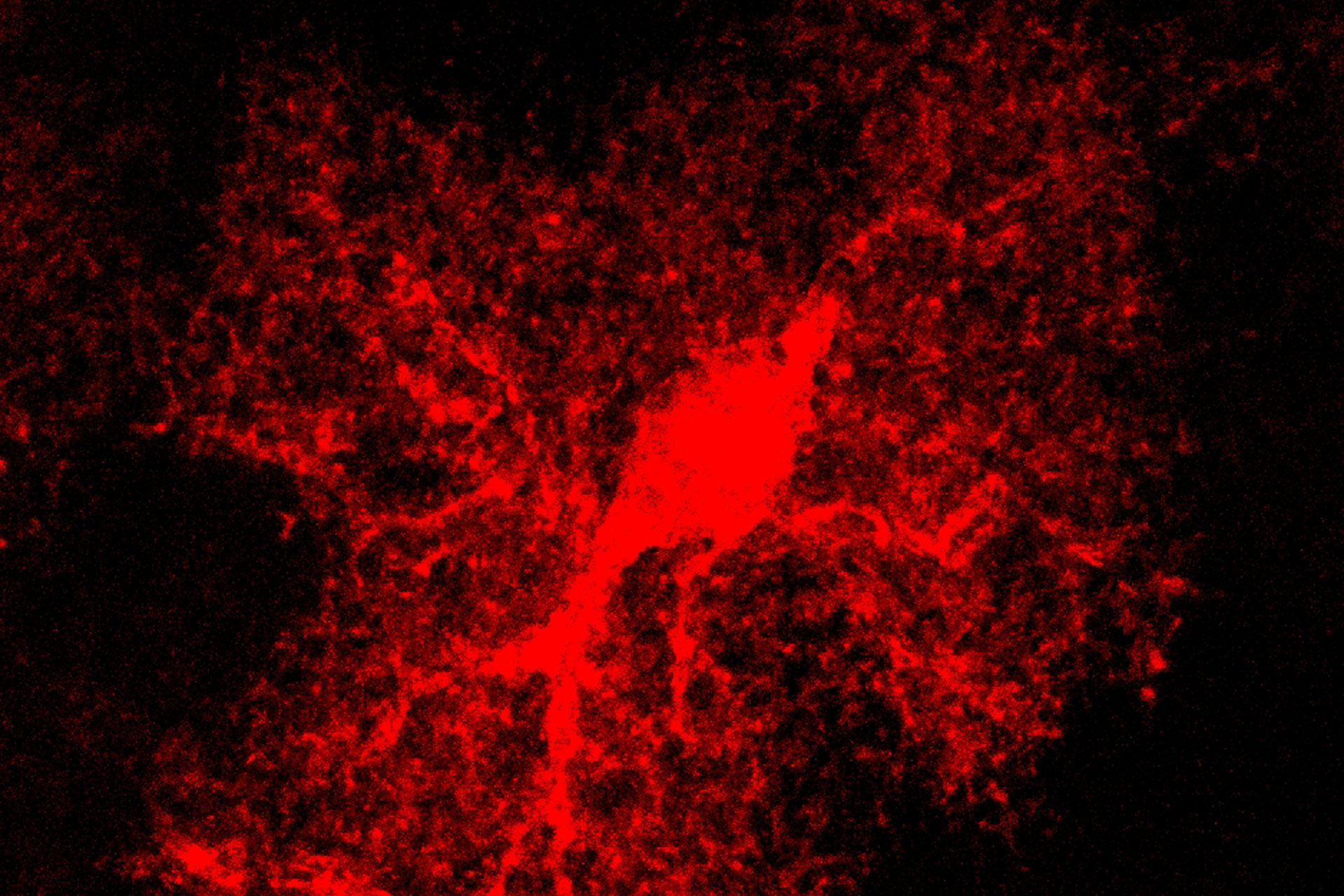
    Neuroscientists Give Invisible Cells a New Look
    Astrocytes’ role in information processing in the brain is being studied by researchers at the Picower Institute for Learning and Memory. Image courtesy of Rodrigo Garcia/Picower Institute

    Using sophisticated and precise imaging tools, Sur’s team will monitor astrocyte and neuron activity in the visual cortex as mice see different stimuli. They’ll also use genetic and pharmaceutical tools to manipulate astrocyte activity. A key mechanism that’s likely involved, Sur says, is the way astrocytes deploy a molecule called GLT1 to regulate the level and time course of the neurotransmitter glutamate. Glutamate is vital because it mediates communication between neurons across synapses. By systematically manipulating the GLT1 activity of astrocytes in the visual cortex and measuring the effects, Sur says, the team will be able to determine how astrocytes contribute to the performance and formation of neural circuits.

    “Just as neurons have their spiking code, we think there is an astrocyte calcium code that reflects and works in partnership with neurons,” Sur says. “That’s totally underappreciated but very important.”

    The results will matter for more than just vision, Sur says. The visual cortex is a perfect model system in which to work, he says, but astrocytes are also believed to be important, if poorly understood, in disorders as wide-ranging as Alzheimer’s disease and developmental disorders such as schizophrenia and autism.

    “Astrocytes are emerging as a major player because disorders of brain development have genetic origins,” Sur says. “Genes expressed in astrocytes are emerging as very important risk factors for autism and schizophrenia.”

    The new grant from the National Eye Institute (grant number R01EY028219) lasts for four years.

    Project Information: ASTROCYTE-NEURON INTERACTIONS IN VISUAL CORTEX CIRCUITS

    Never miss a breakthrough: Join the SciTechDaily newsletter.
    Follow us on Google and Google News.

    Cognitive Science MIT Neurology Neuroscience Picower Institute for Learning and Memory
    Share. Facebook Twitter Pinterest LinkedIn Email Reddit

    Related Articles

    Neuroscientists Discover a Behavioral State Gene That May be Linked to Autism

    MIT Researchers Identify Cells That Represent Feelings of Isolation

    Neuroscientists Identify New Mechanism That Contributes to Strengthening Synapses

    Neuroscientists Reveal That the Ventral Pre-Arcuate Holds “Attentional Template”

    New Evidence That the Brain’s Inferotemporal Cortex Can Identify Objects

    Newly Identified Memory Pathway Could Prevent PTSD

    Researchers Reveal That Cost Considerations Are Wired Into The Learning of Habits

    Neuroscientists Reveal Fundamental Discovery About Cortical Neurons

    Neuroscientists Create Model to Study Burst Suppression and Brain States

    Leave A Reply Cancel Reply

    • Facebook
    • Twitter
    • Pinterest
    • YouTube

    Don't Miss a Discovery

    Subscribe for the Latest in Science & Tech!

    Trending News

    This Alien Planet Has Rock Clouds That Vaporize Before Sunset

    The Simple Habit That Could Lower Your Cancer Risk

    146,000-Year-Old Discovery Rewrites the Story of Human Creativity

    The Type of Alcohol You Drink Could Affect How Long You Live

    This Common Vitamin May Help Stop Prediabetes From Turning Into Diabetes

    Scientists Finally Solve the Mystery of “Clockwork” Earthquakes

    Breakthrough Parkinson’s Drug Targets Disease at Its Genetic Roots

    Just 4 Weeks of Simple Diet Changes Reversed Signs of Aging in Older Adults

    Follow SciTechDaily
    • Facebook
    • Twitter
    • YouTube
    • Pinterest
    • Newsletter
    • RSS
    SciTech News
    • Biology News
    • Chemistry News
    • Earth News
    • Health News
    • Physics News
    • Science News
    • Space News
    • Technology News
    Recent Posts
    • Scientists Discover Common Medications May Secretly Alter Your Gut for Years
    • New Vitamin B12-Based Therapy Could Change How Brain Cancer Is Treated
    • This Common Fat Could Be Fueling Type 2 Diabetes, Researchers Warn
    • Scientists Discover Low-Cost Route To Clean Hydrogen Production
    • Scientists Crack Key Mystery Behind High-Temperature Superconductors
    Copyright © 1998 - 2026 SciTechDaily. All Rights Reserved.
    • Science News
    • About
    • Contact
    • Editorial Board
    • Privacy Policy
    • Terms of Use

    Type above and press Enter to search. Press Esc to cancel.