
Close Menu
    Facebook X (Twitter) Instagram
    SciTechDaily
    • Biology
    • Chemistry
    • Earth
    • Health
    • Physics
    • Science
    • Space
    • Technology
    Facebook X (Twitter) Pinterest YouTube RSS
    SciTechDaily
    Home»Space»Astronomers Catch a Cosmic Boomerang in Action for the First Time
    Space

    Astronomers Catch a Cosmic Boomerang in Action for the First Time

    By Jim Shelton, Yale UniversityAugust 21, 20212 Comments5 Mins Read
    Facebook Twitter Pinterest Telegram LinkedIn WhatsApp Email Reddit
    Share
    Facebook Twitter LinkedIn Pinterest Telegram Email Reddit
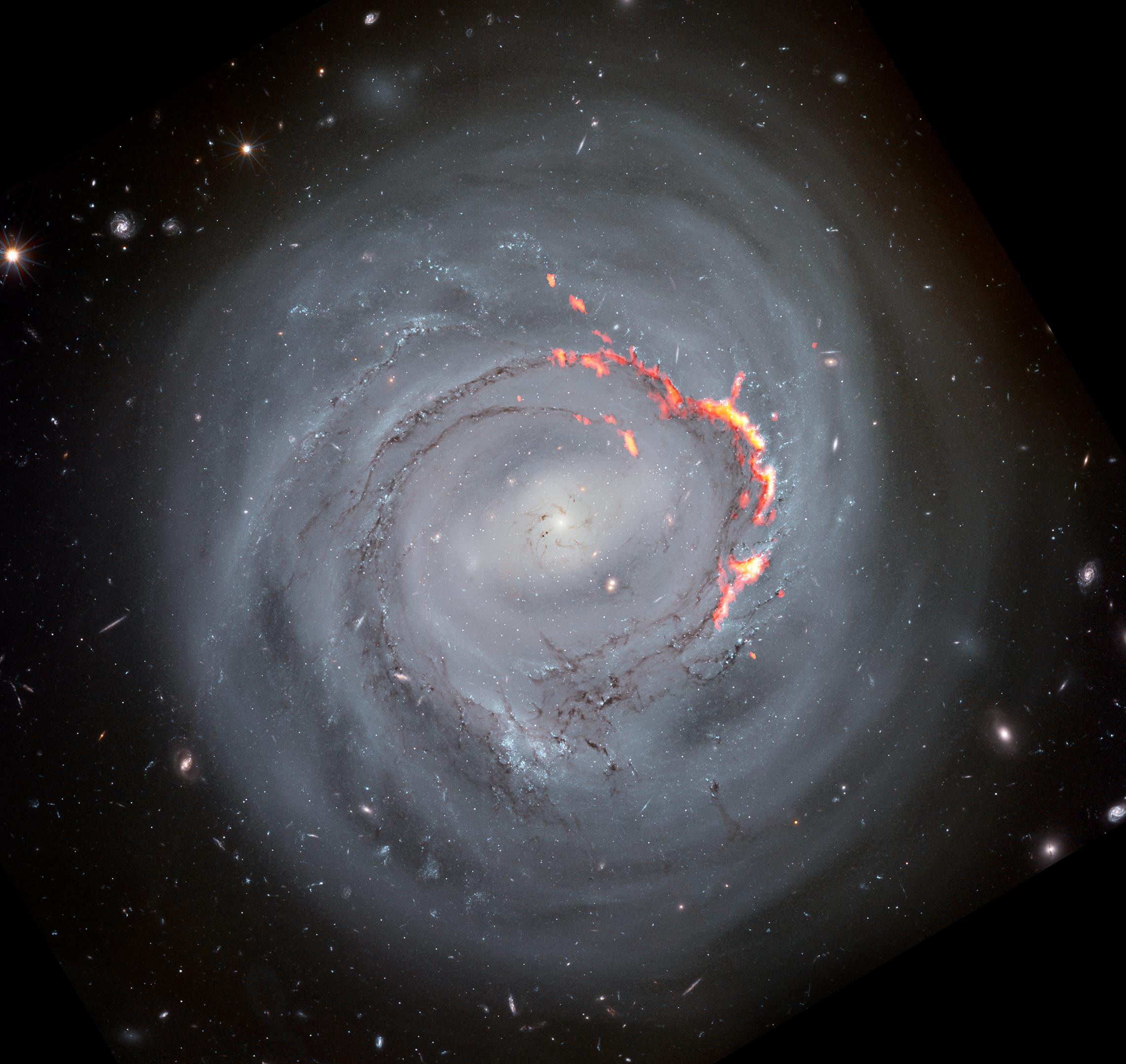
    Filament Structures Left Behind by Ram Pressure Stripping NGC4921
    Shown here in composite view, ALMA data (red/orange) reveals filament structures left behind by ram pressure stripping in a Hubble Space Telescope optical view of NGC4921. Scientists believe that these filaments are formed as magnetic fields in the galaxy prevent some matter from being stripped away. Credit: ALMA (ESO/NAOJ/NRAO)/S. Dagnello (NRAO), NASA/ESA/Hubble/K. Cook (LLNL), L. Shatz

    Gas stripped from a galaxy returns like a boomerang, offering new insight into star formation and galaxy evolution.

    For the first time, astronomers have observed a cosmic boomerang effect — streams of heavy, molecular gas that are stripped away from a distant galaxy only to circle back and return later.

    Astronomers at Yale and Arizona State University led the research team that made the discovery, which had been theorized in simulations but not observed in detail. Their findings are published in The Astrophysical Journal.

    The observation offers new insights into the life cycle of galaxies and the structural formations within galaxies, as traced by molecular gas. In particular, the research focuses on a process called ram pressure stripping, in which gas from galaxy clusters acts like a wind that strips away the star-making material inside a galaxy — hastening its demise.

    “Astronomers are interested in studying how galaxies grow, live, and die,” said lead author William Cramer, who began the research as a Yale graduate student and is now a postdoctoral research scholar at Arizona State. “Effects like ram pressure that can speed up the normal galaxy lifecycle are very important to understand for this reason. Furthermore, the molecular gas in galaxies is the birthplace of new stars, and therefore studying the effect of ram pressure on it is of paramount importance.”
    Side by Side Composite NGC4921
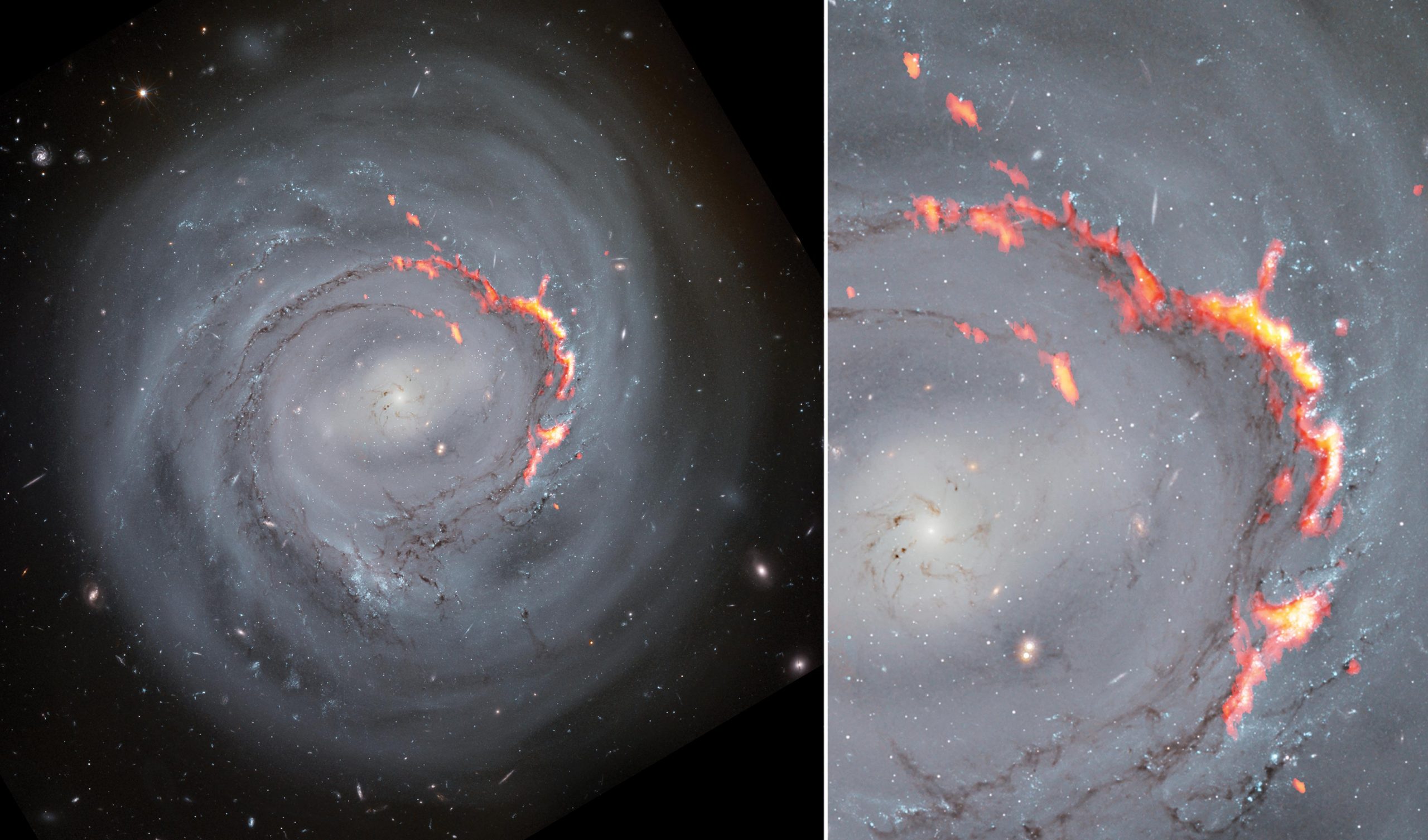
    This side-by-side composite shows ALMA (red/orange) data laid over Hubble Space Telescope (optical) images of NGC4921. A new study of the spiral bar galaxy revealed filament structures similar to the Pillars of Creation but significantly larger. These structures are caused by a process known as ram pressure stripping, which pushes gas out of galaxies, leaving them without the material needed to form new stars. Credit: ALMA (ESO/NAOJ/NRAO)/S. Dagnello (NRAO), NASA/ESA/Hubble/K. Cook (LLNL), L. Shatz

    For the study, the researchers used the Atacama Large Millimeter Array (ALMA) radio telescope, located in northern Chile, to create a high-resolution map of dense molecular gas in the galaxy NGC 4921 as it experiences ram pressure stripping. The map shows unusual structures that form in the ram pressure “wind” — long filaments of heavy gas connected to newly-forming stars. This dense, heavy gas is thought to be more resistant to ram pressure stripping, perhaps due to magnetic fields holding it more firmly in place.

    Filaments, Magnetic Fields, and Gas Resilience

    “When an external force like ram pressure disturbs a galaxy, it offers an opportunity to learn about the internal forces that operate in galaxies,” said co-author Jeffrey Kenney, a professor of astronomy in Yale’s Faculty of Arts and Sciences. “The unusual filaments would not form without magnetic fields, so we also learn about the importance of magnetic fields in galaxies from this ram pressure interaction.”
    Zoomed in Composite NGC4921
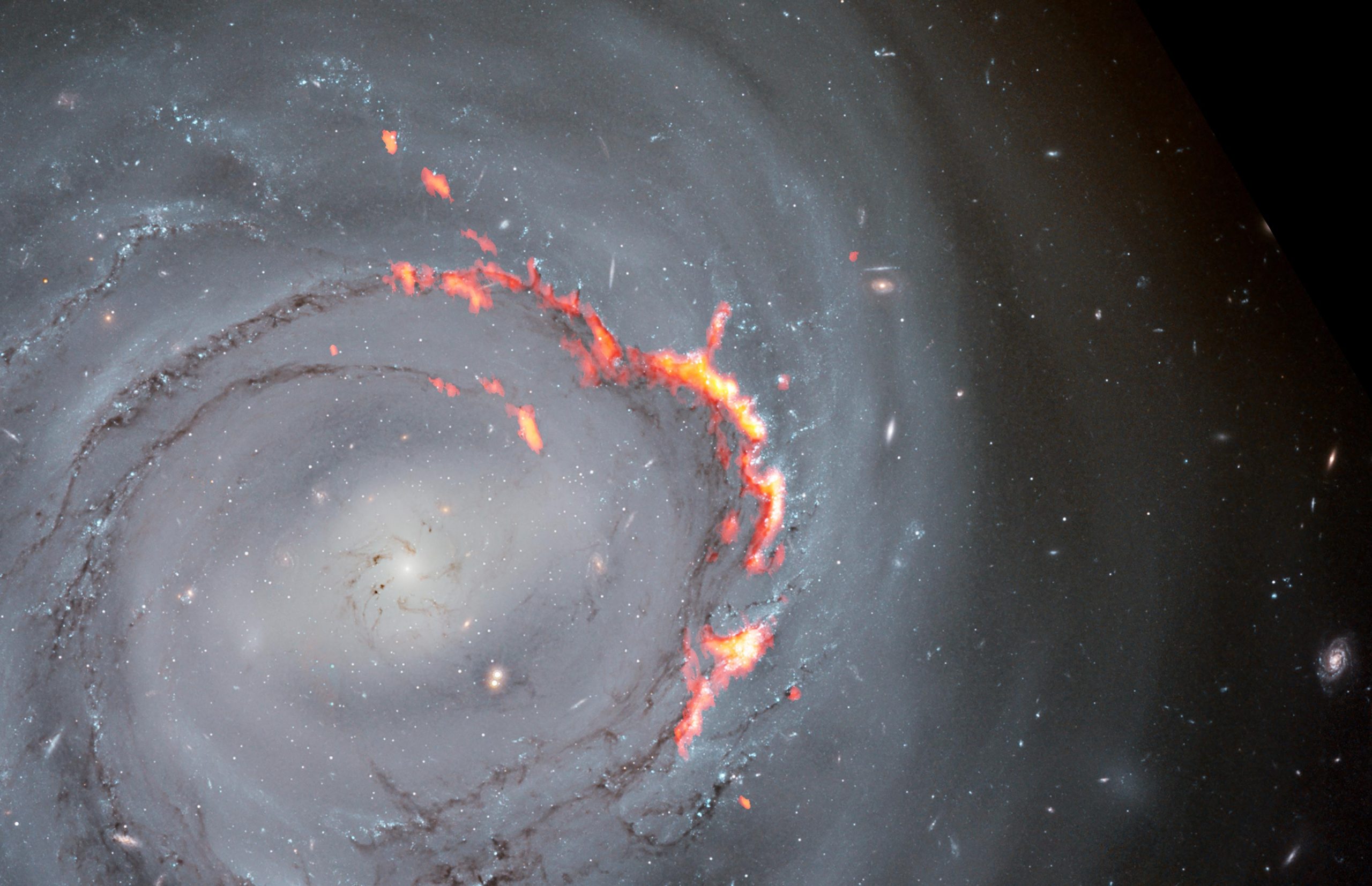
    Zoomed in view of an ALMA (red/orange) and Hubble Space Telescope (optical) composite of NGC4921. This composite highlights filament structures resulting from the effects of ram pressure stripping. Ram pressure stripping is a process known to strip gas out of galaxies, leaving them without the material needed to form new stars. A new study indicates that some material may not be stripped away from the galaxy, and is instead, reaccreted, potentially with the help of magnetic fields, slowing down the process of galaxy death. Credit: ALMA (ESO/NAOJ/NRAO)/S. Dagnello (NRAO), NASA/ESA/Hubble/K. Cook (LLNL), L. Shatz

    The ALMA data clearly show filaments of molecular gas connected to galaxy NGC 4921 — the filaments are, indeed, resisting. But then the researchers saw something else: Some of the previously-stripped gas came back.

    “Instead of being thrown out never to return, some of this gas is moving like a boomerang, being ejected but then circling and falling back to its source,” Cramer said. If this gas is recaptured into the galaxy, it can form new stars. 

    Why the Boomerang Matters

    The boomerang effect is significant for several reasons, according to the researchers. It provides hard evidence about the evolution of galaxies; it confirms a long-held theory about galaxy development; and it aids astronomers trying to predict the birthrate of new stars.

    “The interstellar medium of galaxies is complex, with many variables that are hard to model,” Cramer said. “This observation is important because it shows that fallback of gas can be detected and allows us to search more broadly to help characterize it.”

    For more on this research, read Gas Re-Accretion Observed in Dying Galaxies for the First Time.

    Reference: “Molecular gas filaments and fallback in the ram pressure stripped Coma spiral NGC 4921” by William J. Cramer, Jeffrey D. P. Kenney, Stephanie Tonnesen, Rory Smith, Tony Wong, Pavel Jáchym, Juan R. Cortés, Paulo C. Cortés, Yu-Ting Wu, 27 October 2021, The Astrophysical Journal.
    DOI: 10.3847/1538-4357/ac1793
    arXiv: 2107.11731

    Never miss a breakthrough: Join the SciTechDaily newsletter.
    Follow us on Google and Google News.

    ALMA Astronomy Astrophysics Yale University
    Share. Facebook Twitter Pinterest LinkedIn Email Reddit

    Related Articles

    ALMA Views the Coldest Place in the Universe: The Boomerang Nebula

    Astronomers Use ALMA to Probe Giant Black Holes

    ALMA Gets a Close-Up View of Starbirth

    ALMA Reveals First Ever Snow Line Seen Around a Distant Star

    Astronomers Observe the Birth of a Massive Star in the Milky Way

    Signs of Star Formation Near Supermassive Black Hole at the Galactic Center

    ALMA Views a Key Stage in the Birth of Giant Planets

    The Triangulum Stream, Remnant of a Star Cluster Being Ingested by the Milky Way

    Using ALMA and VLA to Unveil Astronomical Mysteries

    2 Comments

    1. Ed Stauffer on August 22, 2021 9:42 am

      Could the flow of dark matter right to left down a cosmic filament be pushing the gas back into the galaxy.

      Reply
      • A Curious Mind on August 22, 2021 4:43 pm

        It is possible, but the magnetic fields are the ones aiding in the gas returning. Under one of the images, “A new study indicates that some material may not be stripped away from the galaxy, and is instead, re-accreted, potentially with the help of magnetic fields, slowing down the process of galaxy death.” Considering that not all of the material is a part of the boomerang effect, it makes sense to say that the magnetic fields are what’s bringing the gas back into the galaxy.
        To shorten the process:
        1. The gas is “trapped” in the galaxy by the magnetic field, or exists there already.
        2. The ram pressure pushes the gas out of the galaxy using extreme force
        3. some, most and possibly all of that gas is brought back by the same magnetic fields that kept it in place in the beginning.
        this is a basic recap of the article, put into a simpler explanation, to aid with your learning about this event. Enjoy.

        Reply
    Leave A Reply Cancel Reply

    • Facebook
    • Twitter
    • Pinterest
    • YouTube

    Don't Miss a Discovery

    Subscribe for the Latest in Science & Tech!

    Trending News

    Scientists May Have Found the Key to Jupiter and Saturn’s Moon Mystery

    Scientists Uncover Brain Changes That Link Pain to Depression

    Saunas May Do More Than Raise Body Temperature – They Activate Your Immune System

    Exercise in a Pill? Metformin Shows Surprising Effects in Cancer Patients

    Hidden Oceans of Magma Could Be Protecting Alien Life

    New Study Challenges Alzheimer’s Theories: It’s Not Just About Plaques

    Artificial Sweeteners May Harm Future Generations, Study Suggests

    Splashdown! NASA Artemis II Returns From Record-Breaking Moon Mission

    Follow SciTechDaily
    • Facebook
    • Twitter
    • YouTube
    • Pinterest
    • Newsletter
    • RSS
    SciTech News
    • Biology News
    • Chemistry News
    • Earth News
    • Health News
    • Physics News
    • Science News
    • Space News
    • Technology News
    Recent Posts
    • Physicists Discover a Strange New Kind of One-Dimensional Particle
    • Scientists Discover Unexpected Climate Benefit Hidden in Forest Soils
    • The Grand Canyon’s “Swiss Cheese” Rocks Hold a Critical Secret
    • Scientists Discover 430,000-Year-Old Wooden Tools, Rewriting Human History
    • Scientists Make Breakthrough on 40-Year-Old 2D Physics Puzzle
    Copyright © 1998 - 2026 SciTechDaily. All Rights Reserved.
    • Science News
    • About
    • Contact
    • Editorial Board
    • Privacy Policy
    • Terms of Use

    Type above and press Enter to search. Press Esc to cancel.