
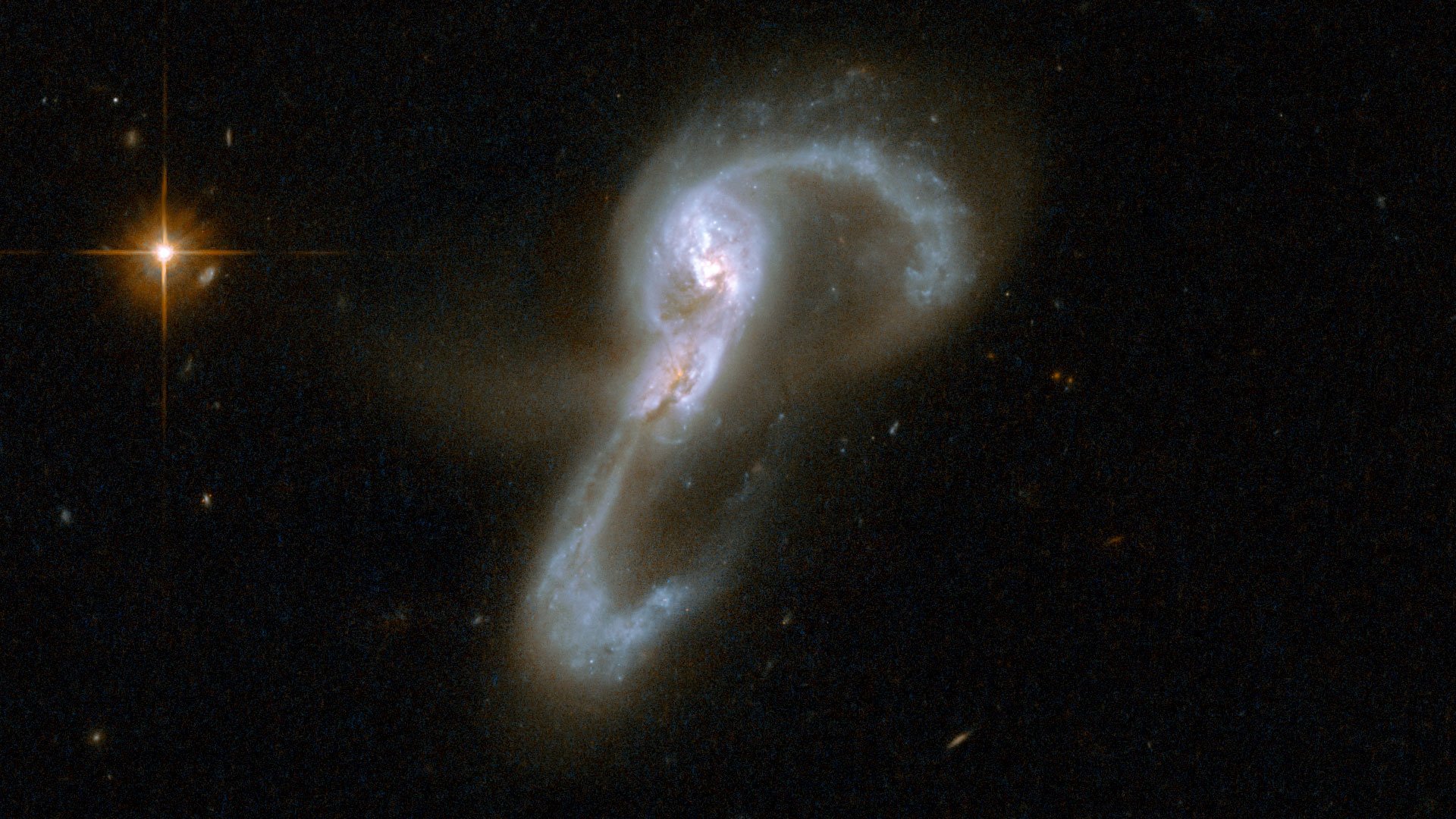
Galaxy-galaxy interactions have long been known to influence galaxy evolution. They are commonplace events, and a large majority of galaxies show signs of interactions, including tidal tails or other morphological distortions. The most dramatic collisions trigger the galaxies to light up, especially in the infrared, and they are some of the most luminous objects in the sky. Their brightness allows them to be studied at cosmological distances, helping astronomers reconstruct activity in the early universe.
Two processes in particular are responsible for the enhanced radiation: bursts of star formation or the fueling of the supermassive black hole at a galaxy’s core (an active galactic nuclei – AGN). Although in principle these two processes are quite different and should be readily distinguishable (AGN, for example, produces much hotter ultraviolet and X-ray radiation), in practice the discriminating features can be faint and/or obscured by dust in the galaxies. Astronomers therefore often use the shape of the galaxy’s entire emission profile from the ultraviolet to the far infrared (its spectral energy distribution – SED), to diagnose what is going on. The dust that absorbs much of the radiation also re-radiates it at the longer infrared wavelengths and computer codes can model and unravel the numerous physical effects.
If bursts of star formation were responsible for powering luminous galaxies in the early universe, then many of today’s stars may have been formed in such events, but if AGN dominated, then there should have been more outflowing jets and fewer new stars. CfA astronomers Jeremy Dietrich, Aaron S. Weiner, Matt Ashby, Rafael Martínez-Galarza, Andrés Ramos-Padilla, Howard Smith, Steve Willner, Andreas Zezas, and two colleagues analyzed twenty-four relatively nearby, luminous merging galaxies to see how often and to what extent AGN activity powered the energetics. They extracted the most meticulous SED information in thirty-three spectral bands from seven NASA missions for these galaxies, correcting for backgrounds, confusion, and other extraneous signals. They then used a new computational code to fit the shape of the SED and to derive the most likely value of the AGN contribution, as well as to measure the star formation rate, the dust properties, and numerous other physical parameters. The scientists tested the reliability of the code by using it on simulations of galaxy mergers and found excellent agreement.
The astronomers find that the AGN contribution in their sample of galaxies reaches as high as ninety percent of the total luminosity; in other cases it falls below twenty percent and is possibly negligible. The team makes efforts to relate the magnitude of the AGN contribution to the merger stage of the system (from the beginning to coalescing stages), but their modest sample size limited the generality of the conclusions. They are expanding their analysis to several hundred other mergers in order to strengthen the conclusions.
Reference: “The AGN Luminosity Fraction in Merging Galaxies” by Jeremy Dietrich, Aaron S. Weiner, Matthew L.N. Ashby, Christopher C. Hayward, Juan Rafael Martínez-Galarza, Andrés F. Ramos Padilla, Lee Rosenthal, Howard A. Smith, S.P. Willner and Andreas Zezas, 31 July 2018, MNRAS.
DOI: 10.1093/mnras/sty2056
Never miss a breakthrough: Join the SciTechDaily newsletter.
Follow us on Google and Google News.
2 Comments
There are some very complicated issues of galaxy formation. Unfortunately, here is the same problem as with the stars. The origin of galaxies remains unclear, in spite of huge activity in the field. What the “formation” means? It means that we have the material that is assembling into galaxies.
“The most dramatic collisions trigger the galaxies to light up, especially in the infrared, and they are some of the most luminous objects in the sky. Their brightness allows them to be studied at cosmological distances, helping astronomers reconstruct activity in the early universe.” and
“The scientists tested the reliability of the code by using it on simulations of galaxy mergers and found excellent agreement.”
What are you writing about? In the last 50 years there has been nothing but negative “merger/collision” ‘data’ printed WHICH ALL SUPPORTS EMERGENT THEORY!
Your fictional simulation proves nothing. Where is the mountain of real data supporting emergent processes that produced 2 trillion galaxies?
Here’s a welcome to reality publication …
As an independent, published member of the astronomy community you can help us submit our bias-free paper by endorsing the article here
https://arxiv.org/auth/endorse?x=KQIAHL .
Watch for more publications coming soon.