
On October 16, 2017, an international group of astronomers and physicists excitedly reported the first simultaneous detection of light and gravitational waves from the same source–a merger of two neutron stars. Now, a team that includes several University of Maryland astronomers has identified a direct relative of that historic event.
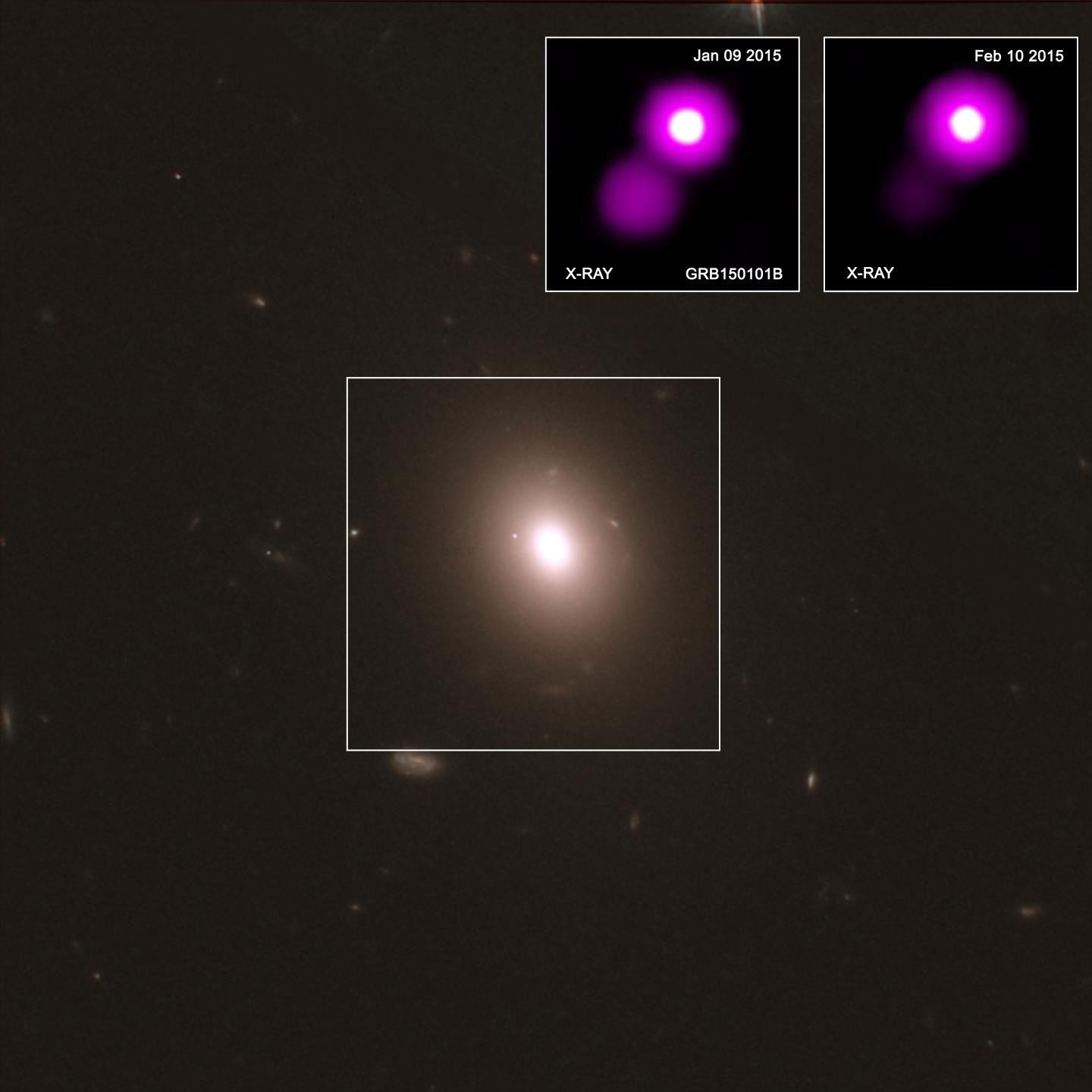
The newly described object, named GRB150101B, was reported as a gamma-ray burst localized by NASA’s Neil Gehrels Swift Observatory in 2015. Follow-up observations by NASA’s Chandra X-ray Observatory, the Hubble Space Telescope (HST), and the Discovery Channel Telescope (DCT) suggest that GRB150101B shares remarkable similarities with the neutron star merger, named GW170817, discovered by the Laser Interferometer Gravitational-wave Observatory (LIGO) and observed by multiple light-gathering telescopes in 2017.
A new study suggests that these two separate objects may, in fact, be directly related. The results were published on October 16, 2018, in the journal Nature Communications.
“It’s a big step to go from one detected object to two,” said study lead author Eleonora Troja, an associate research scientist in the UMD Department of Astronomy with a joint appointment at NASA’s Goddard Space Flight Center. “Our discovery tells us that events like GW170817 and GRB150101B could represent a whole new class of erupting objects that turn on and off–and might actually be relatively common.”
Troja and her colleagues suspect that both GRB150101B and GW170817 were produced by the same type of event: a merger of two neutron stars. These catastrophic coalescences each generated a narrow jet, or beam, of high-energy particles. The jets each produced a short, intense gamma-ray burst (GRB)–a powerful flash that lasts only a few seconds. GW170817 also created ripples in space-time called gravitational waves, suggesting that this might be a common feature of neutron star mergers.
The apparent match between GRB150101B and GW170817 is striking: both produced an unusually faint and short-lived gamma ray burst and both were a source of bright, blue optical light and long-lasting X-ray emission. The host galaxies are also remarkably similar, based on HST and DCT observations. Both are bright elliptical galaxies with a population of stars a few billion years old that display no evidence of new star formation.
“We have a case of cosmic look-alikes,” said study co-author Geoffrey Ryan, a postdoctoral researcher in the UMD Department of Astronomy and a fellow of the Joint Space-Science Institute. “They look the same, act the same and come from similar neighborhoods, so the simplest explanation is that they are from the same family of objects.”
In the cases of both GRB150101B and GW170817, the explosion was likely viewed “off-axis,” that is, with the jet not pointing directly toward Earth. So far, these events are the only two off-axis short GRBs that astronomers have identified.
The optical emission from GRB150101B is largely in the blue portion of the spectrum, providing an important clue that this event is another kilonova, as seen in GW170817. A kilonova is a luminous flash of radioactive light that produces large quantities of important elements like silver, gold, platinum, and uranium.
While there are many commonalities between GRB150101B and GW170817, there are two very important differences. One is their location: GW170817 is relatively close, at about 130 million light-years from Earth, while GRB150101B lies about 1.7 billion light-years away.
The second important difference is that, unlike GW170817, gravitational wave data does not exist for GRB150101B. Without this information, the team cannot calculate the masses of the two objects that merged. It is possible that the event resulted from the merger of a black hole and a neutron star, rather than two neutron stars.
“Surely it’s only a matter of time before another event like GW170817 will provide both gravitational wave data and electromagnetic imagery. If the next such observation reveals a merger between a neutron star and a black hole, that would be truly groundbreaking,” said study co-author Alexander Kutyrev, an associate research scientist in the UMD Department of Astronomy with a joint appointment at NASA’s Goddard Space Flight Center. “Our latest observations give us renewed hope that we’ll see such an event before too long.”
It is possible that a few mergers like the ones seen in GW170817 and GRB150101B have been detected previously, but were not properly identified using complementary observations in different wavelengths of light, according to the researchers. Without such detections–in particular, at longer wavelengths such as X-rays or optical light–it is very difficult to determine the precise location of events that produce gamma-ray bursts.
In the case of GRB150101B, astronomers first thought that the event might coincide with an X-ray source detected by Swift in the center of the galaxy. The most likely explanation for such a source would be a supermassive black hole devouring gas and dust. However, follow-up observations with Chandra placed the event further away from the center of the host galaxy.
According to the researchers, even if LIGO had been operational in early 2015, it would very likely not have detected gravitational waves from GRB150101B because of the event’s greater distance from Earth. All the same, every new event observed with both LIGO and multiple light-gathering telescopes will add important new pieces to the puzzle.
“Every new observation helps us learn better how to identify kilonovae with spectral fingerprints: silver creates a blue color, whereas gold and platinum add a shade of red, for example,” Troja added. “We’ve been able to identify this kilonova without gravitational wave data, so maybe in the future, we’ll even be able to do this without directly observing a gamma-ray burst.”
Reference: “A luminous blue kilonova and an off-axis jet from a compact binary merger at z = 0.1341” by E. Troja, G. Ryan, L. Piro, H. van Eerten, S. B. Cenko, Y. Yoon, S.-K. Lee, M. Im, T. Sakamoto, P. Gatkine, A. Kutyrev and S. Veilleux, 16 October 2018, Nature Communication.
DOI: 10.1038/s41467-018-06558-7
Never miss a breakthrough: Join the SciTechDaily newsletter.
Follow us on Google and Google News.
3 Comments
According to relativity nothing, not even light (EM field) can escape the gravity of a black hole thus an electromagnetic event should not be observed when a pair of black holes merge.
Did you even read the article? Sheesh…
When two Neutron star merger by the striping Electron.by a fusion force operative may have a repulsion until maximum electrons are striped for a merger.But the merger at the point of fusion and fusion balanced giving s great ejection dynamics as comparable with a Blue straggler.But the Neutron star swing and align along when having the spin axis and pole axis merger.But the situation may differ when the plane merger is perpendicular to a situation when the spin axis and pole axis is pi/2 shifted merger This is comparable with.Einstein reference planes of parallel magnetic field forming a unidirectional collapse but repulses when then Einstein magnetic field in opposite directions a repulsive force may be operative.B it blue kilonova must have s swing between a cross dynamicsl oscillations in between call for an.rxterrmy.poeetfjl intermediate Blue Kilonova during the intermediate collapse.We have yet to find differential collision out put of Quantum.mechanics ejections of opposite spins of clockwise and counterclockwise spiral ejections at s distance and myriad of possibilities as the ferromagnetic Nandhadevi antiferromagnetic merger with a middle way oscillation in between ,Einsteins magnetic field reference planes the merger as Electron.striped producing a spin difference such as spin axis may be pi/2 fixed or along the pi shifted.lock up had gone verified by NASA and Hubble out reach group