

- NASA’s Chandra X-ray Observatory continues to study GW170817, a neutron star merger that produced gravitational waves.
- Many telescopes saw different kinds of light after the discovery in August 2017, but only Chandra is still making a detection.
- Early Chandra data revealed the presence of a narrow jet that has slowed down and expanded over time.
- The latest study presents X-ray evidence for a shock — similar to a sonic boom from an airplane — in the aftermath of the merger.
NASA’s Chandra X-ray Observatory has been collecting data on the kilonova associated with GW170817 since shortly after it was first detected in gravitational waves by the Laser Interferometry Gravitational-wave Observatory (LIGO) and Virgo on August 17, 2017.
GW170817 was the first — and thus far the only — cosmic event where both gravitational waves and electromagnetic radiation, or light, were detected. This combination provides scientists with critical information about the physics of neutron star mergers and related phenomena, using observations at many different parts of the electromagnetic spectrum. Chandra is the only observatory still able to detect light from this extraordinary cosmic collision more than four years after the original event.
Astronomers think that after neutron stars merge, the debris generates visible and infrared light from the decay of radioactive elements like platinum and gold formed in the debris from the merger. This burst of light is called a kilonova. Indeed, visible light and infrared emission were detected from GW170817 several hours after the gravitational waves.
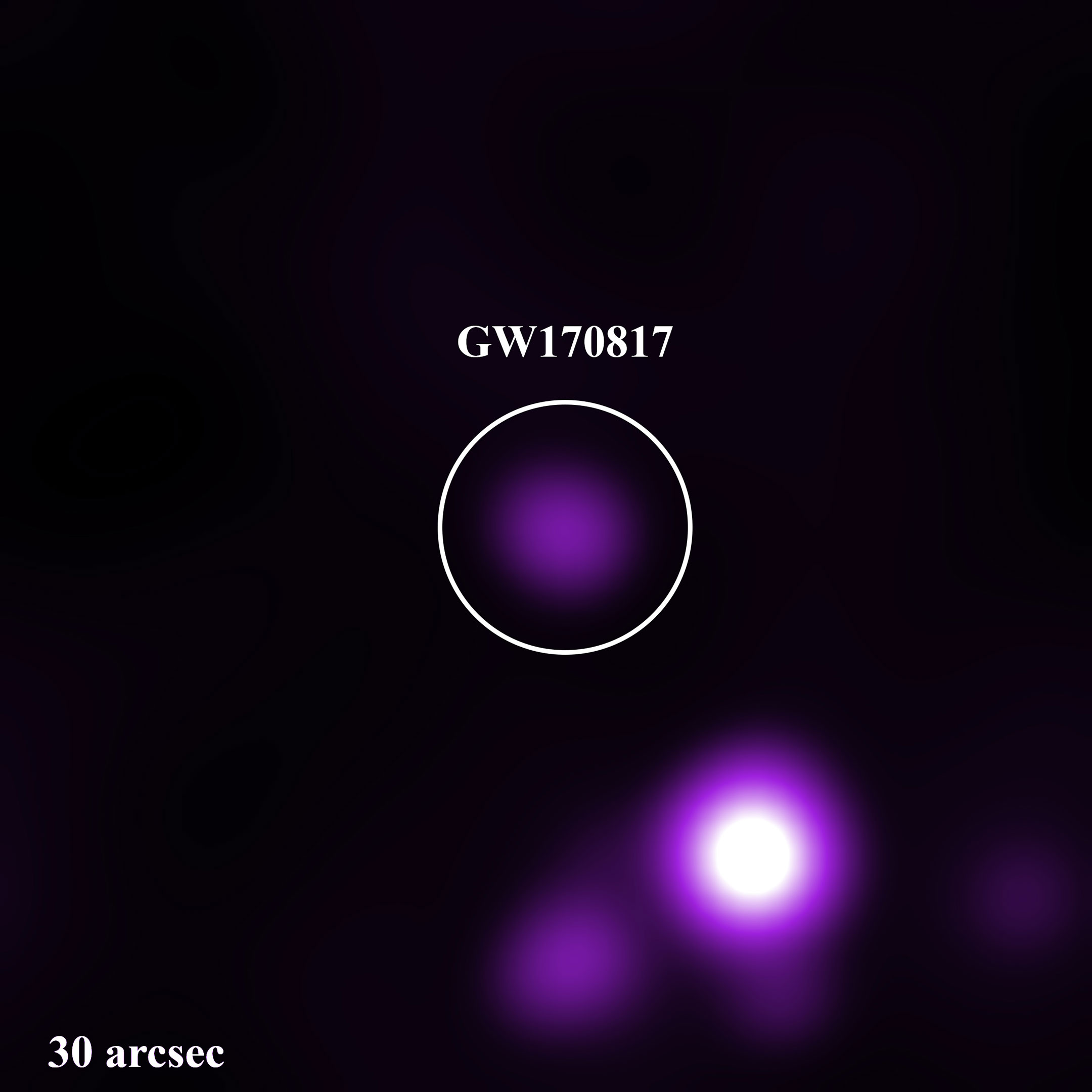
Initially the neutron star merger likely produced a jet of high-energy particles that was not pointed directly at Earth, explaining an initial lack of X-rays seen by Chandra. The jet then slowed down and widened upon impact with surrounding gas and dust. These changes caused an increase in X-rays observed by Chandra followed by a decline in early 2018. However, since the end of 2020, the X-rays detected by Chandra have remained at a nearly constant level. The Chandra image from data taken in December 2020 and January 2021 shows X-ray emission from GW170817 and from the center of its host galaxy, NGC 4993.
A research team studying the Chandra data thinks this steadying of the X-ray emission comes from a shock — like a sonic boom from an airplane — as the merger debris responsible for the kilonova strikes gas around GW170817. Material heated by such a shock would glow steadily in X-rays giving a “kilonova afterglow”, like Chandra has observed. The artist’s illustration shows the merger debris responsible for the kilonova in blue surrounded by a shock depicted in orange and red.
There is also an alternative explanation suggesting that the X-rays come from material falling towards a black hole that formed after the neutron stars merged. This material is depicted by a small disk in the center of the illustration. To avoid a coincidence, it is likely that only one of the two options — the kilonova afterglow or matter falling onto a black hole — is a significant source of the detected X-rays.
The two blue glowing arcs of material above and below the kilonova show where material from the now-faded jet has struck surrounding material.
To distinguish between the two explanations astronomers will keep monitoring GW170817 in X-rays and radio waves. If it is a kilonova afterglow, the radio emission is expected to get brighter over time and be detected again in the next few months or years. If the explanation involves matter falling onto a newly-formed black hole, then the X-ray output should stay steady or decline rapidly and no radio emission will be detected over time.
Researchers recently announced a source was detected in new Chandra observations performed in December 2021. Analysis of that data is ongoing. No radio detection has yet been reported.
For more information on this research see:
- Mysterious Kilonova Explosion Afterglow Potentially Spotted for First Time
- Radioactive Kilonova Glow Suggests Rapid Spin Delayed Collapse of Neutron Stars Into Black Hole
- Astronomers May Have Detected a “Sonic Boom” From a Powerful Blast Known as a Kilonova
A paper describing these results appears in the latest issue of The Astrophysical Journal Letters and is available online [link]. The authors are Aprajita Hajela (Northwestern University), Rafella Marguitti (University of California at Berkeley), Joe Bright (Berkeley), Kate Alexander (Northwestern), Brian Metzger (Columbia University), Vsevovold Nedora (University of Jena, Germany), Adithan Kathirgamarju (Berkeley), Ben Margalit (Berkeley), David Radice (Penn State University), Cristiano Guidorzi (University of Ferrara, Italy), Edo Berger (Center for Astrophysics I Harvard & Smithsonian (CfA)), Andrew MacFadyen (New York University), Dimitrios Giannios (Purdue University), Ryan Chornock (Berkeley), Ian Heywood (University of Oxford, UK), Lorenzo Sironi (Columbia), Ore Gottlieb (Tel Aviv University, Israel), Deanne Coppjans (Northwestern), Tanmoy Laskar (University of Bath, UK), Yvette Cendes (CfA), Rodolfo Barniol Duran (California State University, Sacramento), Tarraneh Eftekhari (CfA), Wen-fai Fong (Northwestern), Austin McDowell (NYU), Matt Nicholl (University of Birmingham, UK), Zhengtong Xie (University of Southampton, UK), Jonathan Zrake (Clemson University), Sebastiano Bernuzzi (University of Jena), Floor Broekgaarden (CfA), Charlie Kilpatrick (Northwestern), Giacomo Terreran (Northwestern), Ashley Villar (Columbia), Peter Blanchard (Northwestern), Sebastian Gomez (CfA), Griffin Hosseinzadeh (University of Arizona), David Jacob Matthews (Berkeley), and Jillian Rastinejad (Northwestern).
NASA’s Marshall Space Flight Center manages the Chandra program. The Smithsonian Astrophysical Observatory’s Chandra X-ray Center controls science operations from Cambridge, Massachusetts, and flight operations from Burlington, Massachusetts.
Never miss a breakthrough: Join the SciTechDaily newsletter.
Follow us on Google and Google News.