
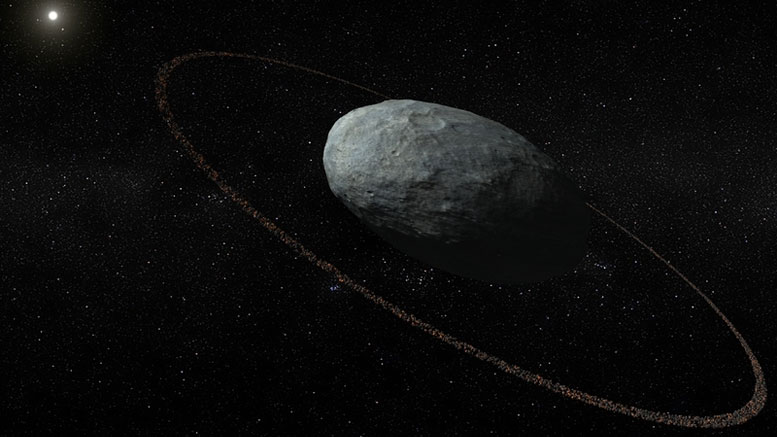
Recent observations reveal that dwarf planet Haumea has a narrow and dense ring orbiting around it. Ten observatories in six European countries were involved in the research campaign. In addition, the astronomers at the Max Planck Institute for Extraterrestrial Physics and more than 50 further institutions were able to constrain the size, shape and density of Haumea. Their findings are closer to theoretical predictions and less puzzling than previous estimates.
The region outside the Neptune orbit in our Solar System is teeming with interesting objects, the so-called TNOs (trans-Neptunian objects). Pluto is the most prominent among the four known trans-Neptunian dwarf planets, but the astronomers are also very interested in the exotic Haumea; an elongated, fast-rotating body, covered with crystalline water ice. However, many of its physical, chemical, and thermal characteristics were not well constrained so far.
“Since its discovery more than ten years ago we knew that Haumea is exotic, but its properties were only poorly known. This is why we pushed for more observations by the most powerful telescopes on Earth and in space,” explains Thomas Müller from the Max Planck Institute for Extraterrestrial Physics (MPE), who led one of the project teams for this study. “It is fantastic to see that a coordinated campaign of observers with small to medium-sized telescopes has now made the most spectacular contribution to our understanding of Haumea and the world of icy dwarf planets beyond Neptune.”
The astronomers took advantage of the unique opportunity of a stellar occultation to collect a wealth of observational data. Such stellar occultations are very similar to a Solar eclipse; however, instead of the Moon passing in front of the Sun, in this case, a small body in our Solar system occults an arbitrary background star. The measurement of the projected shadow on Earth can be directly translated into the object’s size and its (projected) shape.
Already in 2015, the possible occultation of a sufficiently bright star was identified and in September 2016 Gaia catalog was released, whose improved positions for more than one billion stars made predictions of stellar occultations by asteroids much easier. However, the calculation of events caused by TNOs remains difficult. These objects have been discovered fairly recently and astrometric observations are available for only a small part of their orbits. Therefore, a large astrometric observing campaign was needed close in time to a potential occultation event to be able to calculate the shadow path and alert the network of observers in January 2017: a total of ten observatories in six European countries obtained data on the occultation.
The light curves show deep drops caused by Haumea passing in front of the background star. Because the drops are abrupt, Haumea must lack a global atmosphere, such as the one on Pluto. In addition to the main occultation, there are brief dimmings prior to and after the main event.
“We were very surprised to see these secondary events, which hinted at an additional structure around the dwarf planet,” says Ulrich Hopp from the Max Planck Institute for Extraterrestrial Physics and the University Observatory Munich, who was in charge of the observations at the Wendelstein observatory. “The analysis shows that these dips are explained by a narrow and dense ring around Haumea that absorbed about half of the incoming stellar flux.”
Recent occultation campaigns already revealed rings around several minor planets in the trans-Neptune region, such as Chariklo and Chiron, and unexplained lightcurve signatures might indicate that also other objects might have a ring or ring systems. The reflectivity of Haumea’s ring is similar to those found so far. The position angle of the ring coincides with that Haumea’s minor axis, suggesting that the ring lies in Haumea’s equatorial plane. Previous observations have already shown that the satellite Hi’iaka is in orbit there. The ring, however, is close enough to Haumea that accretion cannot proceed to form another satellite.
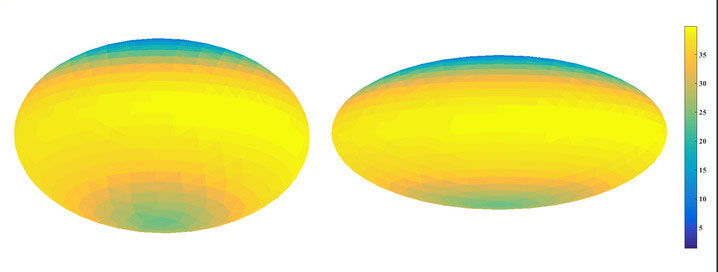
Since Haumea is thought to have a triaxial, ellipsoid shape, the occultation alone cannot provide its three-dimensional shape. From the measurements performed over several days prior to and after the occultation the astronomers obtained additional information on the rotational light curve and derived the shape of the ellipsoid as well as the density of the dwarf planet. The new results are much better in line with the density of other large TNOs than previous measurements. However, the results are inconsistent with a homogenous body in hydrostatic equilibrium. More likely, granular physics needs to be used to model the shape of this celestial body.
“The effort we put into coordinating and preparing this large collaboration paid off beautifully; we got such a lot of information over just a few days,” emphasizes Thomas Müller. “We now know more about the shape and build-up of Haumea and the discovery of a ring around this dwarf planet, with completely different dynamical mass and more distant than other objects with rings, which means that rings are probably much more common than we thought previously. This is a new, unexpected, and exciting research field where small and medium-sized telescopes can make fantastic contributions.”
“Our Solar System never stops to surprise us,” marvels Paola Caselli, director at the MPE. “This new discovery will put important constraints on the formation of dwarf planets and thus the early history of our Solar System. I am looking forward to seeing follow-up observations with other powerful telescopes (including ALMA and JWST) to investigate the composition of the Haumea-satellite-ring system as well as that of other TNO objects.”
Reference: “The size, shape, density and ring of the dwarf planet Haumea from a stellar occultation” by J. L. Ortiz, P. Santos-Sanz, B. Sicardy, G. Benedetti-Rossi, D. Bérard, N. Morales, R. Duffard, F. Braga-Ribas, U. Hopp, C. Ries, V. Nascimbeni, F. Marzari, V. Granata, A. Pál, C. Kiss, T. Pribulla, R. Komžík, K. Hornoch, P. Pravec, P. Bacci, M. Maestripieri, L. Nerli, L. Mazzei, M. Bachini, F. Martinelli, G. Succi, F. Ciabattari, H. Mikuz, A. Carbognani, B. Gaehrken, S. Mottola, S. Hellmich, F. L. Rommel, E. Fernández-Valenzuela, A. Campo Bagatin, S. Cikota, A. Cikota, J. Lecacheux, R. Vieira-Martins, J. I. B. Camargo, M. Assafin, F. Colas, R. Behrend, J. Desmars, E. Meza, A. Alvarez-Candal, W. Beisker, A. R. Gomes-Junior, B. E. Morgado, F. Roques, F. Vachier, J. Berthier, T. G. Mueller, J. M. Madiedo, O. Unsalan, E. Sonbas, N. Karaman, O. Erece, D. T. Koseoglu, T. Ozisik, S. Kalkan, Y. Guney, M. S. Niaei, O. Satir, C. Yesilyaprak, C. Puskullu, A. Kabas, O. Demircan, J. Alikakos, V. Charmandaris, G. Leto, J. Ohlert, J. M. Christille, R. Szakáts, A. Takácsné Farkas, E. Varga-Verebélyi, G. Marton, A. Marciniak, P. Bartczak, T. Santana-Ros, M. Butkiewicz-Bąk, G. Dudziński, V. Alí-Lagoa, K. Gazeas, L. Tzouganatos, N. Paschalis, V. Tsamis, A. Sánchez-Lavega, S. Pérez-Hoyos, R. Hueso, J. C. Guirado, V. Peris and R. Iglesias-Marzoa , 12 October 2017, Nature.
DOI: 10.1038/nature24051
Never miss a breakthrough: Join the SciTechDaily newsletter.
Follow us on Google and Google News.