
Close Menu
    Facebook X (Twitter) Instagram
    SciTechDaily
    • Biology
    • Chemistry
    • Earth
    • Health
    • Physics
    • Science
    • Space
    • Technology
    Facebook X (Twitter) Pinterest YouTube RSS
    SciTechDaily
    Home»Space»Astronomers Discover Ionized Molecules in Galaxy Markarian 231
    Space

    Astronomers Discover Ionized Molecules in Galaxy Markarian 231

    By E. González-Alfonso, Harvard-Smithsonian Center For AstrophysicsMarch 23, 2018No Comments3 Mins Read
    Facebook Twitter Pinterest Telegram LinkedIn WhatsApp Email Reddit
    Share
    Facebook Twitter LinkedIn Pinterest Telegram Email Reddit
    The Ionization Rate of the Molecular Gas in Galaxy Markarian 231
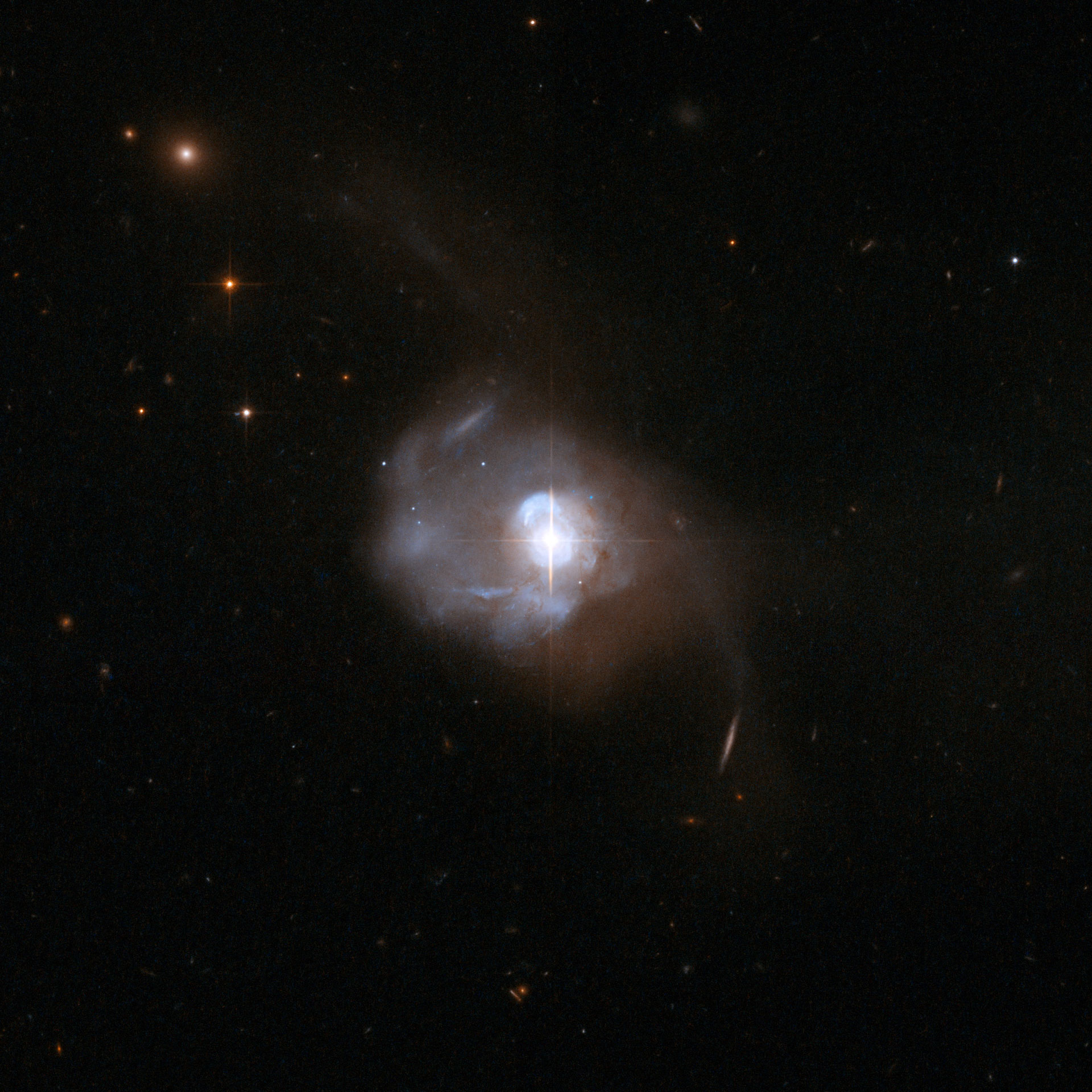
    The galaxy Markarian 231, the nearest quasar to Earth, as seen by the Hubble Space Telescope. The galaxy is the product of a merger between two galaxies. Astronomers have discovered the signatures of the ionized molecules OH+ and H2O+ in its massive outflow and argue that shock-induced cosmic rays are responsible for their ionization. NASA, ESA, the Hubble Heritage Team STScI/AURA-ESA/Hubble Collaboration, and A. Evans University of Virginia, Charlottesville/NRAO/Stony Brook University

    There is a process at work in most galaxies that affects both the central black hole mass as well as the galaxy’s global velocity structure and luminosity. Astronomers suspect that feedback of some kind is involved, and one popular mechanism is outflowing gas. The outflow would deplete a galaxy of the raw material needed both for making new stars and for enhancing the black hole’s mass. The first evidence for molecular outflows was discovered by an infrared satellite about twenty years ago: the molecule OH showed outflowing motions of thousands of kilometers a second in its far-infrared emission lines. The Herschel Space Observatory recently followed up on those detections in great detail, finding that in some extreme cases powerful outflows carry over a thousand solar masses per year and have the power of a hundred billion Suns – a few percent of the total luminous energy of the galaxy.

    CfA astronomers Eduardo Gonzalez-Alfonso, Matt Ashby, and Howard Smith have now discovered that the ionized molecule OH+ traces hot gas in these outflows and also (probably) from the torus of material thought to ring the black hole. The scientists led a team that reduced and modeled three far infrared lines of OH+ and one of the ionized water molecules H2O+ in the galaxy Markarian 231. The lines confirm much of the diagnostics from the neutral molecular gas analyses; the most curious result, however, was the huge abundance of the ionized material, nearly 10% of the neutral gas. The scientists are unable to explain the presence of so much ionized material either with hot, ultraviolet-emitting stars or with X-rays – it requires ten thousand times the excitation that is present in the Milky Way galaxy. They argue instead that cosmic rays are responsible, energized by a repeated acceleration in shock fronts from star formation or similar processes. One additional implication is that strong shocks must be active in the galaxy and should have been responsible for other observable phenomena like the heating of other gas.

    Reference: “Outflowing OH+ in Markarian 231: the ionization rate of the molecular gas” by E. González-Alfonso, J. Fischer, S. Bruderer, M. L. N. Ashby, H. A. Smith, S. Veilleux, H. S. P. Müller, K. P. Stewart and E. Sturm, 16 April 2018, The Astrophysical Journal.
    DOI: 10.3847/1538-4357/aab6b8

    Never miss a breakthrough: Join the SciTechDaily newsletter.
    Follow us on Google and Google News.

    Astronomy Cosmology Harvard-Smithsonian Center for Astrophysics
    Share. Facebook Twitter Pinterest LinkedIn Email Reddit

    Related Articles

    Astronomers Just Reconstructed a Galaxy’s 12-Billion-Year History

    Webb’s Mysterious “Little Red Dots” May Be the Cradle of the First Black Holes

    Mysterious Radio Signals Reveal What’s Hiding Between Galaxies

    Cosmic Mystery Solved: Astronomers Have Discovered the Universe’s “Missing” Matter

    Invisible Storm Lights Up Galaxy Cluster With Record-Breaking Radio Glow

    Herschel Observations Help Identify the Physical Processes Underway in Cold, Dense Clouds

    CfA Scientists Measure the Rate of Expansion of the Universe

    New Study Challenges Planck Results

    Calculations Show the Ideal Time to Study the Cosmos

    Leave A Reply Cancel Reply

    • Facebook
    • Twitter
    • Pinterest
    • YouTube

    Don't Miss a Discovery

    Subscribe for the Latest in Science & Tech!

    Trending News

    Scientists Discover Mysterious Creature Living in the Great Salt Lake – and It Exists Nowhere Else on Earth

    It’s Alive? Surprising Discovery Changes What We Know About Fog

    A Tiny Bright-Blue Octopus Found in the Galápagos Is Completely New to Science

    Scientists Discover Surprising Anti-Aging Power Hidden in Aged Garlic

    Why More People in Their 30s Are Suddenly Getting Colon Cancer

    Scientists Discover Sperm Seem To Bypass a Fundamental Law of Physics

    Archaeologists Discover Mysterious Artificial Island Older Than Stonehenge in Scotland

    Massive Study Warns Marijuana Use in Teens Is Linked to Serious Mental Illness

    Follow SciTechDaily
    • Facebook
    • Twitter
    • YouTube
    • Pinterest
    • Newsletter
    • RSS
    SciTech News
    • Biology News
    • Chemistry News
    • Earth News
    • Health News
    • Physics News
    • Science News
    • Space News
    • Technology News
    Recent Posts
    • Largest Known Wild Chimpanzee Community Breaks Apart After Decades of Unity
    • Scientists Turn Mice Transparent to Uncover Obesity’s Secret Effects on Nerves
    • Scientists Discover a Hidden Cause of Cellular Aging That Can Be Reversed
    • World’s Most-Used Weedkiller Found To Disrupt Honeybee Brains
    • New Crocodile Cousin Discovered After 210 Million Years Hidden in Stone
    Copyright © 1998 - 2026 SciTechDaily. All Rights Reserved.
    • Science News
    • About
    • Contact
    • Editorial Board
    • Privacy Policy
    • Terms of Use

    Type above and press Enter to search. Press Esc to cancel.