
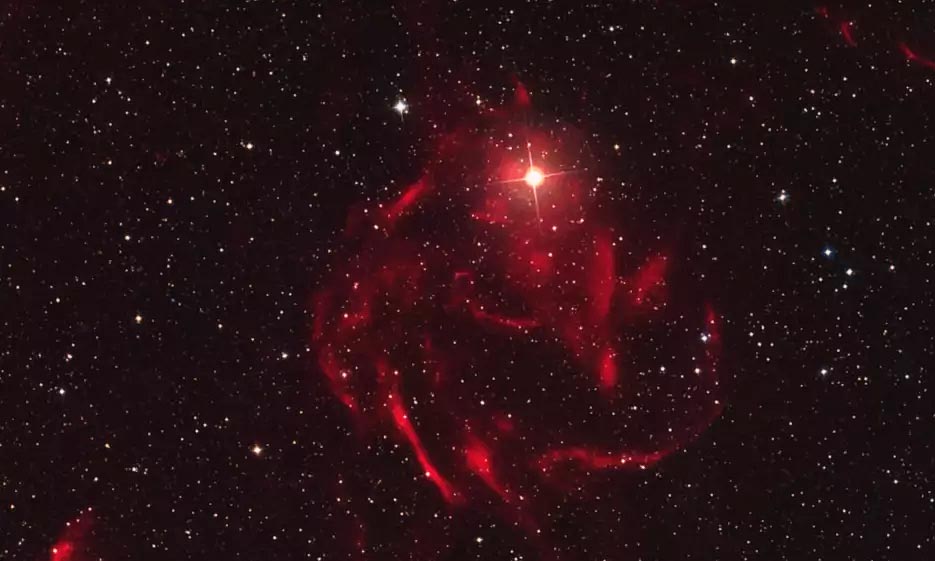
Scientists have confirmed the existence of a fully developed shell of a common-envelope system around a binary star, a discovery initially made by amateur astronomers. This shell, detected around two stars—one a white dwarf and the other slightly less massive than the sun—marks a significant advancement in understanding stellar evolution and the end of life stages of stars in binary systems.
For the first time, scientists, starting from a discovery by scientific amateurs, have succeeded in providing evidence for a fully developed shell of a common-envelope-system (CE) – the phase of the common envelope of a binary star system.
“Toward the end of their lives, normal stars inflate into red giant stars. Since a very large fraction of stars are in binary stars, this affects the evolution at the end of their lives. In close binary systems, the inflating outer part of a star merges as a common envelope around both stars. However, inside this gas envelope the cores of the two stars are practically undisturbed and follow their evolution like independent single stars,” explains astrophysicist Stefan Kimeswenger.
The researchers have now published their results in the journal Astronomy & Astrophysics.
Discovery Thanks to Amateur Astronomers
Many stellar systems are known to be remnants of such an evolution. Their chemical and physical properties serve as a fingerprint. Also stellar systems which are just about to develop a common envelope had already been discovered due to their specific and high brightness. However, the fully developed envelope of a CE and its ejection into interstellar space had not been observed in this form so far.
“These envelopes are of great importance for our understanding of the evolution of stars in their final phase. Moreover, they help us to understand how they enrich the interstellar space with heavy elements, which are then in turn important for the evolution of planetary systems, such as our own,” explains Kimeswenger the importance of the newly discovered galactic nebulae and adds an explanation for why the probability of their discovery is low: “They are too large for the field of view of modern telescopes and at the same time they are very faint. Moreover, their lifetime is rather short, at least when considered in cosmic time scales. It is only a few hundred thousand years.”
The starting point for this unique discovery is a group of German-French amateur astronomers: With painstaking work they searched historical celestial images for unknown objects in the now digitized archives and finally found a fragment of a nebula on photographic plates from the 1980s.
International Cooperation Solves Puzzle
With their finding, the group contacted international scientific experts, including the Department for Astro and Particle Physics at the University of Innsbruck, which is very experienced in this field. By compiling and combining observations from the past 20 years, stemming from public archives of various telescopes and with data from four different space satellites, the researchers in Innsbruck were able to rule out their first assumption, namely the discovery of a planetary nebula caused by the remnants of dying stars. The enormous extent of the nebula finally became apparent with the help of measurements taken by telescopes in Chile. Scientists in the USA finally completed these observations with spectrographs: “The diameter of the main cloud is 15.6 light-years across, almost 1 million times larger than the distance of the earth to the sun and much larger than the distance of our sun to its nearest neighboring star. Moreover, fragments as large as 39 light-years apart have also been found. Since the object lies slightly above the Milky Way, the nebula was able to develop largely undisturbed by other clouds in the surrounding gas,” Kimeswenger describes the discovery.
Model of the New Class of Galactic Nebulae
By combining all this information, the researchers have succeeded in creating a model of the object: It consists of a close binary system of a 66,500-degree white dwarf star and a normal star with a mass slightly below that of the Sun. Both orbit each other in only 8 hours and 2 minutes and at a distance of only 2.2 solar radii. Due to the small distance, the companion star with a temperature of only about 4,700 degrees is strongly heated at the side facing the white dwarf, which leads to extreme phenomena in the spectrum of the star and to very regular variations in brightness. Around both stars there is a gigantic envelope consisting of the outer material of the white dwarf. At just over one solar mass, this material is heavier than the white dwarf and its companion star and was ejected into space some 500,000 years ago.
Another part of the puzzle related to the discovery of the new class of galactic nebulae has not yet been solved, Stefan Kimeswenger says: “It is even possible that this system is related to a nova observation made by Korean and Chinese astronomers in 1086. In any case, the positions of the historical observations match very well with those of our object described here.”
Never miss a breakthrough: Join the SciTechDaily newsletter.
Follow us on Google and Google News.