
The Theory of General Relativity Passes a Range of Precise Tests Set by Pair of Extreme Stars
An international team of researchers from ten countries led by Michael Kramer from the Max Planck Institute for Radio Astronomy in Bonn, Germany, has conducted a 16-year-long experiment to challenge Einstein’s theory of general relativity with some of the most rigorous tests yet. Their study of a unique pair of extreme stars, so-called pulsars, involved seven radio telescopes across the globe and revealed new relativistic effects that were expected and have now been observed for the first time. Einstein’s theory, which was conceived when neither these types of extreme stars nor the techniques used to study them could be imagined, agrees with the observation at a level of at least 99.99%.
More than 100 years after Albert Einstein presented his theory of gravity, scientists around the world continue their efforts to find flaws in general relativity. The observation of any deviation from General Relativity would constitute a major discovery that would open a window on new physics beyond our current theoretical understanding of the Universe.
The research team’s leader, Michael Kramer from the Max Planck Institute for Radio Astronomy (MPIfR) in Bonn, Germany, says: “We studied a system of compact stars that is an unrivaled laboratory to test gravity theories in the presence of very strong gravitational fields. To our delight we were able to test a cornerstone of Einstein’s theory, the energy carried by gravitational waves, with a precision that is 25 times better than with the Nobel-Prize-winning Hulse-Taylor pulsar, and 1000 times better than currently possible with gravitational wave detectors.” He explains that the observations are not only in agreement with the theory, “but we were also able to see effects that could not be studied before”.
Ingrid Stairs from the University of British Columbia at Vancouver gives an example: “We follow the propagation of radio photons emitted from a cosmic lighthouse, a pulsar, and track their motion in the strong gravitational field of a companion pulsar.
We see for the first time how the light is not only delayed due to a strong curvature of spacetime around the companion, but also that the light is deflected by a small angle of 0.04 degrees that we can detect. Never before has such an experiment been conducted at such a high spacetime curvature.”
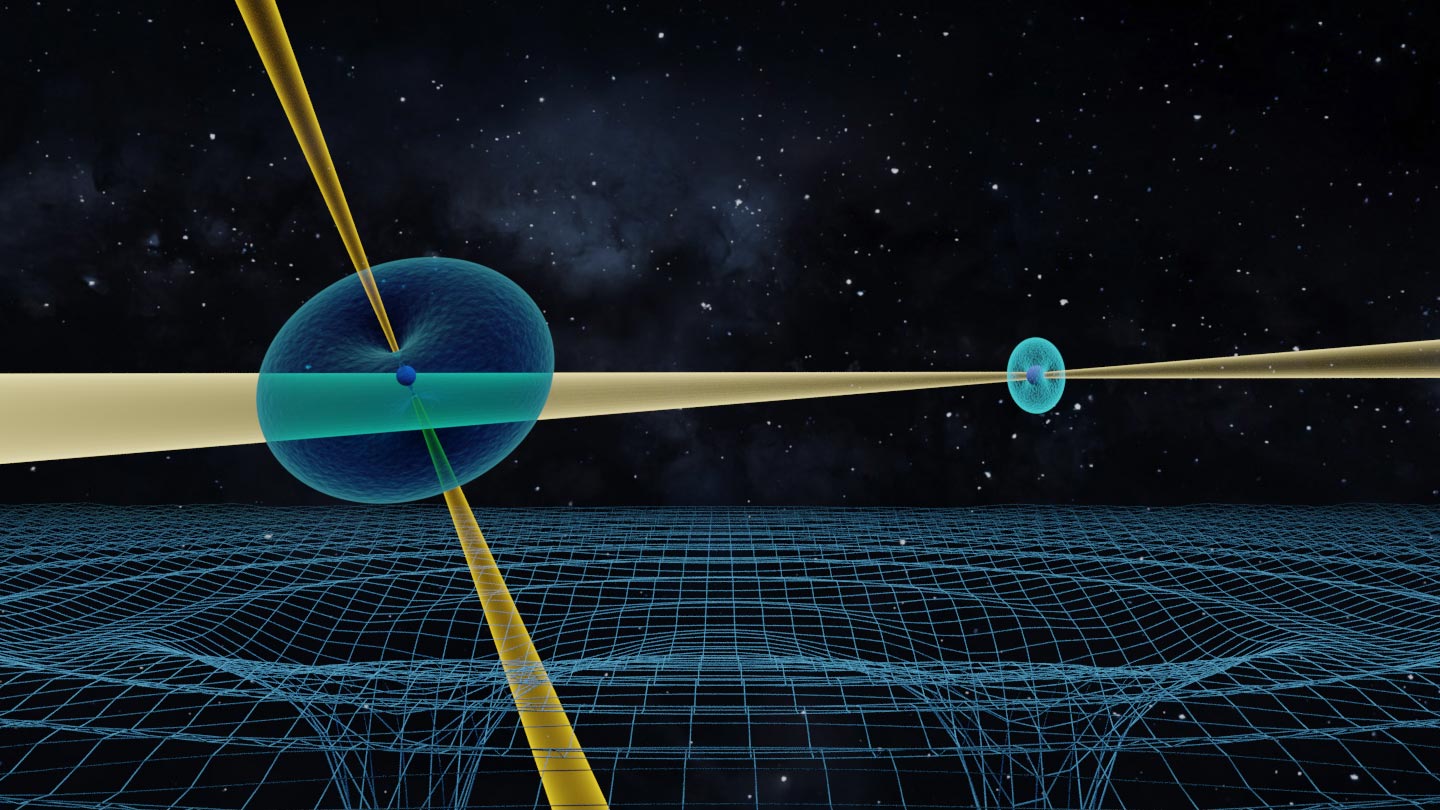
Dance of pulsars. Animation of the double pulsar system PSR J0737-3039 A/B and its line of sight from Earth. The system — consisting of two active radio pulsars — is “edge-on” as seen from Earth, which means that the inclination of the orbital plane relative to our line of sight is only about 0.6 degrees.
This cosmic laboratory known as the “Double Pulsar” was discovered by members of the team in 2003. It consists of two radio pulsars which orbit each other in just 147 min with velocities of about 1 million km/h. One pulsar is spinning very fast, about 44 times a second. The companion is young and has a rotation period of 2.8 seconds. It is their motion around each other that can be used as a near perfect gravity laboratory.
Dick Manchester from Australia’s national science agency, CSIRO, illustrates: “Such fast orbital motion of compact objects like these — they are about 30% more massive than the Sun but only about 24 km across — allows us to test many different predictions of general relativity — seven in total! Apart from gravitational waves, our precision allows us to probe the effects of light propagation, such as the so-called “Shapiro delay” and light-bending. We also measure the effect of “time dilation” that makes clocks run slower in gravitational fields.
We even need to take Einstein’s famous equation E = mc2 into account when considering the effect of the electromagnetic radiation emitted by the fast-spinning pulsar on the orbital motion. This radiation corresponds to a mass loss of 8 million tonnes per second! While this seems a lot, it is only a tiny fraction — 3 parts in a thousand billion billion(!) — of the mass of the pulsar per second.”
The Shapiro time delay. Animation of the measurement of the Shapiro time delay in the double pulsar. When a rapidly spinning pulsar orbits around the common center of mass, the emitted photons propagate along the curved spacetime of the trapped pulsar and are therefore delayed.
The researchers also measured — with a precision of 1 part in a million(!) — that the orbit changes its orientation, a relativistic effect also well known from the orbit of Mercury, but here 140,000 times stronger. They realized that at this level of precision they also need to consider the impact of the pulsar’s rotation on the surrounding spacetime, which is “dragged along” with the spinning pulsar. Norbert Wex from the MPIfR, another main author of the study, explains: “Physicists call this the Lense-Thirring effect or frame-dragging. In our experiment it means that we need to consider the internal structure of a pulsar as a neutron star. Hence, our measurements allow us for the first time to use the precision tracking of the rotations of the neutron star, a technique that we call pulsar timing to provide constraints on the extension of a neutron star.”
The technique of pulsar timing was combined with careful interferometric measurements of the system to determine its distance with high resolution imaging, resulting in a value of 2400 light years with only 8% error margin. Team member Adam Deller, from Swinburne University in Australia and responsible for this part of the experiment, highlights: “It is the combination of different complementary observing techniques that adds to the extreme value of the experiment. In the past, similar studies were often hampered by the limited knowledge of the distance of such systems.” This is not the case here, where in addition to pulsar timing and interferometry also the information gained from effects due to the interstellar medium were carefully taken into account. Bill Coles from the University of California San Diego agrees: “We gathered all possible information on the system and we derived a perfectly consistent picture, involving physics from many different areas, such as nuclear physics, gravity, interstellar medium, plasma physics, and more. This is quite extraordinary.”
“Our results are nicely complementary to other experimental studies which test gravity in other conditions or see different effects, like gravitational wave detectors or the Event Horizon Telescope. They also complement other pulsar experiments, like our timing experiment with the pulsar in a stellar triple system, which has provided an independent (and superb) test of the universality of free fall”, says Paulo Freire, also from MPIfR.
Michael Kramer concludes: “We have reached a level of precision that is unprecedented. Future experiments with even bigger telescopes can and will go still further. Our work has shown the way such experiments need to be conducted and which subtle effects now need to be taken into account. And, maybe, we will find a deviation from general relativity one day…”
For more on this research, see Challenging Einstein’s Greatest Theory in 16-Year Experiment – Theory of General Relativity Tested With Extreme Stars.
Reference: “Strong-field Gravity Tests with the Double Pulsar” by M. Kramer et al., 13 December 2021, Physical Review X.
DOI: 10.1103/PhysRevX.11.041050
Never miss a breakthrough: Join the SciTechDaily newsletter.
Follow us on Google and Google News.
7 Comments
If there’s enough gravity for time dilation to be significant, how much did that affect the perceived rotation and orbital speeds compared to actual speeds inside local reference frames of the pulsars?
It sounds like a very complex experiment to account for all the factors involved.
Unfortunately the interpretation as proof is as erroneous as Eddington’s! See vol 1 no.1 of “The Critical Rationalist”!
Às actual speed of the pulsars in the framee of referrence do not hampered,so another motion occuring simultaneously for same pulars system,say orbìal motion is subjected to time dilation;an effect equal to energy conserved in same secondary motion.
Unfortunately the interpretation as proof is as erroneous as Eddington’s! See vol 1 no.1 of “The Critical Rationalist”!
The concept of constrain motion fits good for the binary system of pulsars,simultaneously considering the surroundig stars’ effect.But basic fact differs is that no frame of reference is inertial.Again rotational bodies system for pulsar pair is is simply secondary.So time dialation is due to only gravitation of the pair,which is of secondary origin and for this energy has to expend by each pulsar.
Does the pulsar star connect to the orbit supermassive Black whole?????
Einstein’s theory of relativity is absolutely incorrect, and it is especially illogical that there are gravitational waves and gravitons!
If gravity is the force of attraction of masses to each other, then each force should act in such a way that it also has its own gravitons and gravitational waves.
The biggest possible deception of the explanation of gravity is that couple, space and time have some common attractive or “love” ties and so in their “survival” that couple makes a fabric, which is a “hunter” of matter and when it enters that network, “a newborn is born” ǴRAVITATION.
This is truly a genocidal pill against understanding the laws of the universe !!! If this is accepted, it means that matter wanders through something that is not space and lasts and exists, which is not time and only when it enters Einstein’s network is “born” gravity.
All these misconceptions and all the “scientific insects caught” in Einstein’s spider web show that none of them has any natural and logical connection with the processes of matter formation, its origin and the formation of gravity and electromagnetism.
What I am presenting has evidence that can overturn more than 80% of erroneous theories to date, such as Einstein’s and even Lorentz’s transformations, not to mention that science knows nothing about the laws of motion of particles or celestial bodies.
This is Copyright, Nikola Milović, who deals with the highest level of science in the history of mankind. !!