
Close Menu
    Facebook X (Twitter) Instagram
    SciTechDaily
    • Biology
    • Chemistry
    • Earth
    • Health
    • Physics
    • Science
    • Space
    • Technology
    Facebook X (Twitter) Pinterest YouTube RSS
    SciTechDaily
    Home»Space»Astronomers Discover One of the Most Massive Binary Stars in the Galaxy
    Space

    Astronomers Discover One of the Most Massive Binary Stars in the Galaxy

    By Mark Thompson, Universe TodaySeptember 10, 2025No Comments4 Mins Read
    Facebook Twitter Pinterest Telegram LinkedIn WhatsApp Email Reddit
    Share
    Facebook Twitter LinkedIn Pinterest Telegram Email Reddit
    Star Cluster NGC 3603 Surrounded by Nebula
    NGC 3603 is a starburst region located 22,000 light years away from the Sun, it’s the closest region of this kind known in our Galaxy. Credit: ESO

    NGC 3603-A1 is a pair of giant stars locked in a rapid 3.8-day orbit. Their dynamic relationship provides clues to how massive stars evolve and form black holes.

    A team of astronomers combined archival data from the Hubble Space Telescope with fresh observations to obtain precise measurements of the binary star system NGC 3603-A1. One of its stars has a mass about 93 times greater than the Sun, while the other is roughly 70 solar masses. Together, they form one of the most massive binary systems ever identified in the Milky Way.

    What makes this system truly extraordinary is the speed of its orbit. The two enormous stars revolve around each other once every 3.8 days. By comparison, during the time it takes Earth to complete a single year around the Sun, these stars complete nearly 100 orbits. Their close proximity and immense size generate powerful interactions that are actively altering both stars.

    A discovery from overlooked data

    Uncovering this system required years of investigation and hinged on a key observation from an unexpected contributor. In the summer of 2020, while working remotely at Lowell Observatory during the pandemic, Carleton College undergraduate Sarah Bodansky noticed details in older Hubble data that had escaped previous analysis.

    “Sarah’s work made it possible to move this project forward. She noticed something that everyone had missed: some of the spectral features doubled when the stars had their greatest motions towards and away from us. Without this discovery, the project would have languished,” says Dr. Phil Massey of Lowell Observatory.
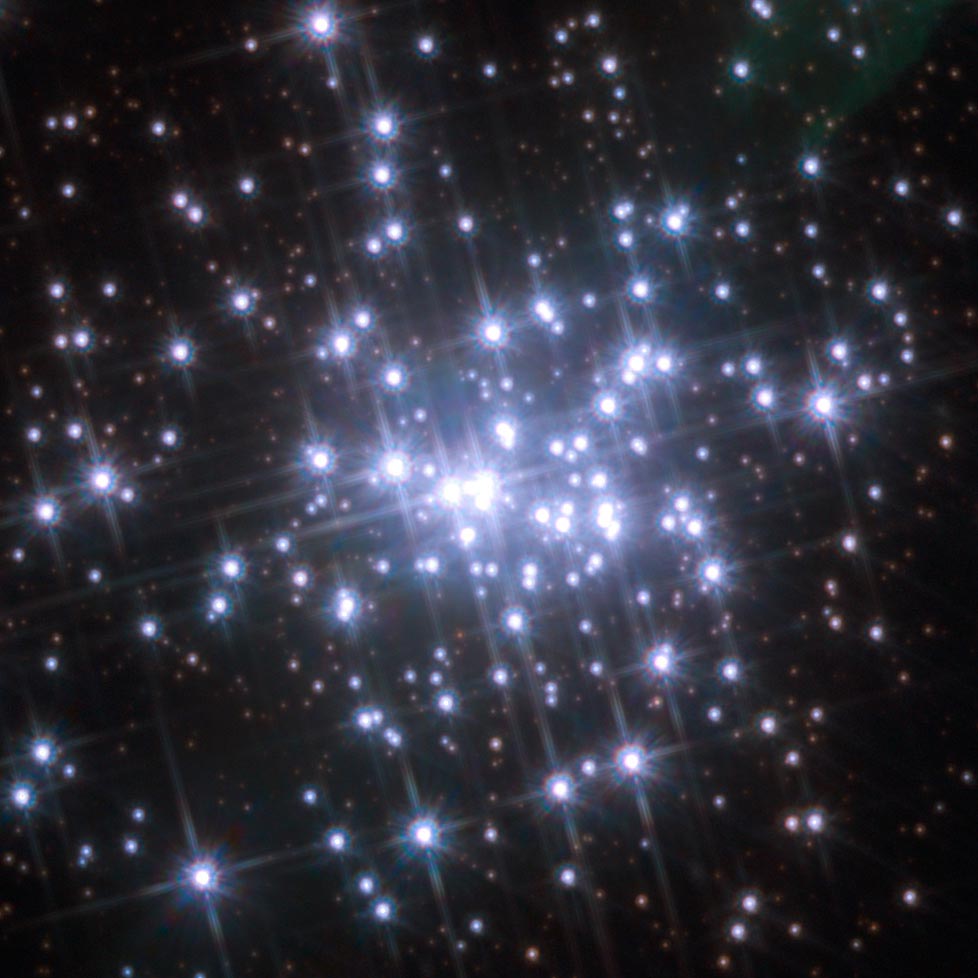
    Dense Core of Star Cluster NGC 3603
    The core of the star cluster in NGC 3603 is shown in great detail in an image from the Wide Field Planetary Camera 2 (WFPC2) camera on the NASA/ESA Hubble Space Telescope. NGC3603-A1 is the brightest (and top right) of the three barely resolved stars at the center. Credit: NASA, ESA and Wolfgang Brandner

    This observation was key because it revealed the binary nature of what had appeared to be a single, fuzzy star. Located in the densely packed star cluster NGC 3603 which is one of the most active star forming regions in our Galaxy, the system could only be resolved using Hubble’s exceptional clarity.

    Young stars masquerading as giants

    Both stars are so massive and energetic that they mimic Wolf-Rayet stars, which are typically older, dying giants that blast away their outer layers with intense stellar winds. However, the stars in NGC 3603-A1 are actually still young, demonstrating the extreme conditions that can make massive stars appear far more evolved than they actually are.

    The interaction between the two stars tells a fascinating story of stellar evolution. The smaller of the pair appears to have stolen mass from its larger companion, causing it to spin faster as a result. This kind of mass transfer is crucial for understanding how massive stars change over time and provides insights into their ultimate fate.

    “For the most massive stars, astronomers usually have to rely on models that aren’t very well-constrained to ‘weigh’ the star. But this study focused on a special type of binary system where we can get a more fundamental measurement of its mass,” says Sarah Bodansky from Carleton College.

    Massive binary systems like NGC 3603-A1 are the progenitors of binary black holes, which can eventually merge and create gravitational waves that scientists have been detecting since 2015. Understanding these stellar relationships helps astronomers predict where and when such collisions might occur.

    Reference: “A New Determination of the Mass of NGC 3603-A1: The Most Massive Binary Known?” by Philip Massey, Sarah Bodansky, Laura R. Penny, Nidia I. Morrell and Kathryn F. Neugent, 25 August 2025, The Astrophysical Journal.
    DOI: 10.3847/1538-4357/ade799

    Adapted from an article originally published on Universe Today.

    Never miss a breakthrough: Join the SciTechDaily newsletter.
    Follow us on Google and Google News.

    Astrophysics Binary Star Gravitational Waves Hubble Space Telescope Stellar Evolution
    Share. Facebook Twitter Pinterest LinkedIn Email Reddit

    Related Articles

    Unprecedented Discovery: Astronomers Discover Primordial Differences in Binary Stars

    New Research Shows That Something Strange Is Going On in the Butterfly Nebula

    Hubble Detects Plasma Ejections Shooting From V Hydrae

    Hubble Reveals Link Between Stars’ Ages and Their Orbits

    Evidence That Local Starbursts Impact the Bulk of the Gas Around Their Host Galaxy

    One of the Most Efficient Star Making Galaxies Ever Observed

    Hubble Data Reveals That Globular Clusters Age at Different Rates

    SN Primo Is Farthest Type Ia Supernova Discovered

    Hubble Observes Rare Blue Stars in Andromeda’s Core

    Leave A Reply Cancel Reply

    • Facebook
    • Twitter
    • Pinterest
    • YouTube

    Don't Miss a Discovery

    Subscribe for the Latest in Science & Tech!

    Trending News

    Scientists Uncover Potential Brain Risks of Popular Fish Oil Supplements

    Scientists Discover a Surprising Way To Make Bread Healthier and More Nutritious

    After 60 Years, Scientists Uncover Unexpected Brain Effects of Popular Diabetes Drug Metformin

    New Research Uncovers Hidden Side Effects of Popular Weight-Loss Drugs

    Scientists Rethink Extreme Warming After Surprising Ocean Discovery

    Landmark Study Links Never Marrying to Significantly Higher Cancer Risk

    Researchers Discover Unknown Beetle Species Just Steps From Their Lab

    Largest-Ever Study Finds Medicinal Cannabis Ineffective for Anxiety, Depression, PTSD

    Follow SciTechDaily
    • Facebook
    • Twitter
    • YouTube
    • Pinterest
    • Newsletter
    • RSS
    SciTech News
    • Biology News
    • Chemistry News
    • Earth News
    • Health News
    • Physics News
    • Science News
    • Space News
    • Technology News
    Recent Posts
    • Early Warning Signals of Esophageal Cancer May Be Hiding in Plain Sight
    • Researchers Have Discovered a THC-Free Cannabis Compound That May Replace Opioids
    • Common Blood Pressure Drug Shows Surprising Power Against Deadly Antibiotic-Resistant Superbug
    • Students Build Dark Matter Detector and Set New Experimental Limits
    • Scientists Discover Caffeine Can Repair Key Memory Circuits After Sleep Loss
    Copyright © 1998 - 2026 SciTechDaily. All Rights Reserved.
    • Science News
    • About
    • Contact
    • Editorial Board
    • Privacy Policy
    • Terms of Use

    Type above and press Enter to search. Press Esc to cancel.