
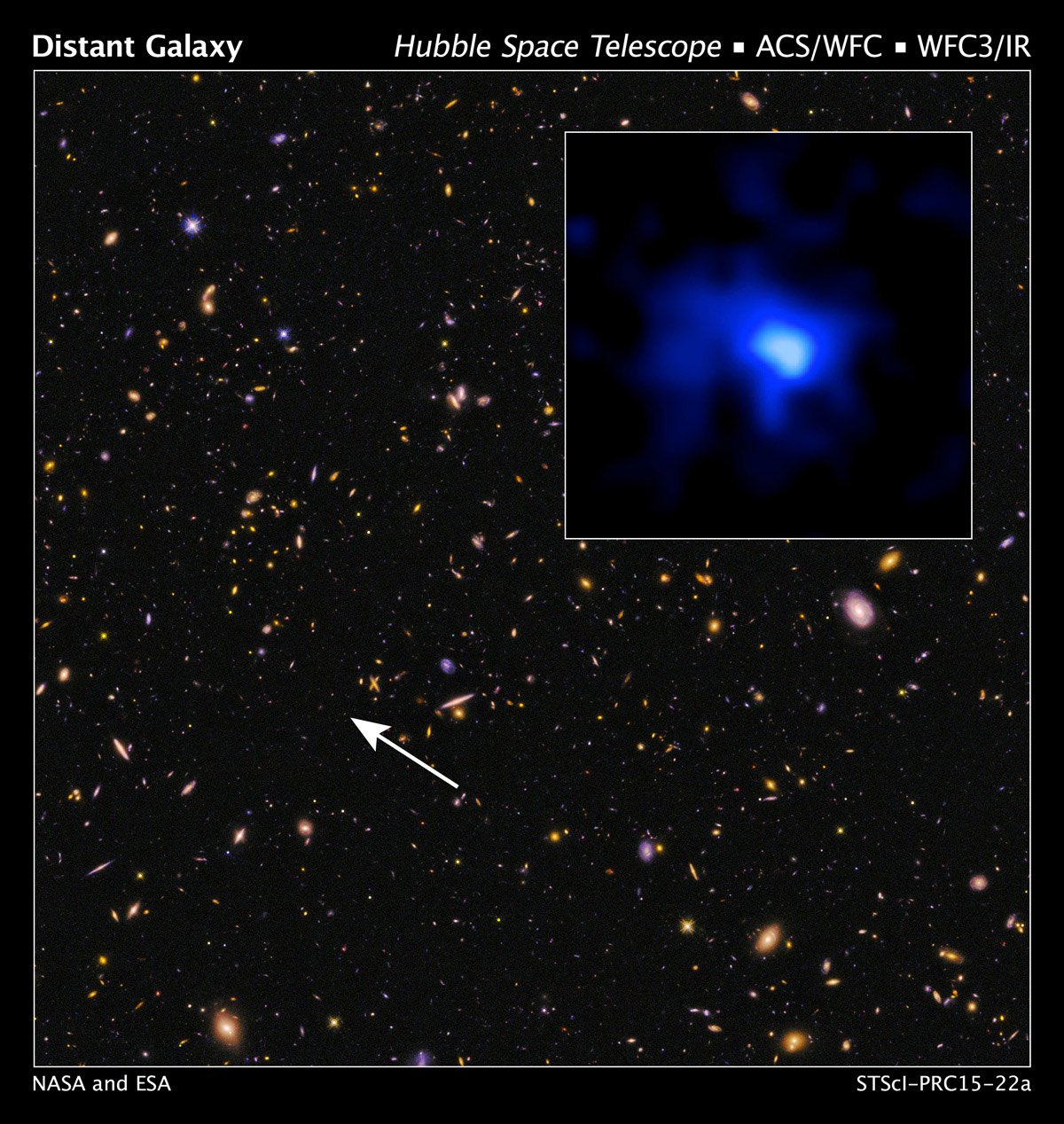
An international team of astronomers has pushed back the cosmic frontier of galaxy exploration to a time when the universe was only 5% of its present age, revealing a galaxy that existed over 13 billion years ago.
The team discovered an exceptionally luminous galaxy more than 13 billion years in the past and determined its exact distance from Earth using the combined data from NASA’s Hubble and Spitzer space telescopes, and the Keck I 10-meter (33-foot) telescope at the W. M. Keck Observatory in Hawaii. These observations confirmed it to be the most distant galaxy currently measured, setting a new record. The galaxy existed so long ago, it appears to be only about 100 million years old.
The galaxy, EGS-zs8-1, was originally identified based on its particular colors in images from Hubble and Spitzer and is one of the brightest and most massive objects in the early universe. “It has already grown to more than 15 percent of the mass of our own Milky Way today,” said Pascal Oesch, lead author of the study from Yale University, New Haven, Connecticut. “But it had only 670 million years to do so. The universe was still very young then.” The new distance measurement also enabled the astronomers to determine that EGS-zs8-1 was still forming stars very rapidly, about 80 times faster than our Milky Way galaxy today (which has a star formation rate of one star per year).
Only a handful of galaxies currently have accurate distances measured in this very early universe. “Every confirmation adds another piece to the puzzle of how the first generations of galaxies formed in the early universe,” said Pieter van Dokkum of Yale, second author of the study. “Only the most sensitive telescopes are powerful enough to reach these large distances.” The discovery was only possible thanks to the relatively new Multi-Object Spectrometer For Infra-Red Exploration (MOSFIRE) instrument on the Keck I telescope, which allows astronomers to efficiently study several galaxies at the same time.
Measuring galaxies at these extreme distances and characterizing their properties is the main goal of astronomers over the next decade. The observations see EGS-zs8-1 at a time when the universe was undergoing very important changes: the hydrogen between galaxies was transitioning from an opaque to a transparent state. “It appears that the young stars in the early galaxies like EGS-zs8-1 were the main drivers for this transition, called reionization,” said study co-author, Rychard Bouwens of the Leiden Observatory, Leiden, Netherlands.
These new Hubble, Spitzer, and Keck observations together also pose new questions. They confirm that massive galaxies already existed early in the history of the universe, but that their physical properties were very different from galaxies seen around us today. Astronomers now have very strong evidence that the peculiar colors of early galaxies seen in the Spitzer images originate from a very rapid formation of massive, young stars, which interacted with the primordial gas in these galaxies.
The new observations underline the very exciting discoveries that NASA’s James Webb Space Telescope will enable when it is launched in 2018. In addition to pushing the cosmic frontier to even earlier cosmic times, the Webb telescope will be able to dissect the infrared galaxy light of EGS-zs8-1 seen with the Spitzer Space Telescope and will provide astronomers with much more detailed insights into its gas properties. “Our current observations indicate that it will be very easy to measure accurate distances to these distant galaxies in the future with the James Webb Space Telescope,” said Garth Illingworth of the University of California Santa Cruz. “The result of Webb’s upcoming measurements will provide a much more complete picture of the formation of galaxies at the cosmic dawn.”
The Hubble Space Telescope is a project of international cooperation between NASA and the European Space Agency. NASA’s Goddard Space Flight Center in Greenbelt, Maryland, manages the telescope. The Space Telescope Science Institute (STScI) in Baltimore conducts Hubble science operations. STScI is operated for NASA by the Association of Universities for Research in Astronomy, Inc., in Washington.
Reference: “A Spectroscopic Redshift Measurement for a Luminous Lyman Break Galaxy at z = 7.730 Using Keck/MOSFIRE” by P. A. Oesch, P. G. van Dokkum, G. D. Illingworth, R. J. Bouwens, I. Momcheva, B. Holden, G. W. Roberts-Borsani, R. Smit, M. Franx, I. Labbé, V. González and D. Magee, 5 May 2015, The Astrophysical Journal Letters.
DOI: 10.1088/2041-8205/804/2/L30
arXiv: 1502.05399
Never miss a breakthrough: Join the SciTechDaily newsletter.
Follow us on Google and Google News.
2 Comments
For proper perspective, this galaxy has had 13 billion years to move even farther away that the pictures depicts. Which means the real age and distance of the universe is really much much older and farther than our current calculations indicate.After all, if that galaxy’s light took 13 billion years to get to us, that means its 13 billion years farther right now than where we think it is.
No galaxy can form in 100 million years (well except if the matter contained in the galaxy was pretty much the only matter in the universe – removing the effect of gravity equalisation from competing galaxies). I have seen so many articles that indicate the age of this sub-verse is much greater than 13 billion years or that the science behind measuring age is lacking in some fundamental way.
Nowadays, I even question The Big Bang and lean far more to space-time generating existence everywhere, which ultimately causes explosions at all levels of existence (which by the way would include a bubble-verse big bang resulting in a flattening effect like the formation of a spiral galaxy – not as an expansionary one).
I see space as being the sole physical entity (as energy) with its sole physical attribute being holistic self-expansion, as in expanding in all directions inwards and outwards (explaining why galaxies are moving away from each other in a relative sense).
I only believe in particles that evolve by the post-explosion flattening effect, not fundamental particles that simply exist (as if that would be possible!).
I do not believe in background radiation as representing the big bang, but rather it represents self-expansion everywhere, where the radiation is caused by inwards expansion causing little bangs when the outwards expansionary pressure exceeds the pressure of the expansion from outside. Difference in radiation levels and concentrations demonstrate local age, not a spreading of energy from a big bang.
Too hard to explain this properly, although once the concept is grasped it is really very simple, and this idea is more intuitively logical than existing theories. I’ve not found the sort of dead ends well accepted theories have (such as singularities). The only bit of faith resides in that there is something that can self-expand, however this simply changes the nonsensical idea of a first cause into a more rational continuous creationary cause scenario. Self-expansion of a single energy would also be the source of all power within the universe ie it provides the energy of energy.