
Close Menu
    Facebook X (Twitter) Instagram
    SciTechDaily
    • Biology
    • Chemistry
    • Earth
    • Health
    • Physics
    • Science
    • Space
    • Technology
    Facebook X (Twitter) Pinterest YouTube RSS
    SciTechDaily
    Home»Space»Astronomers Examine the Processes Involved in Generating Turbulence
    Space

    Astronomers Examine the Processes Involved in Generating Turbulence

    By Harvard-Smithsonian Center for AstrophysicsMay 6, 20161 Comment3 Mins Read
    Facebook Twitter Pinterest Telegram LinkedIn WhatsApp Email Reddit
    Share
    Facebook Twitter LinkedIn Pinterest Telegram Email Reddit
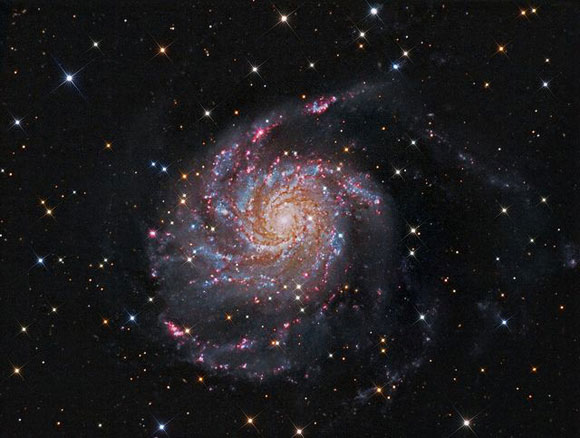
    Astronomers Examine the Physical Processes Involved in Generating Turbulence
    The galaxy M101 as seen in the optical and in the light of atomic hydrogen gas (red). The hydrogen lines reveal that the gas is rapidly moving and turbulent.

    A new study of turbulence in galaxies concludes that in many cases it is generated not by star formation but by gravitational effects alone.

    The gas in galaxies is typically seen to be moving at very rapid, even supersonic velocities, providing clear evidence that the medium is highly turbulent. Looking more closely at gas clouds in our own Milky Way, astronomers have similarly demonstrated using a variety of different observations that the interstellar medium is turbulent. Turbulence is a key physical parameter in the star formation process because, like the thermal pressure of warm gas, it counters the collapse of clouds into stars from gravitational contraction. Despite its importance and ubiquity, however, turbulence is poorly understood. Even its origin is far from clear. Some scientists argue that turbulence results from star formation itself, as new stars and their associated supernovae drive winds that stir up the interstellar medium. Other astronomers counter that the influence of gravity alone is enough to induce supersonic motions in gas as it moves through and across a rotating galaxy.

    CfA astronomer Blakesley Burkhart and her colleague examine in theoretical detail the physical processes involved in generating turbulence, and compare their conclusions with observations of galaxies. It has long been noted that the star formation rate in galaxies appears to correlate approximately with the spread of gas velocities seen in that galaxy. Indeed, that result was one of the reasons that a causal link between star formation and turbulence was proposed. The scientists point out, however, that if star formation were responsible for that spread then the correlation would be much tighter than is observed. Actually, the gravity-driven model of turbulence shows much better agreement with the data. For example, the latter has no trouble reproducing galaxies with very high velocities yet having very low star formation rates; in these situations, there is just not much gas to make new stars, but gravity nevertheless drives the fast motions. The scientists’ results are highly suggestive though not definitive, and very likely there are cases where both star formation and gravity play comparable roles. The authors conclude by discussing the limitations of the current observational dataset, and they suggest future measures to refine their conclusions, but in the meantime, they have demonstrated that turbulence has a more complicated origin than was typically thought.

    Reference: “Is Turbulence in the Interstellar Medium Driven by Feedback or Gravity? An Observational Test” by Mark R. Krumholz and Blakesley Burkhart, 5 March 2016,  MNRAS.
    DOI: 10.1093/mnras/stw434
    .

    Never miss a breakthrough: Join the SciTechDaily newsletter.
    Follow us on Google and Google News.

    Astronomy Astrophysics Cosmology Harvard-Smithsonian Center for Astrophysics Turbulence
    Share. Facebook Twitter Pinterest LinkedIn Email Reddit

    Related Articles

    Webb’s Mysterious “Little Red Dots” May Be the Cradle of the First Black Holes

    Mysterious Radio Signals Reveal What’s Hiding Between Galaxies

    Cosmic Mystery Solved: Astronomers Have Discovered the Universe’s “Missing” Matter

    Invisible Storm Lights Up Galaxy Cluster With Record-Breaking Radio Glow

    Astronomers Search for Trigger of Nearby Supernova

    Herschel Observations Help Identify the Physical Processes Underway in Cold, Dense Clouds

    CfA Scientists Measure the Rate of Expansion of the Universe

    New Study Challenges Planck Results

    Calculations Show the Ideal Time to Study the Cosmos

    1 Comment

    1. Jody on May 7, 2016 10:47 am

      What, are you living back in the horse-and-buggy days? The universe runs on electricity, that’s why you can’t understand gravity having so much influence, because it doesn’t.

      Reply
    Leave A Reply Cancel Reply

    • Facebook
    • Twitter
    • Pinterest
    • YouTube

    Don't Miss a Discovery

    Subscribe for the Latest in Science & Tech!

    Trending News

    Your Blood Pressure Reading Could Be Wrong Because of One Simple Mistake

    Astronomers Stunned by Ancient Galaxy With No Spin

    Physicists May Be on the Verge of Discovering “New Physics” at CERN

    Scientists Solve 320-Million-Year Mystery of Reptile Skin Armor

    Scientists Say This Daily Walking Habit May Be the Secret to Keeping Weight Off After Dieting

    New Therapy Rewires the Brain To Restore Joy in Depression Patients

    Giant Squid Detected off Western Australia in Stunning Deep-Sea Discovery

    Popular Sugar-Free Sweetener Linked to Liver Disease, Study Warns

    Follow SciTechDaily
    • Facebook
    • Twitter
    • YouTube
    • Pinterest
    • Newsletter
    • RSS
    SciTech News
    • Biology News
    • Chemistry News
    • Earth News
    • Health News
    • Physics News
    • Science News
    • Space News
    • Technology News
    Recent Posts
    • Hidden Warm Water Beneath Antarctica Could Rapidly Raise Global Sea Levels
    • Scientists Revive Ancient Chemistry Trick To Engineer Next-Generation Glass
    • Scientists Use AI To Supercharge Ultrafast Laser Simulations by More Than 250x
    • Scientists Just Found a Surprising Way To Destroy “Forever Chemicals”
    • Popular Supplement Ingredient Linked to Shorter Lifespan in Men
    Copyright © 1998 - 2026 SciTechDaily. All Rights Reserved.
    • Science News
    • About
    • Contact
    • Editorial Board
    • Privacy Policy
    • Terms of Use

    Type above and press Enter to search. Press Esc to cancel.