
Using Georgia State’s CHARA Array, an international team of scientists has uncovered unexpected complexity in how stars explode.
Astronomers have obtained images of two stellar explosions, called novae, just days after they erupted, capturing them in detail never achieved before. These observations show directly that novae are far more complex than scientists once believed, involving multiple streams of expelled material and, in some cases, long delays before that material is released.
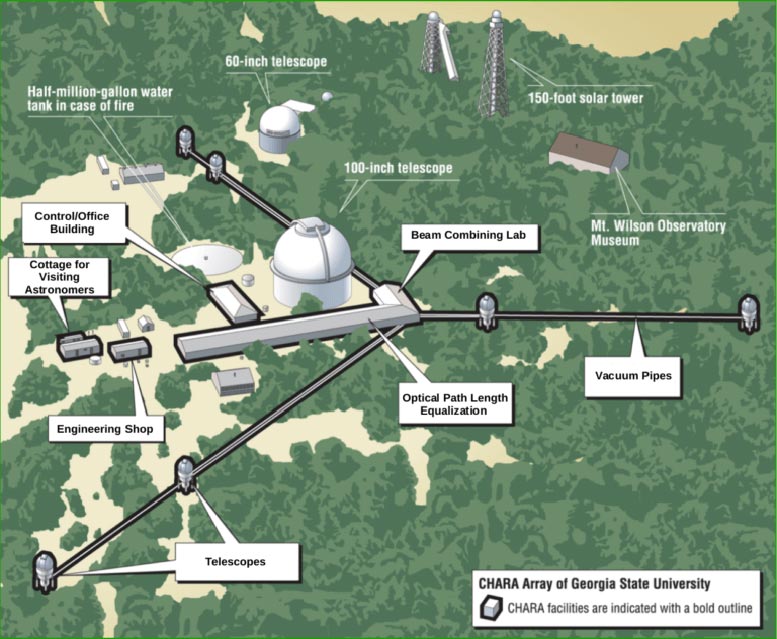
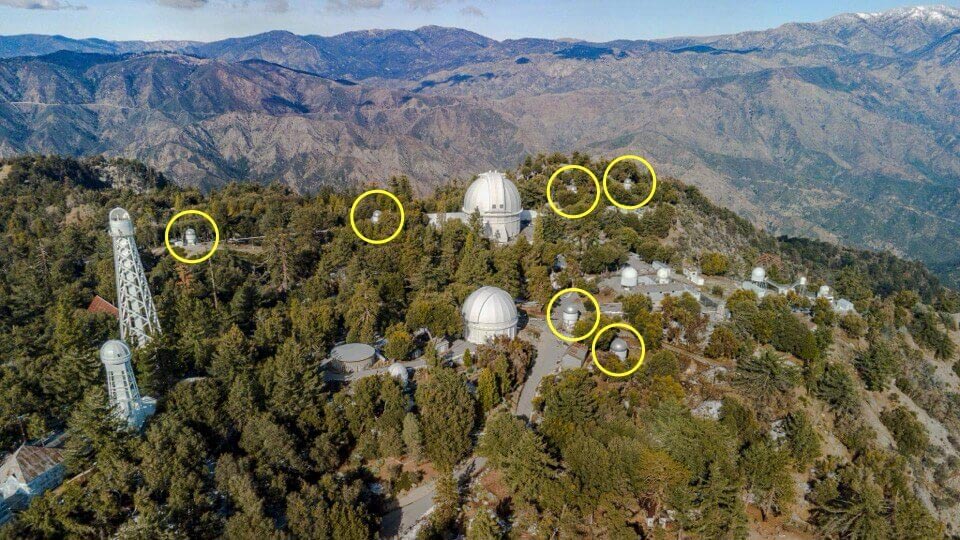
The international study, published in the journal Nature Astronomy, relied on a powerful observing method known as interferometry at the Center for High Angular Resolution Astronomy (CHARA Array) in California. By combining light from several telescopes, researchers achieved the extremely fine resolution needed to image these fast-changing events as they unfolded.
“The images give us a close-up view of how material is ejected away from the star during the explosion,” said Georgia State’s Gail Schaefer, director of the CHARA Array. “Catching these transient events requires flexibility to adapt our night-time schedule as new targets of opportunity are discovered.”
Novae happen when a compact stellar remnant called a white dwarf triggers a runaway nuclear reaction after pulling material from a nearby companion star. Until recently, astronomers had to rely on indirect clues to study the earliest phases of these eruptions, because the expanding debris appeared only as a single point of light.
Understanding how this expelled material is launched and how different flows collide is key to explaining how shock waves form in novae. Such shocks were first revealed by NASA’s Fermi Large Area Telescope (LAT). Over its first 15 years, Fermi-LAT detected GeV gamma-ray emission from more than 20 novae, confirming that these explosions can produce high-energy radiation and making them important targets for multi-messenger astronomy.
A Tale of Two Novae
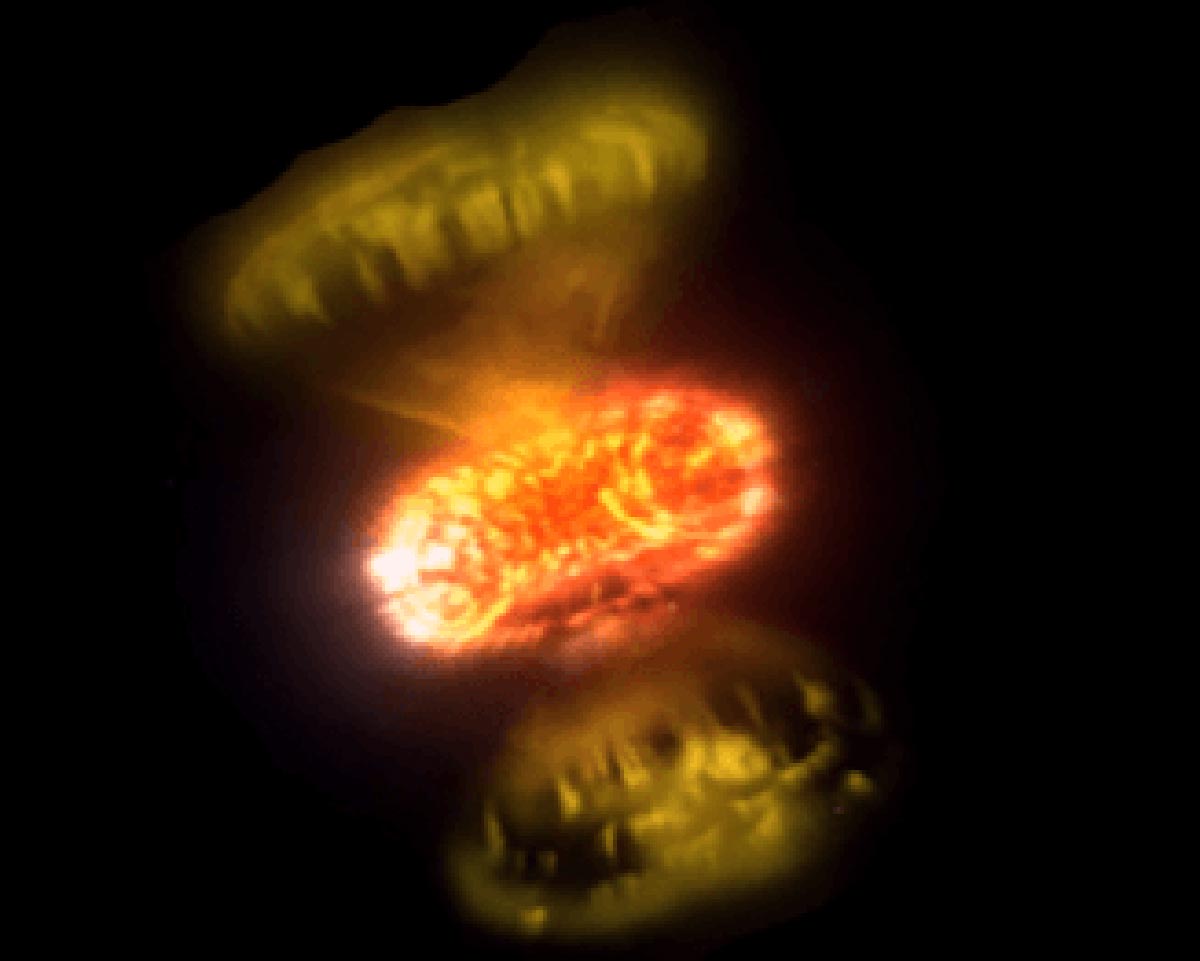
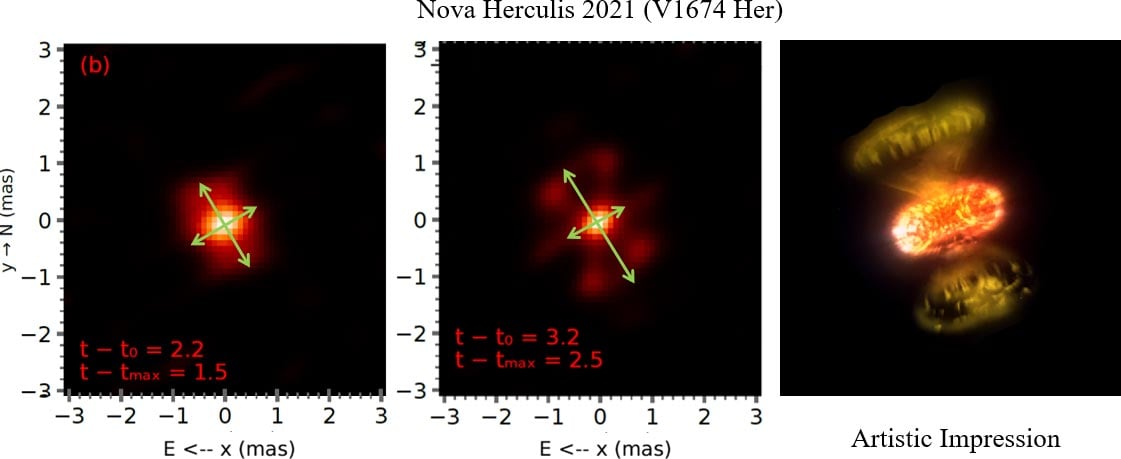
The researchers focused on two very different novae that erupted in 2021. The first, Nova V1674 Herculis, was one of the fastest ever observed, rising and fading over just a few days. Images showed two separate streams of gas flowing in perpendicular directions, indicating that the explosion involved multiple interacting outbursts. Notably, these structures appeared at the same time that NASA’s Fermi Gamma-ray Space Telescope detected gamma rays, directly linking the high-energy emission to collisions between the outflows.
The second object, Nova V1405 Cassiopeiae, behaved in a very different way. It evolved much more slowly and, unexpectedly, retained its outer layers for more than 50 days before releasing them. This observation provides the clearest evidence yet that some novae delay the expulsion of material. When the gas was finally ejected, new shock waves formed, once again producing gamma rays observed by NASA’s Fermi telescope.
“These observations allow us to watch a stellar explosion in real time, something that is very complicated and has long been thought to be extremely challenging,” said Elias Aydi, lead author of the study and a professor of physics and astronomy at Texas Tech University. “Instead of seeing just a simple flash of light, we’re now uncovering the true complexity of how these explosions unfold. It’s like going from a grainy black-and-white photo to high-definition video.”
Revealing Hidden Structures
The ability to resolve such fine detail comes from the use of interferometry, the same technique that made it possible to image the black hole at the center of our galaxy. These sharp images were further complemented by spectra from major observatories such as Gemini, which tracked the evolving fingerprints of the ejected gas. As new features appeared in the spectra, they lined up with the structures revealed in the interferometric images, providing a powerful one-to-one confirmation of how the flows were shaping and colliding.
“This is an extraordinary leap forward,” said John Monnier, a professor of astronomy at the University of Michigan, a co-author of the study and an expert in interferometric imaging. “The fact that we can now watch stars explode and immediately see the structure of the material being blasted into space is remarkable. It opens a new window into some of the most dramatic events in the universe.”
Implications for Stellar Physics
The results not only reveal unexpected complexity in novae but also help explain their powerful shock waves, which are known to produce high-energy radiation such as gamma rays. NASA’s Fermi telescope has been the key instrument in discovering this connection, establishing novae as natural laboratories for studying shock physics and particle acceleration.
“Novae are more than fireworks in our galaxy — they are laboratories for extreme physics,” said Professor Laura Chomiuk, a co-author from Michigan State University and an expert on stellar explosions. “By seeing how and when the material is ejected, we can finally connect the dots between the nuclear reactions on the star’s surface, the geometry of the ejected material, and the high-energy radiation we detect from space.”
The findings challenge the long-held view that nova eruptions are single, impulsive events. Instead, they point to a variety of ejection pathways, including multiple outflows and delayed envelope release, reshaping our understanding of these cosmic blasts.
“This is just the beginning,” Aydi said. “With more observations like these, we can finally start answering big questions about how stars live, die, and affect their surroundings. Novae, once seen as simple explosions, are turning out to be much richer and more fascinating than we imagined.”
Reference: “Multiple outflows and delayed ejections revealed by early imaging of novae” by Elias Aydi, John D. Monnier, Antoine Mérand, Gail H. Schaefer, Laura Chomiuk, Magdalena Otulakowska-Hypka, Jhih-Ling Fan, Kwan Lok Li, Kirill V. Sokolovsky, Ricardo Salinas, Michael Tucker, Benjamin Shappee, Richard Rudy, Kim L. Page, N. Paul M. Kuin, David A. H. Buckley, Peter Craig, Luca Izzo, Justin Linford, Brian D. Metzger, Koji Mukai, Marina Orio, Ken J. Shen, Jay Strader, Jennifer L. Sokoloski, Robert E. Williams, Montana N. Williams, Gesesew R. Habtie, Stefan Kraus, Narsireddy Anugu, Jean-Baptiste Le Bouquin, Sorabh Chhabra, Isabelle Codron, Tyler Gardner, Mayra Gutierrez, Noura Ibrahim, Cyprien Lanthermann, Benjamin R. Setterholm, Christopher Ashall, Jason T. Hinkle, Thomas de Jaeger and Anna V. Payne, 5 December 2025, Nature Astronomy.
DOI: 10.1038/s41550-025-02725-1
The observations of the two novae were obtained as part of the CHARA Array open-access program funded by the National Science Foundation under Grants No. AST-2034336 and AST-2407956. Institutional support for the CHARA Array is provided by Georgia State’s College of Arts & Sciences, Office of the Provost and Office of the Vice President for Research and Economic Development.
Never miss a breakthrough: Join the SciTechDaily newsletter.
Follow us on Google and Google News.