
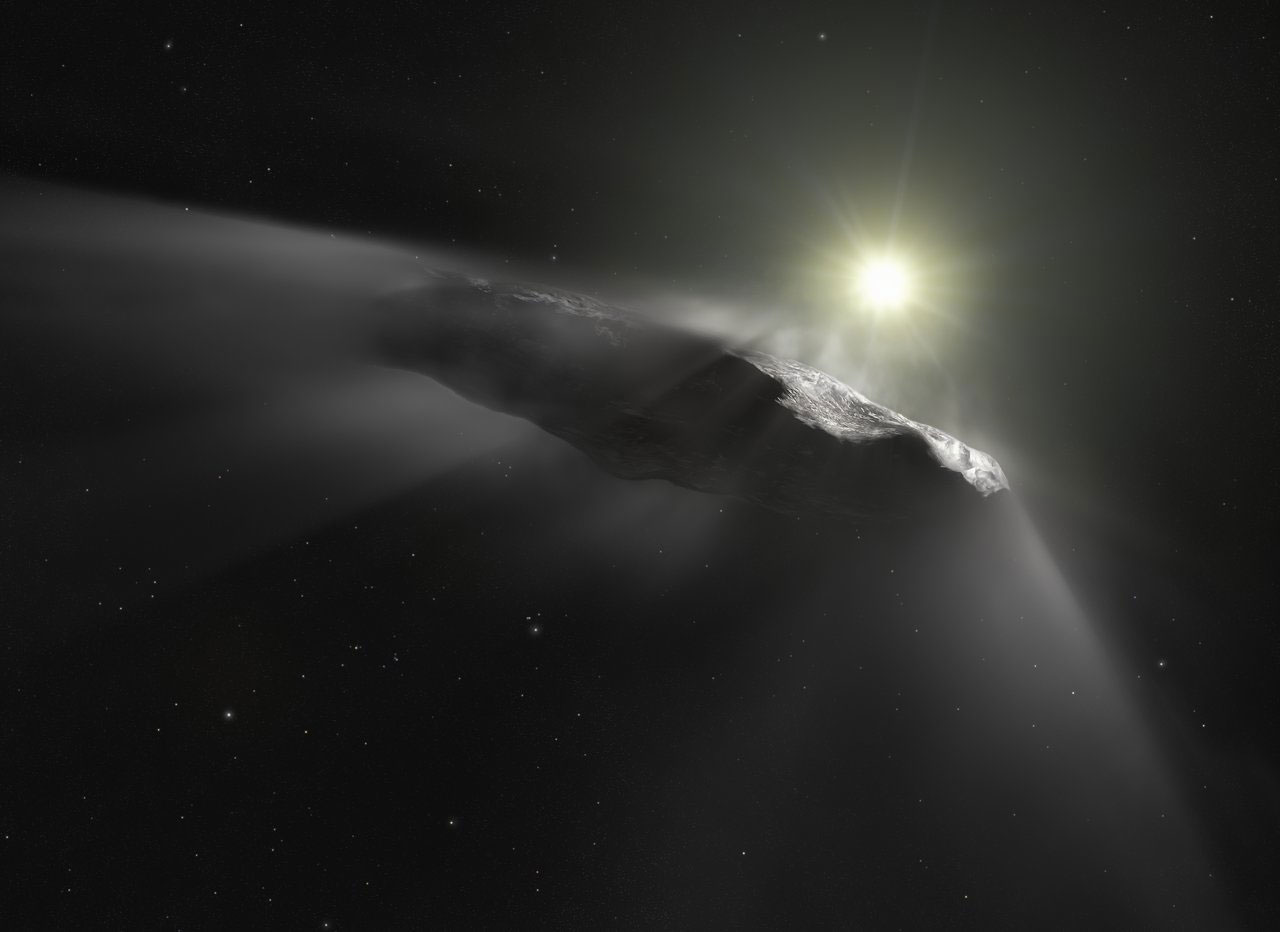
Using data from ESA’s Gaia stellar surveyor, astronomers have identified four stars that are possible places of origin of ‘Oumuamua, an interstellar object spotted during a brief visit to our Solar System in 2017.
The discovery last year sparked a large observational campaign: originally identified as the first known interstellar asteroid, the small body was later revealed to be a comet, as further observations showed it was not slowing down as fast as it should have under gravity alone. The most likely explanation of the tiny variations recorded in its trajectory was that they are caused by gasses emanating from its surface, making it more akin to a comet.
But where in the Milky Way did this cosmic traveler come from?
Comets are leftovers of the formation of planetary systems, and it is possible that ‘Oumuamua was ejected from its home star’s realm while planets were still taking shape there. To look for its home, astronomers had to trace back in time not only the trajectory of the interstellar comet, but also a selection of stars that might have crossed paths with this object in the past few million years.
“Gaia is a powerful time machine for these types of studies, as it provides not only star positions but also their motions,” explains Timo Prusti, Gaia project scientist at ESA.
To this aim, a team of astronomers led by Coryn Bailer-Jones at the Max Planck Institute for Astronomy in Heidelberg, Germany, dived into the data from Gaia’s second release, which was made public in April.
The Gaia data contain positions, distance indicators, and motions in the sky for more than a billion stars in our Galaxy; most importantly, the data set includes radial velocities – how fast they are moving towards or away from us – for a subset of seven million, enabling a full reconstruction of their trajectories. The team looked at these seven million stars, complemented with an extra 220 000 for which radial velocities are available from the astronomical literature.
As a result, Coryn and colleagues identified four stars whose orbits had come within a couple of light-years of ‘Oumuamua in the near past, and with relative velocities low enough to be compatible with likely ejection mechanisms.
All four are dwarf stars – with masses similar to or smaller than our Sun’s – and had their ‘close’ encounter with the interstellar comet between one and seven million years ago. However, none of them is known to either harbor planets or to be part of a binary stellar system; a giant planet or companion star would be the preferred mechanism to have ejected the small body.
While future observations of these four stars might shed new light on their properties and potential to be the home system of ‘Oumuamua, the astronomers are also looking forward to future releases of Gaia data. At least two are planned in the 2020s, which will include a much larger sample of radial velocities, enabling them to reconstruct and investigate the trajectories of many more stars.
“While it’s still early to pinpoint ‘Oumuamua’s home star, this result illustrates the power of Gaia to delve into the history of our Milky Way galaxy,” concludes Timo.
Reference: “Plausible home stars of the interstellar object ‘Oumuamua found in GaiaDR2” by Coryn A. L. Bailer-Jones, Davide Farnocchia, Karen J. Meech, Ramon Brasser, Marco Micheli, Sukanya Chakrabarti, Marc W. Buie and Olivier R. Hainaut, 16 October 2018, The Astrophysical Journal.
DOI: 10.3847/1538-3881/aae3eb
Never miss a breakthrough: Join the SciTechDaily newsletter.
Follow us on Google and Google News.
1 Comment
That’s amazing as I’m from the old ‘Barnard’s ‘Run Away’star days but not as old as Pluto’s discovery.