
Close Menu
    Facebook X (Twitter) Instagram
    SciTechDaily
    • Biology
    • Chemistry
    • Earth
    • Health
    • Physics
    • Science
    • Space
    • Technology
    Facebook X (Twitter) Pinterest YouTube RSS
    SciTechDaily
    Home»Space»Astronomers Map Galaxy Orbits in the Local Supercluster
    Space

    Astronomers Map Galaxy Orbits in the Local Supercluster

    By University Of HawaiiDecember 8, 2017No Comments3 Mins Read
    Facebook Twitter Pinterest Telegram LinkedIn WhatsApp Email Reddit
    Share
    Facebook Twitter LinkedIn Pinterest Telegram Email Reddit
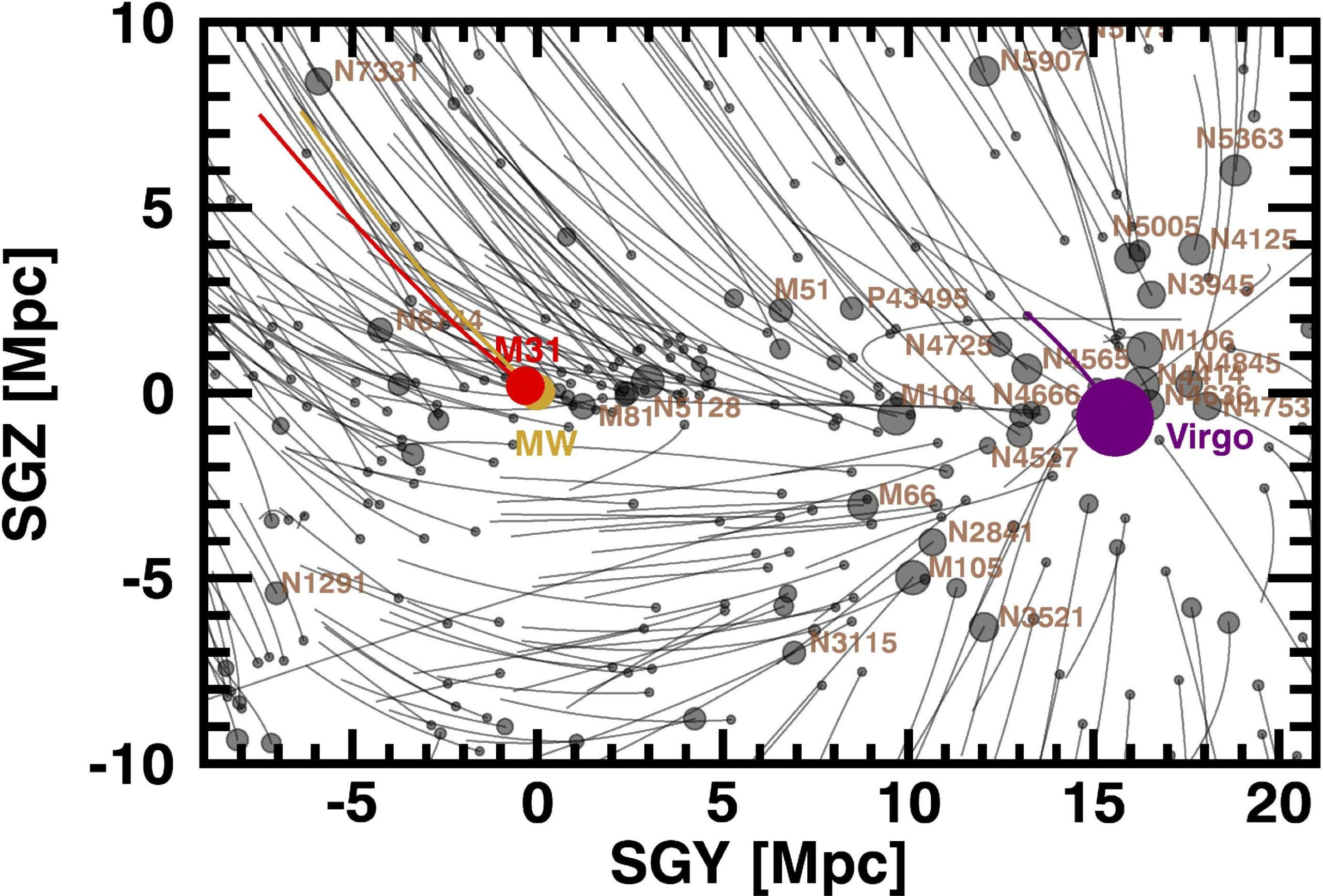
    Galaxy Orbits in the Local Supercluster Map
    Orbits of galaxies in the Local Supercluster. Our home Milky Way galaxy (MW, yellow) and our companion Andromeda galaxy (M31, red) are participating in a downward flow away from a vast underdense region called the Local Void and toward the Virgo Cluster, represented by the purple spherecircle. Most galaxies between us and the Virgo Cluster will eventually fall into the cluster but we lie slightly beyond the capture zone. Credit: R. Brent Tully

    A team of astronomers from Maryland, Hawaii, Israel, and France has produced the most detailed map ever of the orbits of galaxies in our extended local neighborhood, showing the past motions of almost 1400 galaxies within 100 million light-years of the Milky Way.

    The team reconstructed the galaxies’ motions from 13 billion years in the past to the present day. The main gravitational attractor in the mapped area is the Virgo Cluster, with 600 trillion times the mass of the Sun, 50 million light years from us. Over a thousand galaxies have already fallen into the Virgo Cluster, while in the future all galaxies that are currently within 40 million light-years of the cluster will be captured. Our Milky Way galaxy lies just outside this capture zone. However, the Milky Way and Andromeda galaxies, each with 2 trillion times the mass of the Sun, are destined to collide and merge in 5 billion years.

    “For the first time, we are not only visualizing the detailed structure of our Local Supercluster of galaxies but we are seeing how the structure developed over the history of the universe. An analogy is the study of the current geography of the Earth from the movement of plate tectonics,” said co-author Brent Tully, from the University of Hawaii Institute for Astronomy.

    These dramatic merger events are only part of a larger show. There are two overarching flow patterns within this volume of the universe. All galaxies in one hemisphere of the region – including our own Milky Way – are streaming toward a single flat sheet. In addition, essentially every galaxy over the whole volume is flowing, as a leaf would in a river, toward gravitational attractors at far greater distances.

    Representations of the orbits can be seen in a video (above) and, alternatively, with an interactive model (below). With the interactive model, a viewer can pan, zoom, rotate, and pause/activate the time evolution of movement along orbits. The orbits are shown in a reference frame that removes the overall expansion of the universe. What we are seeing are the deviations from cosmic expansion caused by the interactions of local sources of gravity.

    The study, Action Dynamics of the Local Supercluster is published in the December 4 issue of The Astrophysical Journal. It is based on the measurement of 18,000 galaxy distances and a novel method for determining orbits called numerical action. The lead author, Ed Shaya of the University of Maryland, conducted this research in collaboration with Brent Tully, University of Hawaii, Yehuda Hoffman, Hebrew University in Israel, and Daniel Pomarede, University of Paris-Saclay in France.

    Reference: “Action Dynamics of the Local Supercluster” by Edward J. Shaya, R. Brent Tully, Yehuda Hoffman and Daniel Pomarède, 4 December 2017, The Astrophysical Journal.
    DOI: 10.3847/1538-4357/aa9525

    Never miss a breakthrough: Join the SciTechDaily newsletter.
    Follow us on Google and Google News.

    Astronomy Astrophysics Cosmology University of Hawaii
    Share. Facebook Twitter Pinterest LinkedIn Email Reddit

    Related Articles

    Astronomers Unravel Long-Standing Cosmic Mystery

    Distortion of Space-Time Helps Astronomers Set New Magnification Record

    12 Billion-Year Old Supernova Discovered by Astronomers

    Dark Matter Filament in Galaxy Supercluster Directly Measured

    Calculations Show the Ideal Time to Study the Cosmos

    Lyman-Alpha Blobs are Some of the Largest Individual Objects in the Observable Universe

    Links Between Core Collapse Supernovae and Star Formation Established

    The Bolshoi Simulation: Boxing the Universe

    Baryon Oscillation Spectroscopic Survey Measures the Universe’s Expansion and Dark Energy

    Leave A Reply Cancel Reply

    • Facebook
    • Twitter
    • Pinterest
    • YouTube

    Don't Miss a Discovery

    Subscribe for the Latest in Science & Tech!

    Trending News

    Breakthrough Bowel Cancer Trial Leaves Patients Cancer-Free for Nearly 3 Years

    Natural Compound Shows Powerful Potential Against Rheumatoid Arthritis

    100,000-Year-Old Neanderthal Fossils in Poland Reveal Unexpected Genetic Connections

    Simple “Gut Reset” May Prevent Weight Gain After Ozempic or Wegovy

    2.8 Days to Disaster: Scientists Warn Low Earth Orbit Could Suddenly Collapse

    Common Food Compound Shows Surprising Power Against Superbugs

    5 Simple Ways To Remember More and Forget Less

    The Atomic Gap That Could Cost the Semiconductor Industry Billions

    Follow SciTechDaily
    • Facebook
    • Twitter
    • YouTube
    • Pinterest
    • Newsletter
    • RSS
    SciTech News
    • Biology News
    • Chemistry News
    • Earth News
    • Health News
    • Physics News
    • Science News
    • Space News
    • Technology News
    Recent Posts
    • NASA Satellite Captures First-Ever High-Res View of Massive Pacific Tsunami
    • ADHD Isn’t Just a Deficit: Study Reveals Powerful Hidden Strengths
    • Scientists Uncover “Astonishing” Hidden Property of Light
    • Scientists Discover Stem Cells That Could Regrow Teeth and Bone
    • Scientists Discover Natural Molecule That Stops Alzheimer’s Protein Clumps From Forming
    Copyright © 1998 - 2026 SciTechDaily. All Rights Reserved.
    • Science News
    • About
    • Contact
    • Editorial Board
    • Privacy Policy
    • Terms of Use

    Type above and press Enter to search. Press Esc to cancel.