
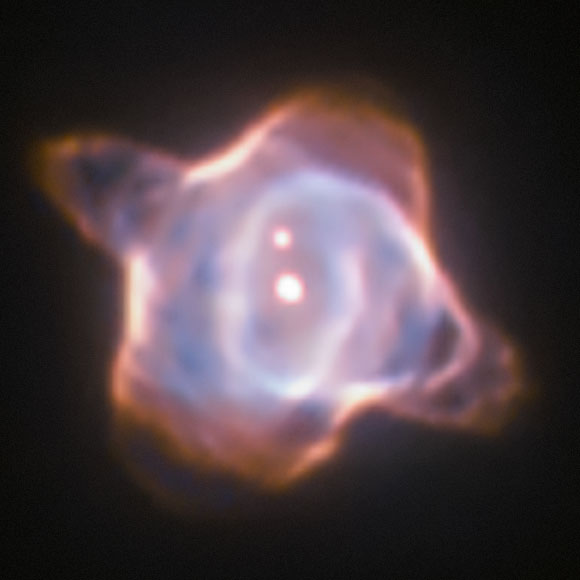
Using the Hubble Space Telescope, an international team of astronomers has been able to study stellar evolution in real time. Over a period of 30 years dramatic increases in the temperature of the star SAO 244567 have been observed. Now the star is cooling again, having been reborn into an earlier phase of stellar evolution. This makes it the first reborn star to have been observed during both the heating and cooling stages of rebirth.
Even though the Universe is constantly changing, most processes are too slow to be observed within a human lifespan. But now an international team of astronomers have observed an exception to this rule. “SAO 244567 is one of the rare examples of a star that allows us to witness stellar evolution in real time”, explains Nicole Reindl from the University of Leicester, UK, lead author of the study. “Over only twenty years the star has doubled its temperature and it was possible to watch the star ionizing its previously ejected envelope, which is now known as the Stingray Nebula.”
SAO 244567, 2700 light-years from Earth, is the central star of the Stingray Nebula and has been visibly evolving between observations made over the last 45 years. Between 1971 and 2002 the surface temperature of the star skyrocketed by almost 40,000 degrees Celsius. Now new observations made with the Cosmic Origins Spectrograph (COS) on the NASA/ESA Hubble Space Telescope have revealed that SAO 244567 has started to cool and expand.
This is unusual, though not unheard of, and the rapid heating could easily be explained if one assumed that SAO 244567 had an initial mass of 3 to 4 times the mass of the Sun. However, the data show that SAO 244567 must have had an original mass similar to that of our Sun. Such low-mass stars usually evolve on much longer timescales, so the rapid heating has been a mystery for decades.
This animation shows the fast evolution of SAO 244567. The animation starts 10,300 BC, with the star having a radius 152 times the size of the Sun and a surface temperature of about 3500 degrees Celsius (63,000 degrees Fahrenheit), giving it its orange color. At this point of its life the star had already lost half of its initial mass.
After 10,000 years the star slowly shrinks to only 40 times the size of the Sun; at the same time, its temperature rises to 6800 degrees Celsius (12,300 degrees Fahrenheit), causing its color to change to white-yellow. As the star heats up to about 20,000 degrees Celsius (36,000 degrees Fahrenheit)) Helium fusion inside the star suddenly gets re-ignited — the late thermal pulse.
After the flash the star heats quickly and becomes a blue-white star with a temperature of 21,000 degrees Celsius (38,000 degrees Fahrenheit), only 4 times larger than the Sun. SAO 244567 shrinks further till it is only a third the size of the Sun and has a temperature of 60,000 degrees Celsius (108,000 degrees Fahrenheit); this status was reached in the year 2002. Now new observations show that the star is still blue and hot — with about 50,000 degrees Celsius (90,000 degrees Fahrenheit) — but started to expand again: its size is about two third of our Sun.
Within the next few hundred years, SAO 244567 will expand back to its giant dimensions and also change its color to orange — as shown at the end of the animation.
Back in 2014 Reindl and her team proposed a theory that resolved the issue of both SAO 244567’s rapid increase in temperature as well as the low mass of the star. They suggested that the heating was due to what is known as a helium-shell flash event: a brief ignition of helium outside the stellar core.
This theory has very clear implications for SAO 244567’s future: if it has indeed experienced such a flash, then this would force the central star to begin to expand and cool again — it would return back to the previous phase of its evolution. This is exactly what the new observations confirmed. As Reindl explains: “The release of nuclear energy by the flash forces the already very compact star to expand back to giant dimensions — the born-again scenario.”
It is not the only example of such a star, but it is the first time ever that a star has been observed during both the heating and cooling stages of such a transformation.
Yet no current stellar evolutionary models can fully explain SAO 244567’s behavior. As Reindl elaborates: “We need refined calculations to explain some still mysterious details in the behavior of SAO 244567. These could not only help us to better understand the star itself but could also provide a deeper insight in the evolution of central stars of planetary nebulae.”
Until astronomers develop more refined models for the life cycles of stars, aspects of SAO 244567’s evolution will remain a mystery.
Reference: “Breaking news from the HST: The central star of the Stingray Nebula is now returning towards the AGB” by Nicole Reindl, T. Rauch, M. M. Miller Bertolami and H. Todt, K. Werner, 12 September 2016, MNRAS Letters.
DOI: 10.1093/mnrasl/slw175
Never miss a breakthrough: Join the SciTechDaily newsletter.
Follow us on Google and Google News.
1 Comment
Outflows are ubiquitous in astrophysics. Despite different sizes, velocity and amount of transported energy, luminosity and degree of collimation, they have obvious morphological similarities. However, what is important for us, there is the picture of the outflows from everywhere and none of inflows into somewhere. That is an obvious asymmetry.