
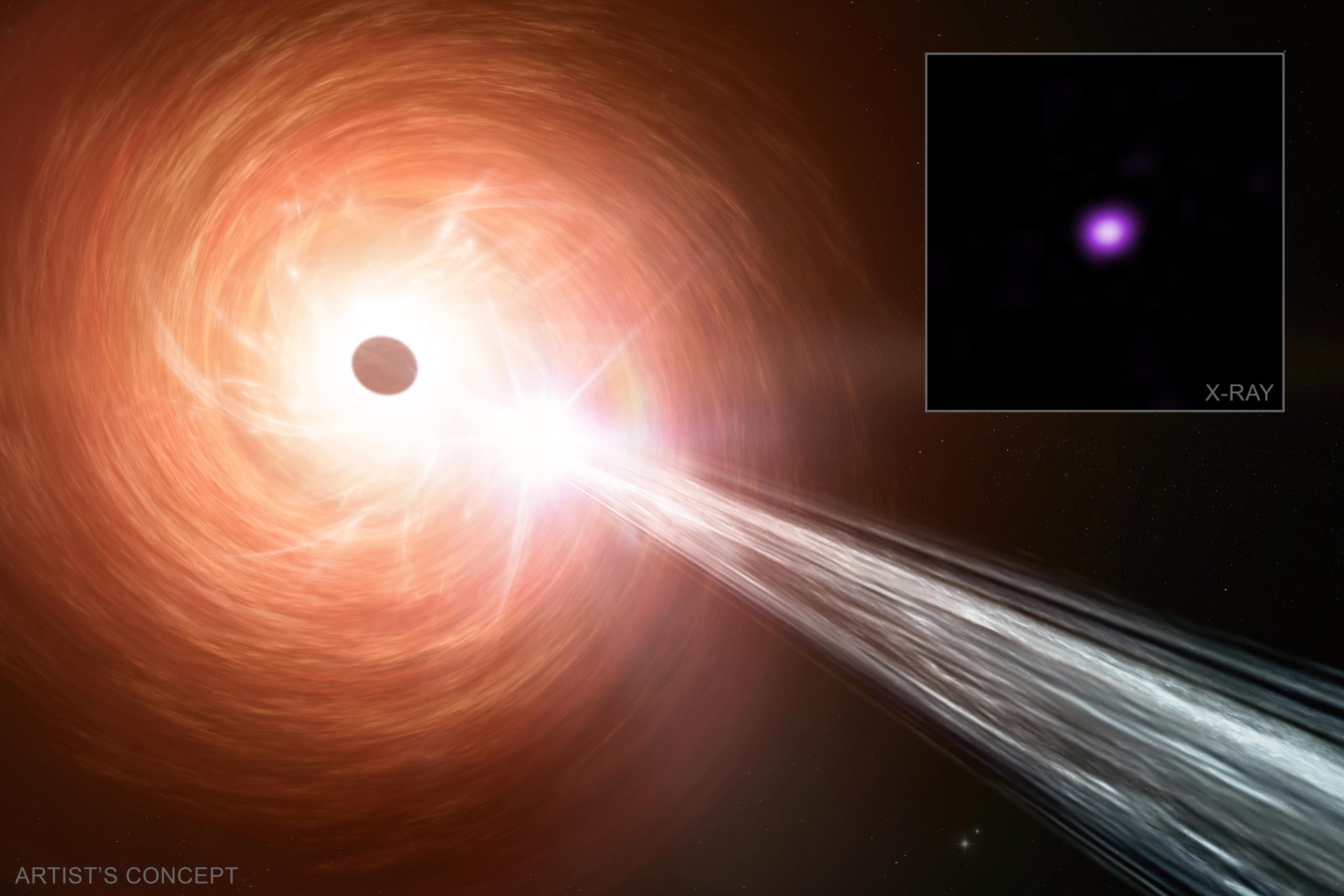
A black hole in a distant quasar is growing faster than the usual limit, according to Chandra observations. This may explain how the first supermassive black holes emerged.
Astronomers have identified a black hole growing at one of the fastest rates ever observed. The finding, made with NASA’s Chandra X-ray Observatory, may help clarify how certain black holes were able to gain such immense mass relatively soon after the Big Bang.
This particular black hole is about a billion times heavier than the Sun and lies roughly 12.8 billion light-years away. Because of this distance, astronomers are viewing it as it was only 920 million years after the universe began. It emits more X-rays than any other black hole yet detected within the universe’s first billion years.
Quasar RACS J0320-35 and its unusual growth
The black hole fuels what scientists classify as a quasar, a brilliant celestial object that shines brighter than entire galaxies. Its extraordinary luminosity comes from the vast amounts of material spiraling around and being pulled into the black hole.
Although the quasar was first discovered by the same research team two years ago, new Chandra observations in 2023 revealed what makes RACS J0320-35 unique. The X-ray results show that its black hole is growing at a pace that surpasses the typical threshold expected for such objects.
“It was a bit shocking to see this black hole growing by leaps and bounds,” said Luca Ighina of the Center for Astrophysics | Harvard & Smithsonian in Cambridge, Massachusetts, who led the study.
Understanding the Eddington limit
As matter is drawn toward a black hole, it becomes heated and emits powerful radiation across a wide range of wavelengths, including X-rays and visible light. This radiation pushes back against the material that is falling in. Once the inflow of matter reaches a certain threshold, the outward pressure from radiation counteracts the black hole’s gravitational pull, preventing material from falling in any faster. This upper limit is known as the Eddington limit.
Researchers suggest that black holes growing at slower rates than this limit must have been born with initial masses of at least 10,000 Suns to reach a billion solar masses within the first billion years after the Big Bang, as seen with RACS J0320-35. One way such a massive black hole could form at birth is through an unusual event: the collapse of a vast gas cloud that contained very few elements heavier than helium, a set of conditions thought to be extremely uncommon.
Possible origins and growth scenarios
If RACS J0320-35 is indeed growing at a high rate — estimated at 2.4 times the Eddington limit — and has done so for a sustained amount of time, its black hole could have started out in a more conventional way, with a mass less than a hundred Suns, caused by the implosion of a massive star.
“By knowing the mass of the black hole and working out how quickly it’s growing, we’re able to work backward to estimate how massive it could have been at birth,” said co-author Alberto Moretti of INAF-Osservatorio Astronomico di Brera in Italy. “With this calculation, we can now test different ideas on how black holes are born.”
To figure out how fast this black hole is growing (between 300 and 3,000 Suns per year), the researchers compared theoretical models with the X-ray signature, or spectrum, from Chandra, which gives the amounts of X-rays at different energies. They found the Chandra spectrum closely matched what they expected from models of a black hole growing faster than the Eddington limit. Data from optical and infrared light also support the interpretation that this black hole is packing on weight faster than the Eddington limit allows.
Insights into cosmic mysteries
“How did the universe create the first generation of black holes?” said co-author Thomas Connor, also of the Center for Astrophysics. “This remains one of the biggest questions in astrophysics and this one object is helping us chase down the answer.”
Another scientific mystery addressed by this result concerns the cause of jets of particles that move away from some black holes at close to the speed of light, as seen in RACS J0320-35. Jets like this are rare for quasars, which may mean that the rapid rate of growth of the black hole is somehow contributing to the creation of these jets.
The quasar was previously discovered as part of a radio telescope survey using the Australian Square Kilometer Array Pathfinder, combined with optical data from the Dark Energy Camera, an instrument mounted on the Victor M. Blanco 4-meter Telescope at the Cerro Tololo Inter-American Observatory in Chile. The U.S. National Science Foundation National Optical-Infrared Astronomy Research Laboratory’s Gemini-South Telescope on Cerro Pachon, Chile was used to obtain the accurate distance of RACS J0320-35.
Reference: “X-Ray Investigation of Possible Super-Eddington Accretion in a Radio-loud Quasar at z = 6.13” by Luca Ighina, Alessandro Caccianiga, Thomas Connor, Alberto Moretti, Fabio Pacucci, Cormac Reynolds, José Afonso, Bruno Arsioli, Silvia Belladitta, Jess W. Broderick, Daniele Dallacasa, Roberto Della Ceca, Francesco Haardt, Erini Lambrides, James K. Leung, Alessandro Lupi, Israel Matute, Fabio Rigamonti, Paola Severgnini, Nick Seymour, Fabrizio Tavecchio and Cristian Vignali, 8 September 2025, The Astrophysical Journal Letters.
DOI: 10.3847/2041-8213/aded0a
NASA’s Marshall Space Flight Center in Huntsville, Alabama, manages the Chandra program. The Smithsonian Astrophysical Observatory’s Chandra X-ray Center controls science operations from Cambridge, and flight operations from Burlington, Massachusetts.
Never miss a breakthrough: Join the SciTechDaily newsletter.
Follow us on Google and Google News.
2 Comments
До горизонта событий Черная Дыра притянет все до чего дотянется силой притяжения. особенно если тело не успело разогнавшись по орбите стабилизироваться. Но при больших скоростях вращения по орбите, и причин для торможения больше, и звезды просто разрывает, собственное вращение. А притянутое к горизонту событий тело постепенно разбирает на частицы, остужает в гонке по диску, и присоединят к своей массе. Если излучение сильно яркое, то и диск толще чем обычно. Но в горячем виде массу черной дыре нельзя всасывать. Аппетит этим и ограничен.
There are other explanations for the super-Eddington luminosity growth, aside from a rapidly swelling black hole accreting matter, such as radiation-driven instabilities, e.g. in compact gases surrounding young, massive stars. The same is true for the jet production. Yet the possibilities from published work have been almost solely limited to a central accreting black hole, and when the models don’t fit, they are adjusted to accommodate, such as moving the seed masses down to intermediate or low mass ranges.