
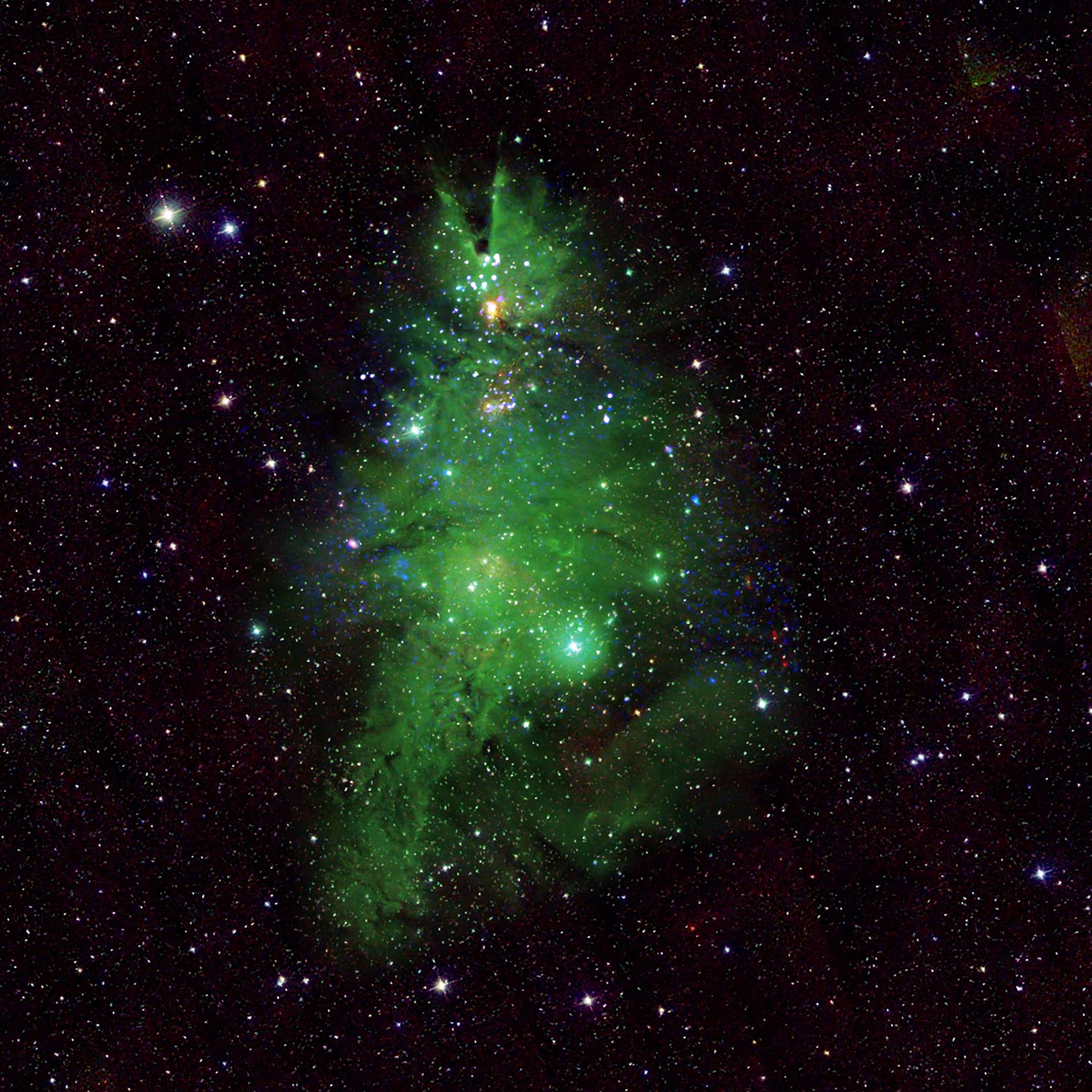
NGC 2264, the “Christmas Tree Cluster,” is a star cluster in the Milky Way, depicted in a newly enhanced image to resemble a cosmic Christmas tree.
- NGC 2264 is a cluster of young stars that has been colored and rotated to emphasize its nickname of the “Christmas Tree Cluster.”
- This composite image contains X-rays from Chandra (blue and white), optical data from WIYN (green gas), and infrared data from 2MASS (white stars).
- The stars in this cluster are between one and five million years old, compared to the Sun’s age of 5 billion years old.
- Young stars are volatile and produce strong flares in X-rays and other types of light, but not in any coordinated way as is shown in the animation.
Cosmic Christmas Tree: NGC 2264’s Stellar Spectacle
This new image of NGC 2264, also known as the “Christmas Tree Cluster,” shows the shape of a cosmic tree with the glow of stellar lights. NGC 2264 is, in fact, a cluster of young stars — with ages between about one and five million years old — in our Milky Way about 2,500 light-years away from Earth. The stars in NGC 2264 are both smaller and larger than the Sun, ranging from some with less than a tenth the mass of the Sun to others containing about seven solar masses.
A Festive Composite Image: Colors and Rotation
This new composite image enhances the resemblance to a Christmas tree through choices of color and rotation. The blue and white lights (which blink in the animated version — see video below) are young stars that give off X-rays detected by NASA’s Chandra X-ray Observatory. Optical data from the National Science Foundation-supported WIYN 0.9-meter telescope on Kitt Peak shows a nebula of gas in the cluster in green, corresponding to the “pine needles” of the tree. Finally, infrared data from the Two Micron All Sky Survey shows foreground and background stars in white. This image has been rotated clockwise by 160 degrees from the astronomer’s standard of North pointing upward, so that it appears like the top of the tree is toward the top of the image.
This composite image shows the Christmas Tree Cluster. The blue and white lights (which blink in the animated version of this image) are young stars that give off X-rays detected by NASA’s Chandra X-ray Observatory. Optical data from the National Science Foundation’s WIYN 0.9-meter telescope on Kitt Peak shows gas in the nebula in green, corresponding to the “pine needles” of the tree, and infrared data from the Two Micron All Sky Survey shows foreground and background stars in white. This image has been rotated clockwise by about 160 degrees from the astronomer’s standard of North pointing upward, so that it appears like the top of the tree is toward the top of the image.
Stellar Dynamics and Observation Techniques
Young stars, like those in NGC 2264, are volatile and produce strong flares in X-rays and other types of variations seen at different wavelengths of light. The coordinated, blinking variations shown in this animation, however, are artificial, to emphasize the locations of the stars seen in X-rays and highlight the similarity of this object to a Christmas tree. In reality the variations of the stars are not synchronized.
The variations observed by Chandra and other telescopes are caused by several different processes. Some of these are related to activity involving magnetic fields, including flares like those undergone by the Sun — but much more powerful — and hot spots and dark regions on the surfaces of the stars that go in and out of view as the stars rotate. There can also be changes in the thickness of gas obscuring the stars, and changes in the amount of material still falling onto the stars from disks of surrounding gas.
NASA’s Marshall Space Flight Center manages the Chandra program. The Smithsonian Astrophysical Observatory’s Chandra X-ray Center controls science operations from Cambridge, Massachusetts, and flight operations from Burlington, Massachusetts.
Never miss a breakthrough: Join the SciTechDaily newsletter.
Follow us on Google and Google News.