
Close Menu
    Facebook X (Twitter) Instagram
    SciTechDaily
    • Biology
    • Chemistry
    • Earth
    • Health
    • Physics
    • Science
    • Space
    • Technology
    Facebook X (Twitter) Pinterest YouTube RSS
    SciTechDaily
    Home»Space»Astrophysicists Reveal Amount of Dark Matter is Less Than Previously Thought
    Space

    Astrophysicists Reveal Amount of Dark Matter is Less Than Previously Thought

    By International Center for Radio Astronomy ResearchOctober 9, 2014No Comments3 Mins Read
    Facebook Twitter Pinterest Telegram LinkedIn WhatsApp Email Reddit
    Share
    Facebook Twitter LinkedIn Pinterest Telegram Email Reddit
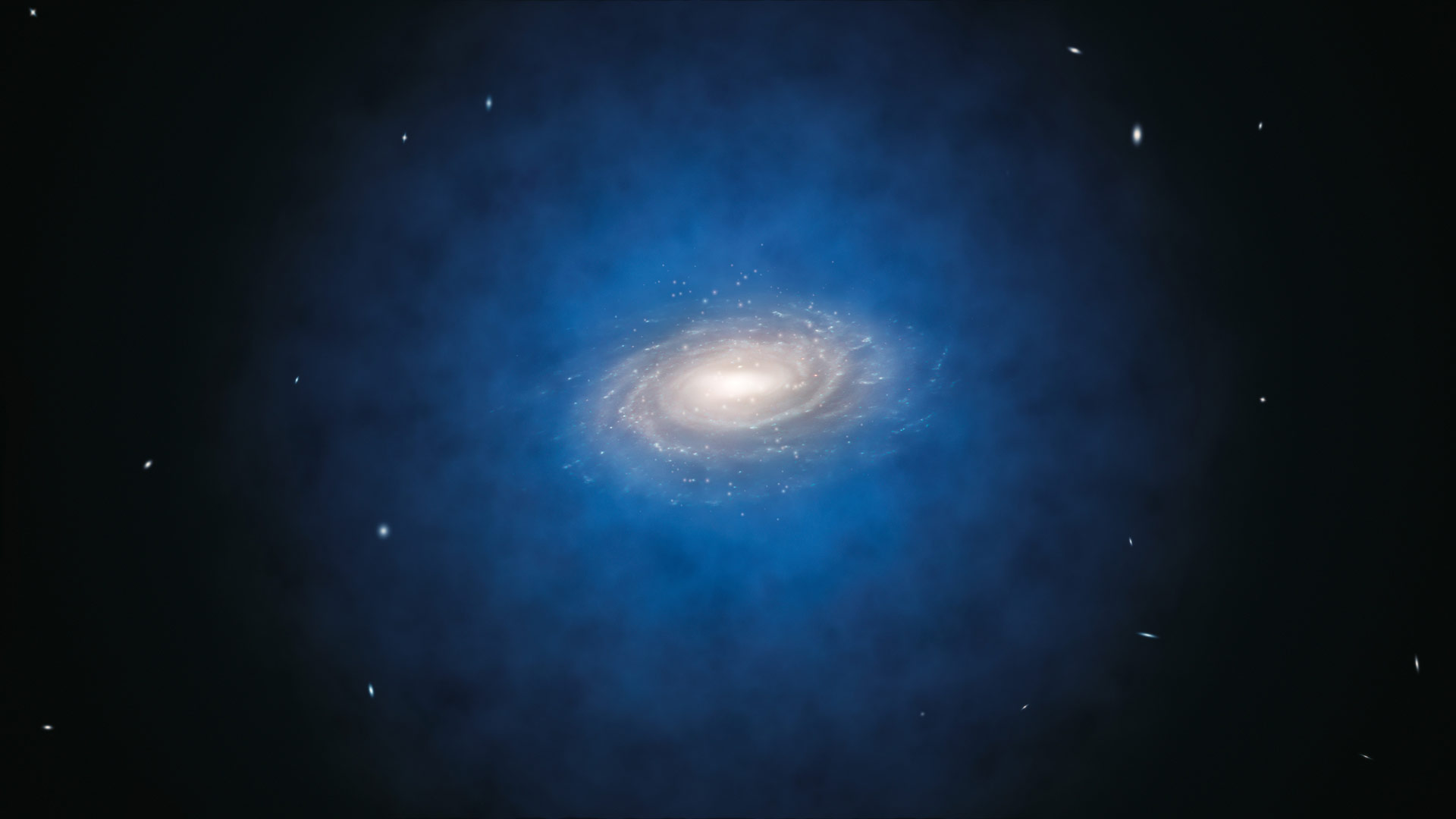
    Dark Matter Distribution Around the Milky Way
    Artist’s impression of the Milky Way and its dark matter halo (shown in blue, but in reality invisible). Credit: ESO/L. Calçada

    New research from the University of Western Australia reveals that the amount of dark matter in the Milky Way is half as much as previously thought.

    Australian astronomers used a method developed almost 100 years ago to discover that the weight of dark matter in our own galaxy is 800,000,000,000 (or 8 x 10¹¹) times the mass of the Sun.

    They probed the edge of the Milky Way, looking closely, for the first time, at the fringes of the galaxy about 5 million billion kilometers from Earth.

    Astrophysicist Dr. Prajwal Kafle, from The University of Western Australia node of the International Center for Radio Astronomy Research, said we have known for a while that most of the Universe is hidden.

    “Stars, dust, you and me, all the things that we see, only make up about 4 percent of the entire Universe,” he said.

    “About 25 percent is dark matter and the rest is dark energy.”

    Dr. Kafle, who is originally from Nepal, was able to measure the mass of the dark matter in the Milky Way by studying the speed of stars throughout the galaxy, including the edges, which had never been studied to this detail before.


    This animation shows a supercomputer simulation of a galaxy like the Milky Way and its invisible dark matter halo. We zoom in to the galaxy and can see knots of dark matter where we would expect to see many satellite galaxies, but they don’t exist in the real Universe. That’s the missing satellite problem. Credit: Prof Chris Power and Dr Rick Newton, ICRAR. Music by Reuben Christman

    He used a robust technique developed by British astronomer James Jeans in 1915 — decades before the discovery of dark matter.

    Dr. Kafle’s measurement helps to solve a mystery that has been haunting theorists for almost two decades.

    “The current idea of galaxy formation and evolution, called the Lambda Cold Dark Matter theory, predicts that there should be a handful of big satellite galaxies around the Milky Way that are visible with the naked eye, but we don’t see that,” Dr Kafle said.

    “When you use our measurement of the mass of the dark matter the theory predicts that there should only be three satellite galaxies out there, which is exactly what we see; the Large Magellanic Cloud, the Small Magellanic Cloud, and the Sagittarius Dwarf Galaxy.”

    University of Sydney astrophysicist Professor Geraint Lewis, who was also involved in the research, said the missing satellite problem had been “a thorn in the cosmological side for almost 15 years.”

    “Dr. Kafle’s work has shown that it might not be as bad as everyone thought, although there are still problems to overcome,” he said.

    The study also presented a holistic model of the Milky Way, which allowed the scientists to measure several interesting things such as the speed required to leave the galaxy.

    “Be prepared to hit 550 kilometers per second (1.2 million mph) if you want to escape the gravitational clutches of our galaxy,” Dr Kafle said.

    “A rocket launched from Earth needs just 11 kilometers per second (24,600 mph) to leave its surface, which is already about 300 times faster than the maximum Australian speed limit in a car!”

    Reference: “On the Shoulders of Giants: Properties of the Stellar Halo and the Milky Way Mass Distribution” by Prajwal R. Kafle, Sanjib Sharma, Geraint F. Lewis and Joss Bland-Hawthorn, 24 September 2014, The Astrophysical Journal.
    DOI: 10.1088/0004-637X/794/1/59
    arXiv: 1408.1787


    Never miss a breakthrough: Join the SciTechDaily newsletter.
    Follow us on Google and Google News.

    Astronomy Astrophysics Dark Matter International Center for Radio Astronomy Research
    Share. Facebook Twitter Pinterest LinkedIn Email Reddit

    Related Articles

    Scientists Have Discovered a Unique and Powerful Dark Matter Detector

    New All-Sky Map of Milky Way’s Outer Reaches Released – Could Offer a New Test of Dark Matter Theories

    Whispers From the Dark Side: What Gravitational Waves Can Reveal About Dark Matter

    New Research Finds That Supermassive Black Holes Could Form From Dark Matter

    X-Ray Emission From Mysterious Dark Matter

    Light From Inside Galaxy Clusters May Be Linked With Mysterious Form of Matter

    Extended Dark Matter Halo Detected Around Ancient Dwarf Galaxy – “First Signature of Galactic Cannibalism”

    The Universe Is Getting Hot, Hot, Hot – Temperature Has Increased 10-Fold Over the Last 10 Billion Years

    Milky Way’s Dark Side Revealed by Measurements of Pulsar Acceleration

    Leave A Reply Cancel Reply

    • Facebook
    • Twitter
    • Pinterest
    • YouTube

    Don't Miss a Discovery

    Subscribe for the Latest in Science & Tech!

    Trending News

    Scientists Warn That This Common Pet Fish Can Wreck Entire Ecosystems

    Scientists Make Breakthrough in Turning Plastic Trash Into Clean Fuel Using Sunlight

    This Popular Supplement May Interfere With Cancer Treatment, Scientists Warn

    Scientists Finally Solved One of Water’s Biggest Mysteries

    Could This New Weight-Loss Pill Disrupt the Entire Market? Here’s What You Should Know About Orforglipron

    Earth’s Crust Is Tearing Open in Africa, and It Could Form a New Ocean

    Breakthrough Bowel Cancer Trial Leaves Patients Cancer-Free for Nearly 3 Years

    Natural Compound Shows Powerful Potential Against Rheumatoid Arthritis

    Follow SciTechDaily
    • Facebook
    • Twitter
    • YouTube
    • Pinterest
    • Newsletter
    • RSS
    SciTech News
    • Biology News
    • Chemistry News
    • Earth News
    • Health News
    • Physics News
    • Science News
    • Space News
    • Technology News
    Recent Posts
    • Ancient Roman Ship Coating Reveals Secrets Hidden for 2,200 Years
    • Enormous Prehistoric Insects Puzzle Scientists
    • College Student Identifies Bizarre New Carnivorous Dinosaur Three Times Older Than T. rex
    • The Most Effective Knee Arthritis Treatments Aren’t What You Expect
    • Scientists Develop Bioengineered Chewing Gum That Could Help Fight Oral Cancer
    Copyright © 1998 - 2026 SciTechDaily. All Rights Reserved.
    • Science News
    • About
    • Contact
    • Editorial Board
    • Privacy Policy
    • Terms of Use

    Type above and press Enter to search. Press Esc to cancel.