
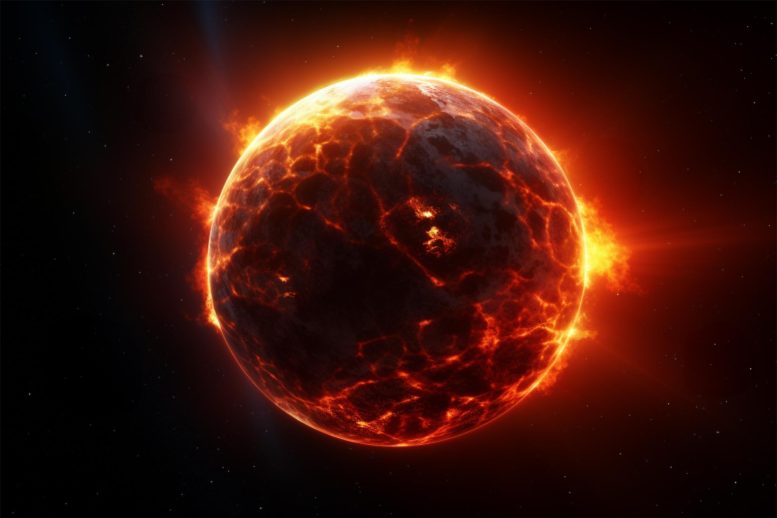
Study reveals how magma oceans may affect the evolution of hot exoplanets.
Lava worlds, massive exoplanets home to sparkling skies and roiling volcanic seas called magma oceans, are distinctly unlike the planets in our solar system.
To date, nearly 50% of all rocky exoplanets yet discovered have been found capable of maintaining magma on their surfaces, likely because these planets are so close to their host stars they orbit in fewer than 10 days. Being so close causes the planet to be bombarded by harsh weather and forces surface temperatures to the extreme, making it all but completely inhospitable to life as we know it today.
Molten Oceans’ Influence
Now, in a new study, scientists have shown that these sweeping molten oceans have a large influence on the observed properties of hot rocky Super-Earths, such as their size and evolutionary path.
Their research, published recently in The Astrophysical Journal, found that due to lava’s extremely compressible nature, oceans of magma can cause lava-rich planets without atmospheres to be modestly denser than similarly sized solid planets as well as impact the structure of their mantles, the thick inner layer that surrounds a planet’s core.
Even so, since these objects are notoriously under-studied, it can be a difficult task to characterize the fundamental workings of lava planets, said Kiersten Boley. She is the lead author of the study and a graduate student in astronomy at The Ohio State University.
Detection and Understanding
“Lava worlds are very odd, very interesting things and because of the way we detect exoplanets, we’re more biased to finding them,” said Boley, whose research revolves around understanding what essential ingredients makes exoplanets unique and how tweaking those elements, or in the case of lava worlds, their temperatures, can completely change them.
One of the most well-known of these mysterious burning worlds is 55 Cancri e, an exoplanet about 41 light-years away that scientists describe as home to both sparkling skies and roiling lava seas.
While there are objects in our solar system, such as Jupiter’s moon Io, that are extremely volcanically active, there aren’t true lava planets in our stretch of the cosmos that scientists can get up close and personal to study. However, investigating how the composition of magma oceans contributes to the evolution of other planets, such as for how long they stay molten and for what reasons they eventually cool down, can offer clues into Earth’s own fiery history, said Boley.
“When planets initially form, particularly for rocky terrestrial planets, they go through a magma ocean stage as they’re cooling down,” said Boley. “So lava worlds can give us some insight into what may have happened in the evolution of nearly any terrestrial planet.”
Study Techniques and Findings
Using the exoplanet interior modeler software Exoplex and data collected from previous studies to construct a module that included information on several types of magma compositions, researchers simulated several evolutionary scenarios of an Earth-like planet with surface temperatures from between 2,600 and 3,860 degrees Fahrenheit (1,430 to 2,130 degrees Celsius) – the melting point at which the planet’s solid mantle would turn to liquid.
From the models they created, the team was able to discern that mantles of magma ocean planets can take on one of three forms: the first in which the entire mantle is completely molten, the second where a magma ocean lies on the surface, and a third sandwich-esque model that consists of a magma ocean at the surface, a solid rock layer in the middle and another layer of molten magma that lies closest to the planet’s core.
The results suggest that the second and third forms are slightly more common than planets that are completely molten. Depending on the composition of magma oceans, some atmosphere-free exoplanets are better than others at trapping volatile elements – compounds such as oxygen and carbon necessary to the formation of early atmospheres – for billions of years.
For example, the study notes that a basal magma class planet that is 4 times more massive than Earth can trap more than 130 times the mass of water than in Earth’s oceans today, and about 1,000 times the amount of carbon currently present in the planet’s surface and crust.
“When we’re talking about the evolution of a planet and its potential to have different elements that you would need to support life, being able to trap a lot of volatile elements within their mantles could have greater implications for habitability,” said Boley.
Implications for Habitability and Future Research
Lava planets are a long way from becoming habitable enough to support life, but it’s important to understand the processes that help these worlds get there. Nevertheless, this study makes clear that measuring their density isn’t exactly the best way to characterize these worlds when comparing them to solid exoplanets as a magma ocean neither significantly increases nor decreases its planet’s density, said Boley.
Instead, their research reveals that scientists should focus on other terrestrial parameters such as fluctuations in a planet’s surface gravity to test their theories about how hot lava worlds operate, especially if future researchers plan on using their data to aid in larger planetary studies.
“This work, which is a combination of earth sciences and astronomy, basically opens up exciting new questions about lava worlds,” said Boley.
Reference: “Fizzy Super-Earths: Impacts of Magma Composition on the Bulk Density and Structure of Lava Worlds” by Kiersten M. Boley, Wendy R. Panero, Cayman T. Unterborn, Joseph G. Schulze, Romy Rodríguez Martínez and Ji Wang, 7 September 2023, The Astrophysical Journal.
DOI: 10.3847/1538-4357/acea85
The study was supported by the National Science Foundation. Other co-authors are Wendy Panero, Joseph Schulze, Romy Martinez, and Ji Wang, all from Ohio State, as well as Cayman Unterborn from the Southwest Research Institute.
Never miss a breakthrough: Join the SciTechDaily newsletter.
Follow us on Google and Google News.