
Close Menu
    Facebook X (Twitter) Instagram
    SciTechDaily
    • Biology
    • Chemistry
    • Earth
    • Health
    • Physics
    • Science
    • Space
    • Technology
    Facebook X (Twitter) Pinterest YouTube RSS
    SciTechDaily
    Home»Space»Attack of the Galactic Clones
    Space

    Attack of the Galactic Clones

    By ESA/HubbleNovember 21, 20211 Comment2 Mins Read
    Facebook Twitter Pinterest Telegram LinkedIn WhatsApp Email Reddit
    Share
    Facebook Twitter LinkedIn Pinterest Telegram Email Reddit
    SGAS 0033+02
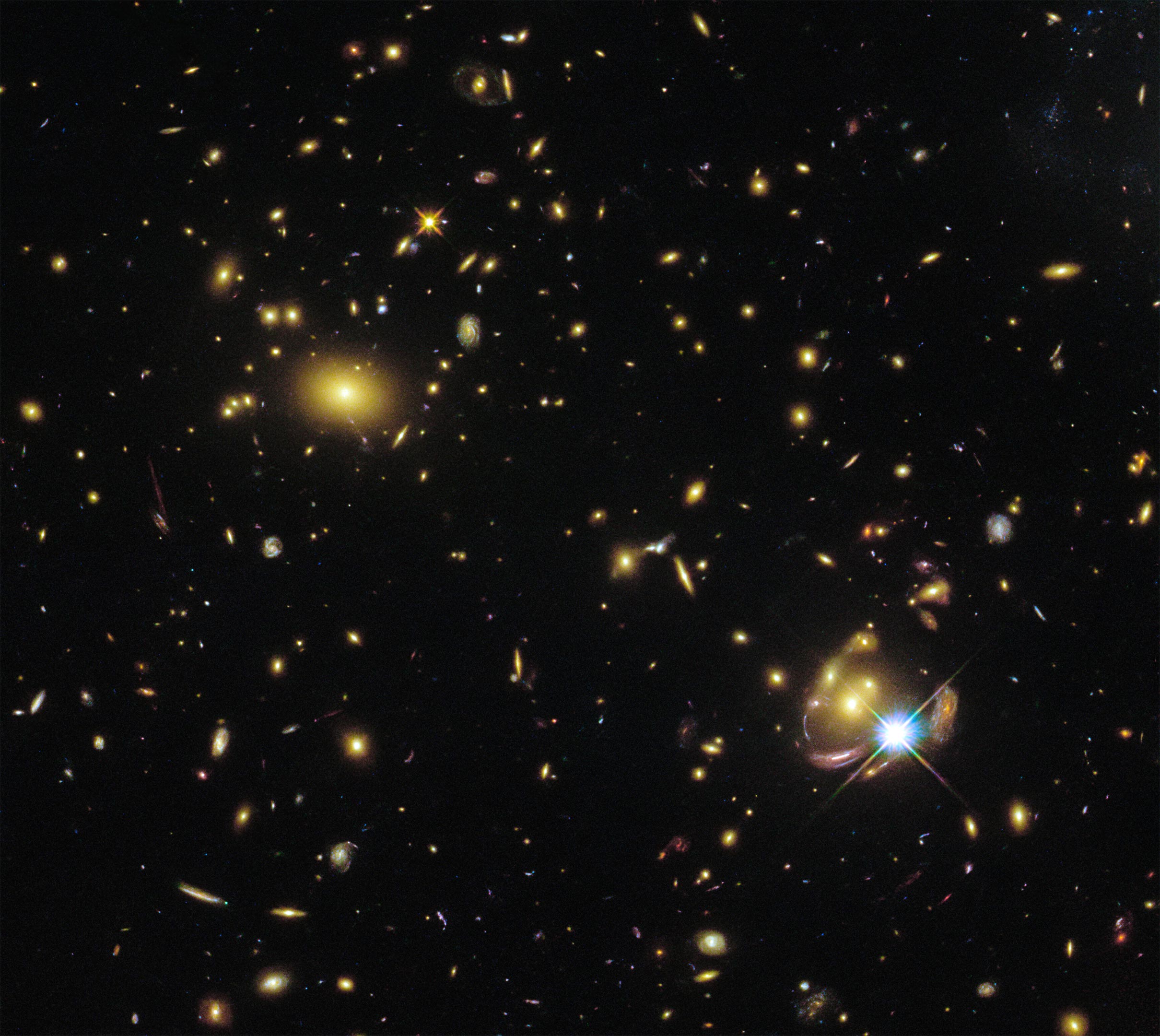
    The galaxy SGAS 0033+02 is visible multiple times in this image due to gravitational lensing. It appears as a curved arc just to the upper right of the very bright star, and also as two small round dots above and to the right of the star, respectively. Credit: ESA/Hubble & NASA, E. Wuyts

    Hubble spotted galaxy SGAS 0033+02 three times in one image, thanks to gravitational lensing and its rare alignment with a bright star.

    This star- and galaxy-studded image was captured by Hubble’s Wide Field Camera 3 (WFC3), using data that were collected for scientific purposes. The object of interest was a galaxy that is visible in the bottom left corner of the image, named SGAS 0033+02. What makes this particular galaxy interesting is a little unusual — it appears not just once in this image, but three times. The thrice-visible galaxy is a little difficult to spot: it appears once as a curved arc just to the upper right of the very bright star, and twice more as small round dots above the star and to the right of the star respectively.

    SGAS 0033+02’s multiple appearances in the same image are not the result of an error, but instead are due to a remarkable phenomenon known as gravitational lensing. Gravitational lensing occurs when the light from a very distant galaxy — such as SGAS 0033+02 — is curved (or ‘lensed’) by the gravity of a massive celestial object that lies in the foreground, between the distant galaxy and the Earth. SGAS 0033+02 was discovered by its namesake, the Sloan Giant Arcs Survey (SGAS), which aimed to identify highly magnified galaxies that were gravitationally lensed by foreground galaxy clusters. SGAS 0033+02 is of special interest because of its highly unusual proximity in the sky to a very bright star. The star is useful, because it can be used to calibrate and correct observations of the lensed SGAS 0033+02.

    Never miss a breakthrough: Join the SciTechDaily newsletter.
    Follow us on Google and Google News.

    Astronomy European Space Agency Hubble Space Telescope NASA
    Share. Facebook Twitter Pinterest LinkedIn Email Reddit

    Related Articles

    Hubble’s Newest Discovery Isn’t a Star, It’s a Window Into the Dark Universe

    This Nearby Galaxy Shows How Frozen Clouds Ignite Into Stars

    This Chaotic Spiral Galaxy Is Still Recovering From a Cosmic Collision

    This Strange Spiral Galaxy Is Hiding a Massive Black Hole

    Hubble Zooms In on a Galaxy That Maps the Universe’s Expansion

    Hubble Captures a Dazzling Spiral Galaxy Alive With Birth and Destruction

    Hubble Spots a Glowing “Ring of Fire” in a Distant Spiral Galaxy

    Dust, Light & Ancient Collisions: The Sombrero Galaxy Like You’ve Never Seen It

    Star Formation in Motion: Hubble Reveals Spiraling Stars and Sculpted Nebulae

    1 Comment

    1. John Smith on February 17, 2023 12:43 am

      This is quite remarkable.

      Reply
    Leave A Reply Cancel Reply

    • Facebook
    • Twitter
    • Pinterest
    • YouTube

    Don't Miss a Discovery

    Subscribe for the Latest in Science & Tech!

    Trending News

    Could Low Vitamin D Be Making Your Pain Worse?

    Scientists Discover Once-Weekly Workout That Melts Belly Fat Surprisingly Effectively

    Scientists Just Tested a Thruster Powerful Enough for Human Missions to Mars

    Doctors Say Your Ice Pack Might Be Making Injuries Worse

    Scientists Discover 43-Foot Sea Reptile Twice the Size of a Great White Shark

    Bees and Birds Are Drinking Alcohol From Flowers

    Scientists Discover How Obesity May Trigger Alzheimer’s Disease

    Scientists Confirm Alcohol Causes Widespread Health Damage

    Follow SciTechDaily
    • Facebook
    • Twitter
    • YouTube
    • Pinterest
    • Newsletter
    • RSS
    SciTech News
    • Biology News
    • Chemistry News
    • Earth News
    • Health News
    • Physics News
    • Science News
    • Space News
    • Technology News
    Recent Posts
    • Just Minutes of Intense Exercise Could Slash Disease Risk by 50%
    • People Who Stop Ozempic Often Don’t Gain the Weight Back
    • Why More People in Their 30s Are Suddenly Getting Colon Cancer
    • Scientists Discover Sperm Seem To Bypass a Fundamental Law of Physics
    • The Secret Behind Indigenous Andeans’ “Digestive Superpower” May Be Potatoes
    Copyright © 1998 - 2026 SciTechDaily. All Rights Reserved.
    • Science News
    • About
    • Contact
    • Editorial Board
    • Privacy Policy
    • Terms of Use

    Type above and press Enter to search. Press Esc to cancel.