
Close Menu
    Facebook X (Twitter) Instagram
    SciTechDaily
    • Biology
    • Chemistry
    • Earth
    • Health
    • Physics
    • Science
    • Space
    • Technology
    Facebook X (Twitter) Pinterest YouTube RSS
    SciTechDaily
    Home»Space»Baseline Configuration of Ariane 6 Selected
    Space

    Baseline Configuration of Ariane 6 Selected

    By European Space AgencyJuly 9, 20131 Comment3 Mins Read
    Facebook Twitter Pinterest Telegram LinkedIn WhatsApp Email Reddit
    Share
    Facebook Twitter LinkedIn Pinterest Telegram Email Reddit
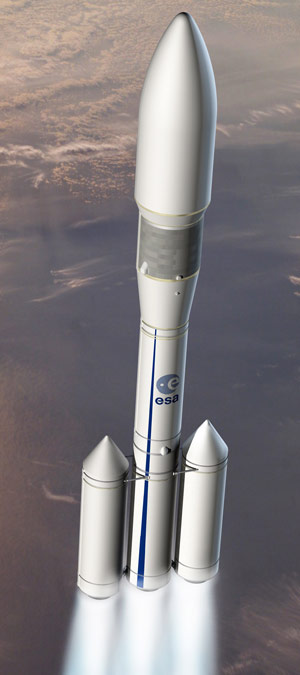
    Ariane 6 Baseline Configuration Selected
    Artist’s view of Ariane 6. Credit: ESA–D. Ducros, 2013

    The baseline configuration for Europe’s Ariane 6 launch vehicle has been selected.

    In November 2012, European Ministers responsible for space, meeting in Naples, Italy, approved the start of preparatory activities for Europe’s next-generation Ariane 6 launch vehicle.

    The objective of Ariane 6 is to maintain guaranteed autonomous access to space for Europe, while minimizing exploitation costs and suppressing any support to exploitation.

    The performance requested for the new launch vehicle was 3–6.5 tonnes in equivalent geostationary transfer orbit (GTO), to cover both governmental and commercial needs. The general configuration retained was ‘PPH’ – indicating the sequence of stages using solid propulsion, solid propulsion, and cryogenic propulsion.

    Ministers also requested that the new launch vehicle exploits maximum commonalities with the cryogenic reignitable upper stage of Ariane 5 ME.

    Process
    Seven months after ESA’s Ministerial Council decision, the project team of ESA, supported by CNES, has endorsed the final concept proposed by industry for the vehicle that will become Europe’s workhorse for reaching space in the 2020s and beyond.

    This concept was selected after six months of trade-off studies done by a ‘plateau project’ integrating industrial teams (Astrium, Avio, Herakles, and the participation of Safran, MT Aerospace, and others) working under ESA contract, consistent with Ministerial decisions mentioned above.

    The choice of configuration was made by consensus and based on the following main criteria: exploitation costs, time to market, and development costs.

    Ariane 6 will benefit from the advances by European industry in solid and cryogenic propulsion, structures, systems, avionics, ground segment, and operations through the Ariane and Vega programs.
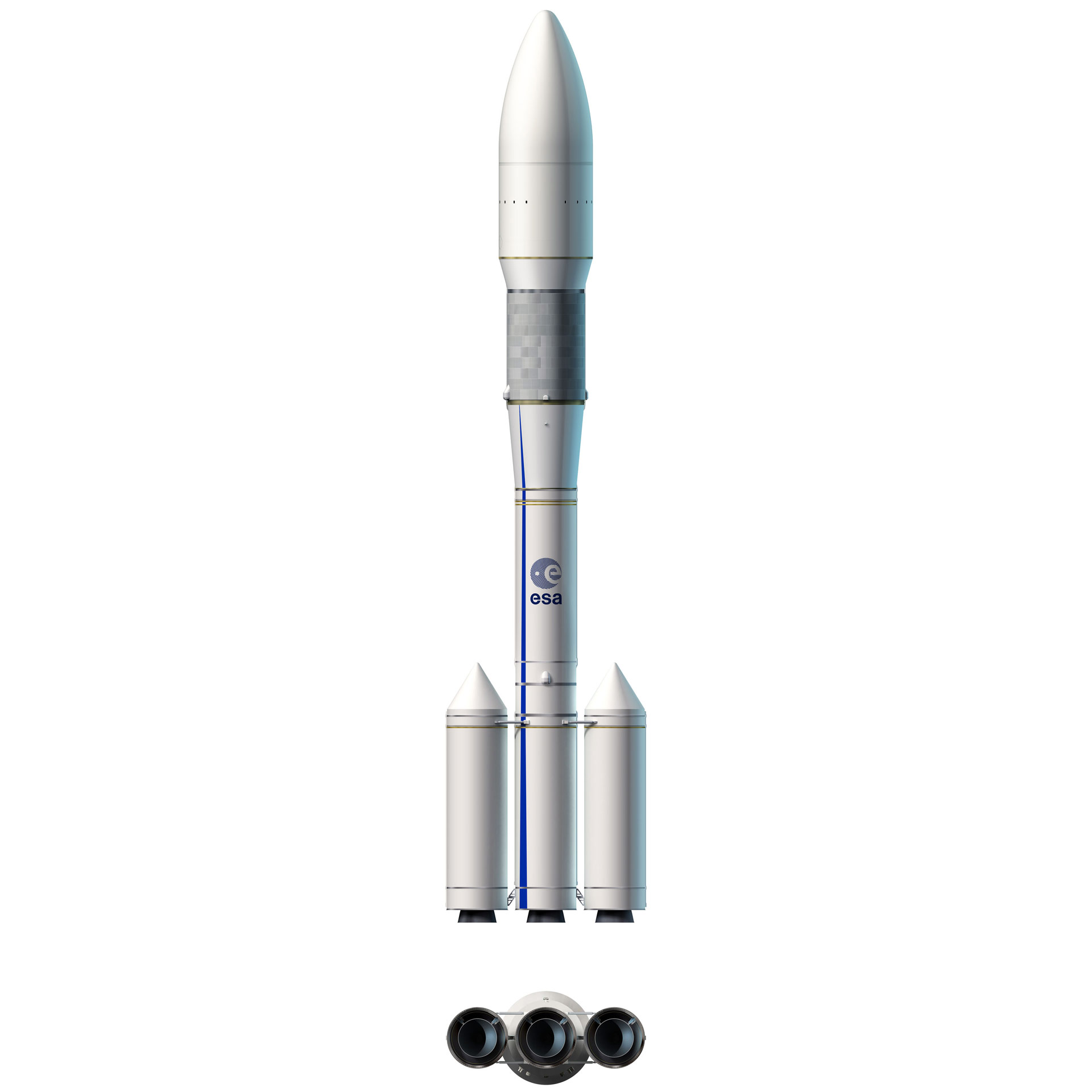
    Ariane 6
    ‘Multi P linear’ concept. Credit: ESA–D. Ducros, 2013

    Baseline Configuration Selected
    The selected ‘Multi P linear’ concept is based on a lower ‘composite’ of four motors, each loaded with around 135 tonnes of solid propellant, providing also synergies with the Vega evolution perspectives. An “in-line” arrangement of three will serve as the first stage, while the fourth will be mounted above as the second stage.

    The third stage will be an adapted version of the Ariane 5 ME upper stage, equipped with the Vinci engine and specific propellant tanks.

    The 5.4 m-diameter (17.7 ft) payload fairing will be able to accommodate the same volume of satellites as Ariane 5.

    Steps to October 2013
    The next step will be for ESA to consult with the industry to gather competing ideas on key work packages of the new launch system. The industry will have maximum flexibility for meeting the requirements.

    Consolidation of the current Phase A will take place at the Preliminary Requirements Review (PRR) in October 2013.

    Decisions taken by the ESA Council at Ministerial level in November 2012 are being implemented strictly and timely.


    Never miss a breakthrough: Join the SciTechDaily newsletter.
    Follow us on Google and Google News.

    European Space Agency Space Exploration Space Shuttle Spacecraft
    Share. Facebook Twitter Pinterest LinkedIn Email Reddit

    Related Articles

    Moon Bricks Will Pave the Way for Human Space Exploration

    ESA Sets Goals for Space Exploration

    ESA’s Vega Rocket Has Launched on Its Maiden Voyage, Carries 9 Satellites

    Orion Mockup Takes Final Splash Test

    NASA Plans Trajectory Maneuver for Mars Science Laboratory Spacecraft

    NASA Probe Takes Close-Up Photos of Giant Vesta Asteroid

    Russia’s Mars Probe will Come Down in January

    NASA’s Voyager 1 in “Cosmic Purgatory”

    Hubble Reaches New Milestone: 10,000th Scientific Paper Published

    1 Comment

    1. Michael Maddocks on July 9, 2013 10:56 am

      All I can say is this…
      http//i576.photobucket.com/albums/ss203/GarbageHaus/AustinPowers.png

      Reply
    Leave A Reply Cancel Reply

    • Facebook
    • Twitter
    • Pinterest
    • YouTube

    Don't Miss a Discovery

    Subscribe for the Latest in Science & Tech!

    Trending News

    Even Occasional Binge Drinking May Triple Liver Damage Risk

    Liftoff! NASA’s Artemis II Launch Sends Astronauts Around the Moon for First Time in 50 Years

    Scientists Discover New Way To Eliminate “Zombie Cells” Driving Aging

    This New Quantum Theory Could Change Everything We Know About the Big Bang

    This One Vitamin May Help Protect Your Brain From Dementia Years Later

    Stopping Weight-Loss Drugs Like Ozempic Can Quickly Erase Heart Benefits

    A 500-Million-Year-Old Surprise Is Forcing Scientists to Rethink Spider Evolution

    Coffee and Blood Pressure: What You Need To Know Before Your Next Cup

    Follow SciTechDaily
    • Facebook
    • Twitter
    • YouTube
    • Pinterest
    • Newsletter
    • RSS
    SciTech News
    • Biology News
    • Chemistry News
    • Earth News
    • Health News
    • Physics News
    • Science News
    • Space News
    • Technology News
    Recent Posts
    • Chemists Thought Phosphorus Was Fully Understood – They Were Wrong
    • Scientists Discover Strange Property of Rice and Turn It Into a Smart Material
    • New Water Filter Removes up to 98% of Hard-To-Catch “Forever Chemicals”
    • This Nearby Earth-Sized Planet Could Answer Big Questions About Alien Worlds
    • A Fiery Finale: How NASA’s Artemis II Moon Mission Returns to Earth
    Copyright © 1998 - 2026 SciTechDaily. All Rights Reserved.
    • Science News
    • About
    • Contact
    • Editorial Board
    • Privacy Policy
    • Terms of Use

    Type above and press Enter to search. Press Esc to cancel.