
Scientists elucidate the process through which synapses compete with each other, and describe how during development, weak and noisy synapses are eliminated during development.
Scientists from Kyushu University have uncovered the mechanisms underlying a crucial but often overlooked stage in brain development known as synaptic pruning.
The research team used mouse mitral cells, a kind of neuron in the olfactory system, for their study. They discovered that when neurons accept a neurotransmitter signal, the recipient dendrite is shielded via a sequence of chemical pathways. Simultaneously, the depolarization triggers other dendrites from the identical cell to follow a separate pathway that promotes pruning. The findings were recently published in the journal Developmental Cell.
How neurons connect and remodel themselves is a fundamental question in neurobiology. The key concept behind proper networking is in neurons forming and strengthening connection with other neurons while pruning excessive and incorrect ones.
“A common phrase in neural circuit remodeling is ‘fire together wire together’ and ‘out of sync, lose your link.’ The former describes how neurons that pass signals between each other tend to strengthen connections, whereas the latter explains that without said signaling that connection diminishes,” explains Professor Takeshi Imai from Kyushu University’s Faculty of Medical Sciences, who led the study. “It’s a refining process that is fundamental for proper brain maturation.”
Olfactory bulb of mouse two days after birth with fluorescence indicating signaling. The video shows that glomeruli, the signaling way station in the olfactory bulb, spontaneously send out signals. This spontaneous signaling will eventually lead to proper networking and pruning of mitral cells. The video was imaged ex vivo using two-photon microscopy. Credit: Kyushu University/Imai Lab
A Long-Standing Mystery in Neural Circuit Remodeling
Over the decades, researchers—including Prof Imai—have explored the fundamental process of how neurons form and strengthen their connections. However, there had been one major gap in the process that few people were examining: how the connections are eliminated.
“The elimination of neuronal connections, what we call pruning, was something everybody in the field knew about and observed. But if you look at the literature, there was a lack of study on the exact mechanism that drove the process,” explains first author Satoshi Fujimoto.
Elimination of connections happens everywhere in the nervous system, for example in neuromuscular junctions, the neurons that send signals to your muscles to move. At first, the muscle fibers receive inputs from many motor neurons. As you grow, these connections are finetuned, where some are strengthened, and others are eliminated, until just one neuron connects to one muscle fiber. It is why you have awkward motor control and coordination at an early age.

“We decided to investigate what exactly happens in neurons during remodeling, so, we looked into using mouse mitral cells, a type of cell housed in the olfactory bulb, the brain center involved in our sense of smell. In adults, mitral cells have a single connection to a signaling waystation called the glomerulus. But in early development mitral cells send branches into many glomeruli,” states Fujimoto. “As time progresses, these branches get pruned to leave a single strong connection. In the end, the mitral cells can sniff out only a specific type of smell.”
Glutamate in Pruning and Strengthening Connections
First, the team found that spontaneous waves of the neurotransmitter glutamate in the olfactory bulb facilitate dendrite pruning. The team then focused on the mitral cell’s inner signaling pathways. What they found was a unique protection/punishment machinery that would strengthen certain connections and kick off the pruning of others.
“We found that in the mitral cells it was the signaling from glutamate that was essential for pruning. When glutamate binds to its receptor NMDAR in a dendrite, it suppresses the pruning machinery molecule called RhoA,” continues Fujimoto. “This ‘save-me’ signal is important to protect it from pruning.”
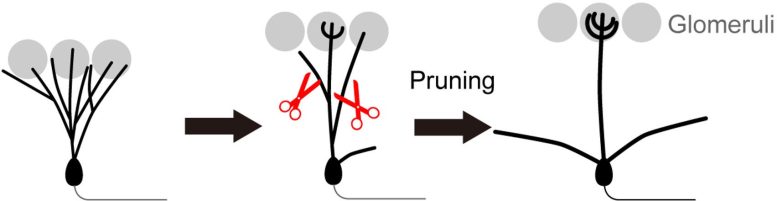
Upon the glutamate input, the mitral cell also depolarizes and fires a signal. The team also found that depolarization triggers the activation of RhoA in other dendrites of the same cell, and kicking off the pruning process. Simply put, the dendrite that receives the direct glutamate signal is protected, while the other dendrites get pruned.
“This ‘punishment’ signal for synapse elimination only acts on non-protected synapses, and it explains how only a strong connection becomes the winner and all the others mediating weak and noisy inputs become the losers,” Imai explains.
The team’s findings reveal new information about an over-looked but critical phase in neural development.
“Proper pruning of neuronal connections is just as important as the strengthening of the network. If it goes awry in either direction it can lead to different kinds of neurophysiological disorders. Too few connections have been linked to schizophrenia, whereas too many connections have been found in people with autism spectrum disorder, for example.” says Imai. “To understand these sorts of pathologies we need to look carefully at every step of development.”
Reference: “Activity-dependent local protection and lateral inhibition control synaptic competition in developing mitral cells in mice” by Satoshi Fujimoto, Marcus N. Leiwe, Shuhei Aihara, Richi Sakaguchi, Yuko Muroyama, Reiko Kobayakawa, Ko Kobayakawa, Tetsuichiro Saito and Takeshi Imai, 7 June 2023, Developmental Cell.
DOI: 10.1016/j.devcel.2023.05.004
Never miss a breakthrough: Join the SciTechDaily newsletter.
Follow us on Google and Google News.