
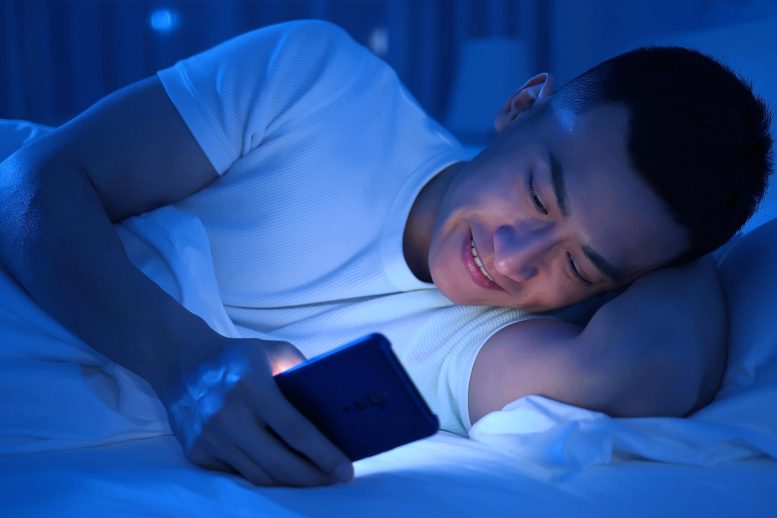
According to an Oregon State University study, the harm of blue light exposure rises with age.
According to a recent study from Oregon State University, the harmful consequences of daily, lifetime exposure to the blue light emitted by phones, computers, and home lighting become worse as people age.
The common fruit fly, Drosophila melanogaster, was used in the research, which was recently published in Nature Partner Journals Aging. Drosophila melanogaster is a useful model organism because it shares cellular and developmental mechanisms with humans and other animals.
Impact on Mitochondrial Function and Aging
A team led by Jaga Giebultowicz, a scientist at the OSU College of Science who specializes in biological clocks, studied the survival rate of flies maintained in darkness and then transferred to an environment of continual blue light from light-emitting diodes, or LEDs, at increasingly older ages.
The transitions from darkness to light happened at the ages of two, 20, 40, and 60 days, and the research focused on the impact of blue light on the mitochondria of the flies’ cells.
Mitochondria serve as a cell’s power plant, producing adenosine triphosphate, or ATP, a chemical energy source.
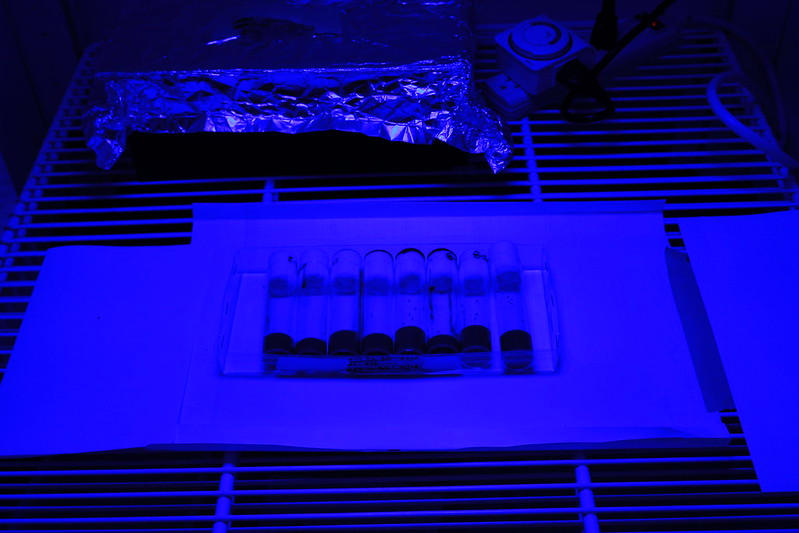
In earlier research, Giebultowicz showed that prolonged exposure to blue light affected flies’ longevity, regardless of whether it shined in their eyes.
Blue Light Impairs Energy Production in Cells
“The novel aspect of this new study is showing that chronic exposure to blue light can impair energy-producing pathways even in cells that are not specialized in sensing light,” Giebultowicz said. “We determined that specific reactions in mitochondria were dramatically reduced by blue light, while other reactions were decreased by age independent of blue light. You can think of it as blue light exposure adding insult to injury in aging flies.”
Yujuan Song, Jun Yang, David Hendrix, and Matthew Robinson from the OSU College of Science, as well as Alexander Law and Doris Kretzschmar from Oregon Health & Science University, worked with Giebultowicz on the study, which was partly funded by the National Institutes of Health.
Natural light is important for a person’s circadian rhythm, which is a 24-hour cycle of physiological activities that influence one’s eating and sleeping habits and include hormone production, brain wave activity, and cell regeneration.
Potential Health Risks of Long-Term Blue Light Exposure
But according to Giebultowicz, there is research that suggests that greater exposure to artificial light may be a risk factor for sleep and circadian disorders. Humans are also exposed to growing levels of blue light due to the widespread use of LED lights and device displays, which emit a high fraction of blue light.
“This technology, LED lighting, even in most developed countries, has not been used long enough to know its effects across the human lifespan,” she said. “There are increasing concerns that extended exposure to artificial light, especially blue-enriched LED light, may be detrimental to human health. While the full effects of blue light exposure across the lifespan are not yet known in humans, accelerated aging observed in short-lived model organisms should alert us to the potential of cellular damage by this stressor.”
In the meantime, there are a few things people can do to help themselves that don’t involve sitting for hours in darkness, the researchers say. Eyeglasses with amber lenses will filter out the blue light and protect your retinas. And phones, laptops, and other devices can be set to block blue emissions.
Age-Dependent Effects of Blue Light on Lifespan and Brain Health
“Our previous work demonstrated that daily lifelong exposure to blue light, but not other visible wavelengths, has damaging effects on the brain, motor abilities, and lifespan of the model organism,” Giebultowicz said. “Now we’re reporting that the damaging effects of blue light on the flies are strongly age-dependent – the same length of exposure to the same intensity of light decreases lifespan and increases neurodegeneration more significantly in old flies than in young ones.”
In the earlier research, flies subjected to daily cycles of 12 hours in light and 12 hours in darkness had shorter lives compared to flies kept in total darkness or those kept in light with the blue wavelengths filtered out.
The flies exposed to blue light showed damage to their retinal cells and brain neurons and had impaired locomotion – the flies’ ability to climb the walls of their enclosures, a common behavior, was diminished.
Some of the flies in the experiment were mutants that didn’t develop eyes, and even those eyeless flies displayed impairment, suggesting flies didn’t have to see the light to be harmed by it.
Reference: “Age-dependent effects of blue light exposure on lifespan, neurodegeneration, and mitochondria physiology in Drosophila melanogaster” by Yujuan Song, Jun Yang, Alexander D. Law, David A. Hendrix, Doris Kretzschmar, Matthew Robinson and Jadwiga M. Giebultowicz, 27 July 2022, Nature Partner Journals Aging.
DOI: 10.1038/s41514-022-00092-z
The study was funded by the National Institutes of Health.
Never miss a breakthrough: Join the SciTechDaily newsletter.
Follow us on Google and Google News.
5 Comments
Are they claiming that exposure to the blue sky will accelerate aging as well?
Only in your – I’ll be generous and say “fertile” – imagination. Nowhere in this article is the blue sky mentioned, as it should not, because we all know – don’t we? – that the blue sky is simply natural sunlight being scattered by the atmosphere. We have evolved under natural sunlight, not sitting in front of a computer screen
Finally! The big payoff for learning that “mitochondria are the powerhouse of the cell” and carrying that knowledge around for 45 years! Thanks Scitechdaily!
We’ve evolved for billions of years under a BLUE sky, this belief that blue light harms your eyes is a bunch of hooey.
Jfc jane. Pick up a book and learn something 🙄🙄