
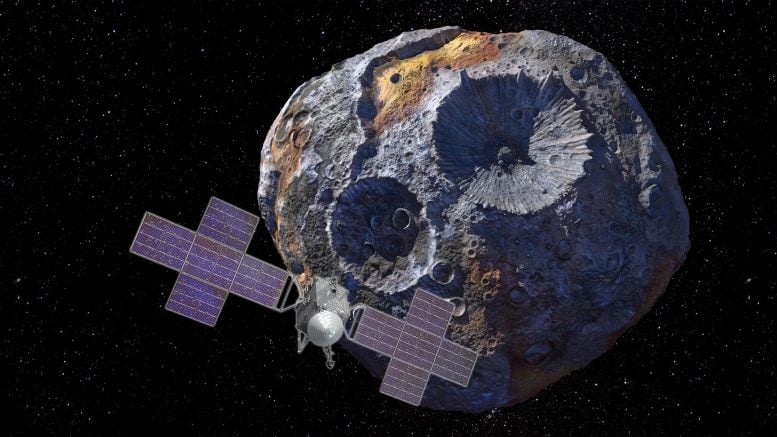
“Behind the Spacecraft” is a series of short videos that offer glimpses of the people who’ve helped make this upcoming journey to a metal-rich asteroid possible.
What motivates someone to dedicate years to help construct something that will be rocketed into space, never to be seen again on our planet? For the scientists, engineers, and technicians behind NASA’s Psyche mission to a metal-rich asteroid, the answers are wide-ranging. However, they share a common thread: a passion to explore the unknown.

That inspiration is highlighted in the new “Behind the Spacecraft” video series, in which five members of the Psyche team tell the story of how they ended up on a mission designed to answer questions about the mysterious asteroid Psyche.
Watch a trailer about the series:
Meet some of the engineers who helped build NASA’s Psyche mission, which is set to launch in October on a journey of 2.2 billion miles (3.6 billion kilometers) to a metal-rich asteroid of the same name. Credit: NASA
- Christina Hernandez, a flight systems engineer at NASA’s Jet Propulsion Laboratory in Southern California, helped guide the team through the verification-and-validation phase of the mission to ready the spacecraft for the extreme conditions of space. For her, engineering is a way to make science fiction reality. And as a heavy metal fan, she’s excited that Psyche is a mission bound for a metal world.
- Meena Sreekantamurthy, a power electronics engineer at the Johns Hopkins Applied Physics Laboratory, worked on the power supply unit for one of the spacecraft’s science instruments. She paints and draws in her free time and marvels that something she helped build with her own hands will reach the asteroid belt.
- Ben Inouye is an engineer who worked on the team that designed and built the spacecraft power system. Before coming to JPL, which manages the mission, he worked as a marine engineer. Now he draws a line from the discoveries made at sea to those that the Psyche mission’s robotic quest hopes to make.
- Julie Li oversaw development of the spacecraft’s sci-fi-worthy solar electric propulsion hardware at Maxar Technologies. As a child, she wanted to be an astronaut, and her first job after college was as a design engineer on NASA’s space shuttle. Today, the spacecraft builder is also an outdoor adventurer.
- Luis Dominguez is the systems and electrical lead at JPL for the assembly, test, and launch operations phase of the mission. As someone who never imagined as a child that he’d be an engineer working somewhere like JPL, he urges the kids he meets to embrace their curiosity. (The video featuring Dominguez will also be available in Spanish.)
Meet Christina Hernandez, a flight systems engineer on NASA’s Psyche mission, which will be the first to explore a metal-rich asteroid, also named Psyche. In this video Hernandez, from NASA’s Jet Propulsion Laboratory, talks about getting Psyche ready for launch through the spacecraft’s verification-and-validation phase and her passion for heavy metal music. Credit: NASA
Livestreams and Broadcasts
Produced by NASA 360, the videos will be released weekly on Tuesdays. The first (embedded above) was released on August 22. JPL will host a livestream with Julie Li at 1 p.m. EDT (10 a.m. PDT) on September 13 and one with Luis Dominguez at 1 p.m. EDT (10 a.m. PDT) on September 20 on JPL YouTube, Facebook, and X. Questions can be submitted via the livestream chats.
Psyche is set to launch atop a SpaceX Falcon Heavy from Launch Complex 39A at Kennedy Space Center at 10:38 a.m. EDT (7:38 a.m. PDT) on October 5, with additional opportunities scheduled through October 25.
More About the Mission
Spanning approximately 173 miles (279 kilometers) at its broadest, the asteroid Psyche may be a fragmentary core of a planetesimal (one of the building blocks of a rocky planet), or it could be primordial material that never melted. The primary objective of the Psyche mission is to discern between these possibilities. The mission will further shed light on the mysteries surrounding Earth’s metallic core and the genesis of our solar system. Upon its scheduled arrival at Psyche in 2029, the spacecraft will embark on a 26-month observation period, capturing images and collecting data to enhance our understanding of the asteroid.
Never miss a breakthrough: Join the SciTechDaily newsletter.
Follow us on Google and Google News.