
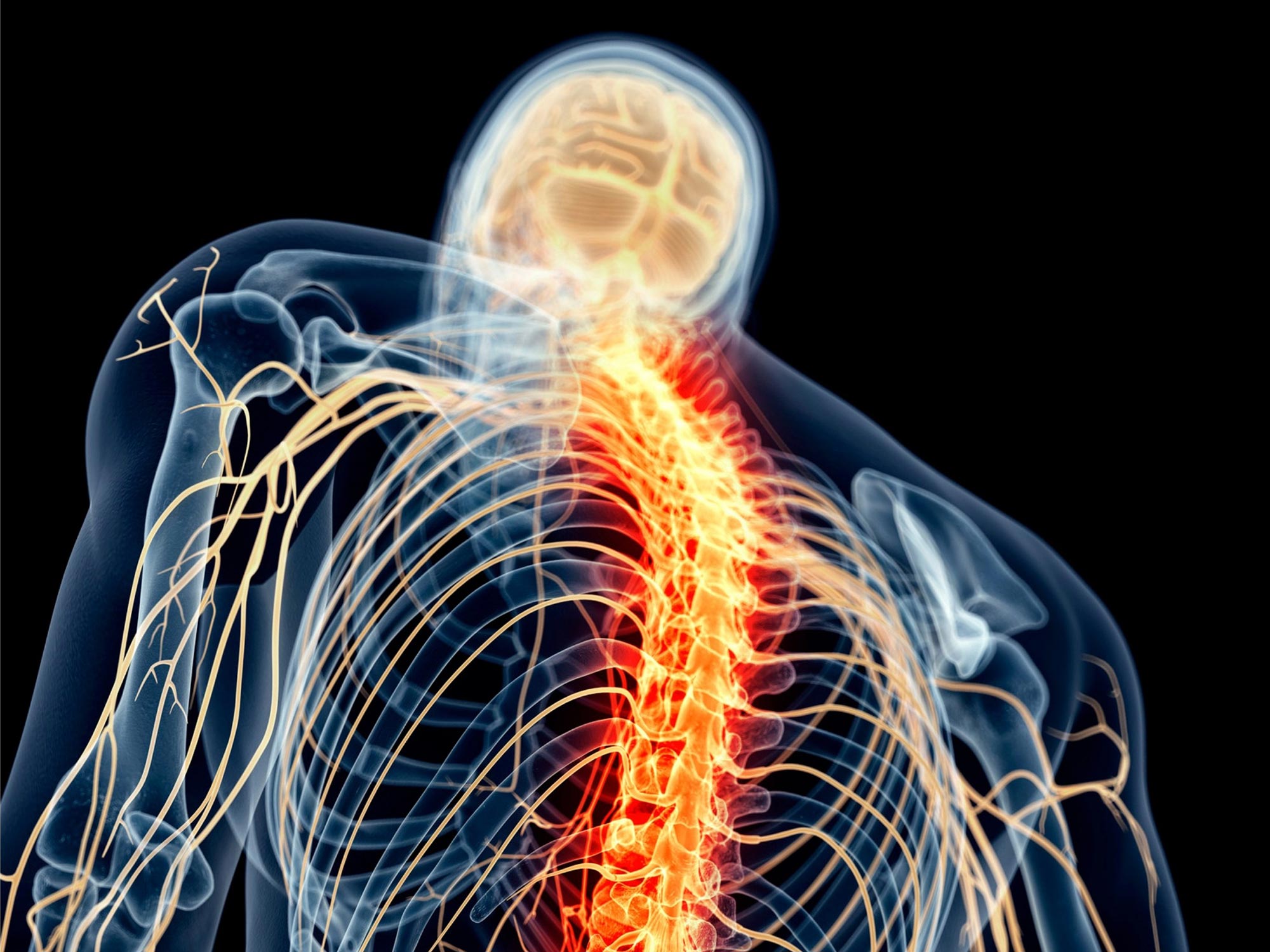
The new method is designed to focus specifically on pain-related signals, without interfering with normal activity in other parts of the brain.
A new preclinical study has identified a gene therapy approach that focuses directly on pain-processing regions of the brain while avoiding the addiction risks associated with narcotic drugs. The advance could eventually benefit more than 50 million Americans who live with chronic pain.
Living with chronic pain is often compared to hearing a radio blaring at full volume with no way to turn it down. Opioid drugs such as morphine lower that volume by dulling pain signals, but they also influence many other brain systems, which can lead to serious side effects and dependence.
According to research published in Nature by scientists from the University of Pennsylvania Perelman School of Medicine and School of Nursing, together with collaborators at Carnegie Mellon University and Stanford University, the experimental gene therapy acts more like a precise volume control. It reduces pain signals while leaving the rest of the brain largely unaffected.
“The goal was to reduce pain while lessening or eliminating the risk of addiction and dangerous side effects,” said Gregory Corder, PhD, co-senior author and assistant professor of Psychiatry and Neuroscience at Penn. “By targeting the precise brain circuits that morphine acts on, we believe this is a first step in offering new relief for people whose lives are upended by chronic pain.”
An AI-driven blueprint for non-addictive, brain circuit-specific pain medicine
Morphine, a narcotic derived from opium, carries a high risk of misuse because patients can develop tolerance over time and need progressively larger doses to achieve the same pain relief. By closely imaging brain cells involved in tracking pain, the researchers gained a clearer understanding of how morphine reduces discomfort.
Building on this insight, the team created a mouse-model behavioral system powered by artificial intelligence (AI). The platform monitors natural behaviors, produces a detailed measure of pain levels, and helps determine how much treatment is required to reduce pain.
The resulting data served as a guide for developing a targeted gene therapy that reproduces morphine’s pain-relieving effects without engaging the brain’s reward systems. The therapy includes an “off switch” that specifically dampens pain signals in the brain. When activated, it delivers long-lasting pain relief while preserving normal sensation and avoiding pathways linked to addiction.
“To our knowledge, this represents the world’s first CNS-targeted gene therapy for pain, and a concrete blueprint for non-addictive, circuit-specific pain medicine,” Corder said.
Easing one crisis without fueling another
The results are the culmination of more than six years of investigation powered by a National Institutes of Health New Innovator Award that allowed Corder and his colleagues to research the mechanisms of chronic pain.
In 2019, 600,000 deaths were attributed to drug use, with 80 percent of those related to opioids. Nearly half of Philadelphians who responded to a 2025 Pew survey reported knowing someone with opioid use disorder (OUD). One-third knew someone who had died as the result of an overdose.
Chronic pain, known to some as a ‘silent epidemic’ impacts approximately 50 million Americans, costing upward of $635 million annually in direct medical expenses and indirect costs from lost productivity, including missed work and reduced earning capacity. Now, these findings have the potential to help ease that pain—or, turning down the noise—for some, should the science hold through additional testing and into clinical trials.
The team is moving forward with Michael Platt, PhD, the James S. Riepe University Professor, Professor of Neuroscience, Professor of Psychology, on the next phase of work as a hopeful bridge toward future clinical trials.
“The journey from discovery to implementation is long, and this represents a strong first step,” Platt said. “Speaking both as a scientist and as a family member of people affected by chronic pain, the potential to relieve suffering without fueling the opioid crisis is exciting.”
Reference: “Mimicking opioid analgesia in cortical pain circuits” by Corinna S. Oswell, Sophie A. Rogers, Justin G. James, Nora M. McCall, Alex I. Hsu, Gregory J. Salimando, Malaika Mahmood, Lisa M. Wooldridge, Meghan Wachira, Adrienne Y. Jo, Raquel Adaia Sandoval Ortega, Jessica A. Wojick, Katherine Beattie, Sofia A. Farinas, Samar N. Chehimi, Amrith Rodrigues, Jacqueline W. K. Wu, Lindsay L. Ejoh, Blake A. Kimmey, Emily Lo, Ghalia Azouz, Jose J. Vasquez, Matthew R. Banghart, Kevin T. Beier, Kate Townsend Creasy, Richard C. Crist, Charu Ramakrishnan, Benjamin C. Reiner, Karl Deisseroth, Eric A. Yttri and Gregory Corder, 7 January 2026, Nature.
DOI: 10.1038/s41586-025-09908-w
This work was supported by the National Institutes of Health (NIGMS DP2GM140923, NIDA R00DA043609, NIDA R01DA054374, NINDS R01NS130044, NIDA R01DA056599, NIDA R21DA055846, NIDA F31DA062445, NINDS F31NS143421, NIDA F32DA053099, NIDA F32DA055458, NIDA F31DA057795, NINDS F31NS125927, NIDA T32DA028874, NINDS RF1NS126073), the Howard Hughes Medical Institute, the Whitehall Foundation, and the Tito’s Love Research Fund.
Some authors are inventors on a provisional patent application through the University of Pennsylvania and Stanford University regarding the custom sequences used to develop, and the applications of, synthetic opioid promoters (patent application number: 63/383,462 ‘Human and Murine Oprm1 Promoters and Uses Thereof’). See the full paper for additional disclosures.
Never miss a breakthrough: Join the SciTechDaily newsletter.
Follow us on Google and Google News.
7 Comments
Whow what a miracle, I,have been on methadone foryears i was injured at work put on a load of opiods any kind i wanted,for many years.now im on methadone because my doctor resined.there is no other doctor .now 15yeats goes by and in dtill on methadone 140mli was st 190 thats my highest. I dont think i will never get off methadone.
Open to being involved in clinical trials. Of this.
Tell me about the non-invasive electromagnetic modulation and frequency insertion/conversation with managed speed and pulse ect.. that sounds much less invasive at least. I think it’s a cure for drug addiction and mental illness. Autism ect. I’m interested in the treatment and I know a legion of human beings who could benefit. If it’s financially feasible ordinary souls. Thank you.
If this works it will give hundreds of thousands their lives back. I have suffered with chronic pain for 30 years and nothing gets rid of it. The only time I am pain free is when I am asleep or under general anasthetic.
How can l obtain these benefits. Im ready.
That’s really nice, but how much is it going charge my insurance? Or is it even covered by my insurance? There’s nothing wrong with prescribing narcotics if the person has evidence that they need the narcotics. Then be monitored with the narcotics and also doesn’t need to be 120 or 180 a month! 60 a month would be perfect. That’s 2 a day. Maybe 3 a day because I was told by a friend that has been at the same doctor, taking the same medicine for 20 years that the medicine hasn’t been as strong the last few years. Right after they banned poppy farming in Afghanistan I knew potency was going to decline, but what can we do besides live with it because we can’t afford it. Now we have no medicine because they took it away and then say we don’t want to be cured of pain if you’re not getting Gene Therapy. That’s dictatorship at its finest. Saying you don’t care how we feel about doing it.
What needs to happen with this situation is start with the doctors, where the power comes from anyway, only doctors that have legitimate evidence of the patients problem. The ones that DO have the evidence a doctor wants and needs, but can’t find a good doctor and has to suffer for the bad trying to abuse the system. Always the good has to suffer for the bad. It’s whatever I guess, I mean what can we do about it? I guess that leaves a person looking for junk in the streets. I know Medicaid will NEVER cover that, and how much it is going to cost? Not everyone has good insurance? I know everyone that would and should is rich people.
I’d like to know if chronic painkiller for mentally ill on LITHIUM stronger then Tylenol. Will be invented
A pt having say spine surgery must suffer post surgery without painmeds except Tylenol post surgery