
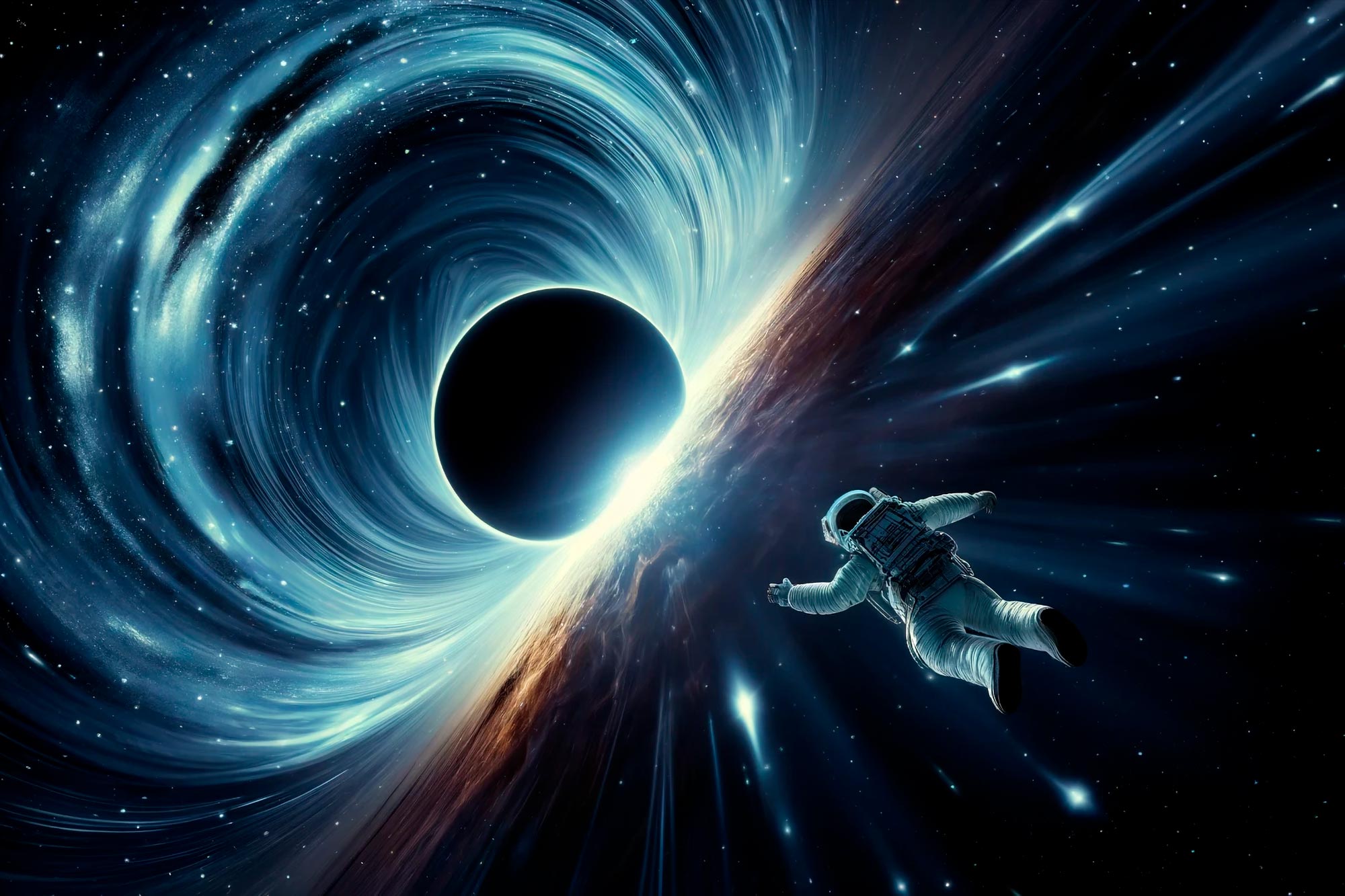
NASA’s new black hole visualizations simulate the dramatic effects of crossing the event horizon, highlighting the severe distortions in space-time and the eventual spaghettification near the singularity.
Ever wonder what happens when you fall into a black hole? Now, thanks to a new, immersive visualization produced on a NASA supercomputer, viewers can plunge into the event horizon, a black hole’s point of no return.
The Science Behind the Visualization
“People often ask about this, and simulating these difficult-to-imagine processes helps me connect the mathematics of relativity to actual consequences in the real universe,” said Jeremy Schnittman, an astrophysicist at NASA’s Goddard Space Flight Center in Greenbelt, Maryland, who created the visualizations. “So I simulated two different scenarios, one where a camera — a stand-in for a daring astronaut — just misses the event horizon and slingshots back out, and one where it crosses the boundary, sealing its fate.”
The visualizations are available in multiple forms. Explainer videos act as sightseeing guides, illuminating the bizarre effects of Einstein’s general theory of relativity. Versions rendered as 360-degree videos let viewers look all around during the trip, while others play as flat all-sky maps.
In this visualization of a flight toward a supermassive black hole, labels highlight many of the fascinating features produced by the effects of general relativity along the way. Produced on a NASA supercomputer, the simulation tracks a camera as it approaches, briefly orbits, and then crosses the event horizon — the point of no return — of a monster black hole much like the one at the center of our galaxy. Credit: NASA’s Goddard Space Flight Center/J. Schnittman and B. Powell
View the plunge in 360 video on YouTube
Technical Details of the Project
To create the visualizations, Schnittman teamed up with fellow Goddard scientist Brian Powell and used the Discover supercomputer at the NASA Center for Climate Simulation. The project generated about 10 terabytes of data — equivalent to roughly half of the estimated text content in the Library of Congress — and took about 5 days running on just 0.3% of Discover’s 129,000 processors. The same feat would take more than a decade on a typical laptop.
Characteristics of the Simulated Black Hole
The destination is a supermassive black hole with 4.3 million times the mass of our Sun, equivalent to the monster located at the center of our Milky Way galaxy.
“If you have the choice, you want to fall into a supermassive black hole,” Schnittman explained. “Stellar-mass black holes, which contain up to about 30 solar masses, possess much smaller event horizons and stronger tidal forces, which can rip apart approaching objects before they get to the horizon.”
This occurs because the gravitational pull on the end of an object nearer the black hole is much stronger than that on the other end. Infalling objects stretch out like noodles, a process astrophysicists call spaghettification.
Visual and Physical Effects Near a Black Hole
The simulated black hole’s event horizon spans about 16 million miles (25 million kilometers), or about 17% of the distance from Earth to the Sun. A flat, swirling cloud of hot, glowing gas called an accretion disk surrounds it and serves as a visual reference during the fall. So do glowing structures called photon rings, which form closer to the black hole from light that has orbited it one or more times. A backdrop of the starry sky as seen from Earth completes the scene.
Tour an alternative visualization that tracks a camera as it approaches, falls toward, briefly orbits, and escapes a supermassive black hole. This immersive 360-degree version allows viewers to look around during the flight. Credit: NASA’s Goddard Space Flight Center/J. Schnittman and B. Powell
View the flyby explainer on YouTube
As the camera approaches the black hole, reaching speeds ever closer to that of light itself, the glow from the accretion disk and background stars becomes amplified in much the same way as the sound of an oncoming racecar rises in pitch. Their light appears brighter and whiter when looking into the direction of travel.
The Journey to the Event Horizon
The movies begin with the camera located nearly 400 million miles (640 million kilometers) away, with the black hole quickly filling the view. Along the way, the black hole’s disk, photon rings, and the night sky become increasingly distorted — and even form multiple images as their light traverses the increasingly warped space-time.
In real time, the camera takes about 3 hours to fall to the event horizon, executing almost two complete 30-minute orbits along the way. But to anyone observing from afar, it would never quite get there. As space-time becomes ever more distorted closer to the horizon, the image of the camera would slow and then seem to freeze just shy of it. This is why astronomers originally referred to black holes as “frozen stars.”
Fate Inside the Event Horizon
At the event horizon, even space-time itself flows inward at the speed of light, the cosmic speed limit. Once inside it, both the camera and the space-time in which it’s moving rush toward the black hole’s center — a one-dimensional point called a singularity, where the laws of physics as we know them cease to operate.
“Once the camera crosses the horizon, its destruction by spaghettification is just 12.8 seconds away,” Schnittman said. From there, it’s only 79,500 miles (128,000 kilometers) to the singularity. This final leg of the voyage is over in the blink of an eye.
Theoretical Implications of Time Dilation
In the alternative scenario, the camera orbits close to the event horizon but it never crosses over and escapes to safety. If an astronaut flew a spacecraft on this 6-hour round trip while her colleagues on a mothership remained far from the black hole, she’d return 36 minutes younger than her colleagues. That’s because time passes more slowly near a strong gravitational source and when moving near the speed of light.
“This situation can be even more extreme,” Schnittman noted. “If the black hole were rapidly rotating, like the one shown in the 2014 movie ‘Interstellar,’ she would return many years younger than her shipmates.”
Never miss a breakthrough: Join the SciTechDaily newsletter.
Follow us on Google and Google News.