
A study in Nature Astronomy reveals a synchronized co-evolution of supermassive black holes and their host galaxies, driven by shared gas supplies and consistent across galaxy types. This groundbreaking research provides vital insights for understanding black hole-galaxy dynamics and shaping future studies.
A new paper provides critical new insights into the co-evolution of supermassive black holes and their host galaxies. The research, conducted by Dr. Ming-Yang Zhuang, who graduated from Peking University in 2022 and is currently affiliated with the University of Illinois Urbana-Champaign, and Prof. Luis C. Ho from the Kavli Institute for Astronomy and Astrophysics at Peking University, derived structural and photometric properties of host galaxies of nearly 11,500 redshift ≤ 0.35 unobscured active galactic nuclei (AGNs) using data from Pan-STARRS1 3PI Steradian Survey to explore the connections between black hole mass and the properties of host galaxies in the nearby Universe. Peking University is the primary affiliation of the paper. The study, entitled “Evolutionary Paths of Active Galactic Nuclei and Their Host Galaxies,” was published recently in Nature Astronomy.
The Mystery of Black Hole-Galaxy Relations
The tight correlations observed between the masses of supermassive black holes and the properties of their host galaxies have long intrigued astronomers. No consensus has been reached, however, on how the black hole-galaxy relations arose or how they evolved over time. The specific link between the black hole mass and the properties of host galaxies of AGNs in the nearby universe has remained elusive.
Galaxy Evolution & Synchronization
The study found that galaxies with actively accreting black holes follow a similar relationship between black hole mass and stellar mass, regardless of galaxy type. Moreover, the position of a galaxy on this relation appears linked to the level of star formation and black hole accretion activity.
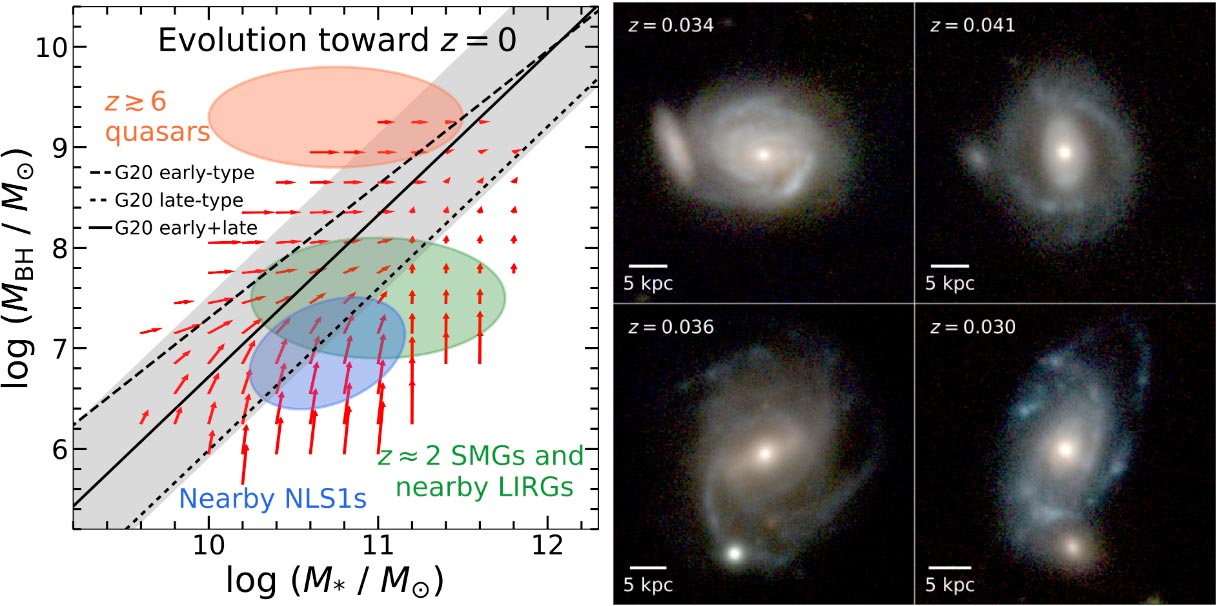
“Our results unveil evolutionary trajectories for galaxies on the black hole mass-stellar mass plane,” said Dr. Zhuang. “The joint evolution of the galaxy and its central black hole appears synchronized over long timescales. Galaxies that have overweight black holes catch up by making more stars. Those that have skinny black holes allow the black hole to eat more. In the end, the two reach a happy balance.”
Gas Supply & Evolutionary Path
The availability of a common gas supply for black hole accretion and star formation may account for the lockstep, synchronized growth of objects on the local relation. The evolutionary path of objects with undermassive black holes situated below the local relation supports a scenario suggested by recent simulations in which black hole growth initially lags behind star formation but later the situation reverses after the gas becomes stabilized at higher stellar mass. AGNs with overmassive black holes above the local relation continue to gain stellar mass, consistent with the detection of active star formation and abundant gas content in early-type AGN host galaxies.
Feedback Mechanisms & Future Research Directions
These trajectories suggest that radiative-mode AGN feedback mechanisms, which are expected to suppress star formation, are less effective for galaxies below the scaling relation. For galaxies above the relation, kinetic-mode feedback appears insufficient to halt long-term star formation.
“This work provides new insights on the coevolution of supermassive black holes and their host galaxies that can serve as the definitive benchmark and framework for evolutionary studies,” highlighted Prof. Ho. “The results offer critical observational constraints for numerical simulations modeling the complex interplay between black holes and their host galaxies.”
“This article explores the evolutionary paths of galaxies on the black hole mass–stellar mass plane in the nearby Universe, linking the properties of star formation and black hole accretion and providing critical constraints for active galactic nuclei feedback,” the editor of Nature Astronomy highly commends. “The findings in this paper are extremely interesting and are quite important for our understanding of black hole and galaxy co-evolution across cosmic times and their star formation and accretion,” says one of the reviewers.
Reference: “Evolutionary paths of active galactic nuclei and their host galaxies” by Ming-Yang Zhuang, and Luis C. Ho, 17 August 2023, Nature Astronomy.
DOI: 10.1038/s41550-023-02051-4
This work is supported by the National Key R&D Program of China and the National Science Foundation of China.
Never miss a breakthrough: Join the SciTechDaily newsletter.
Follow us on Google and Google News.