
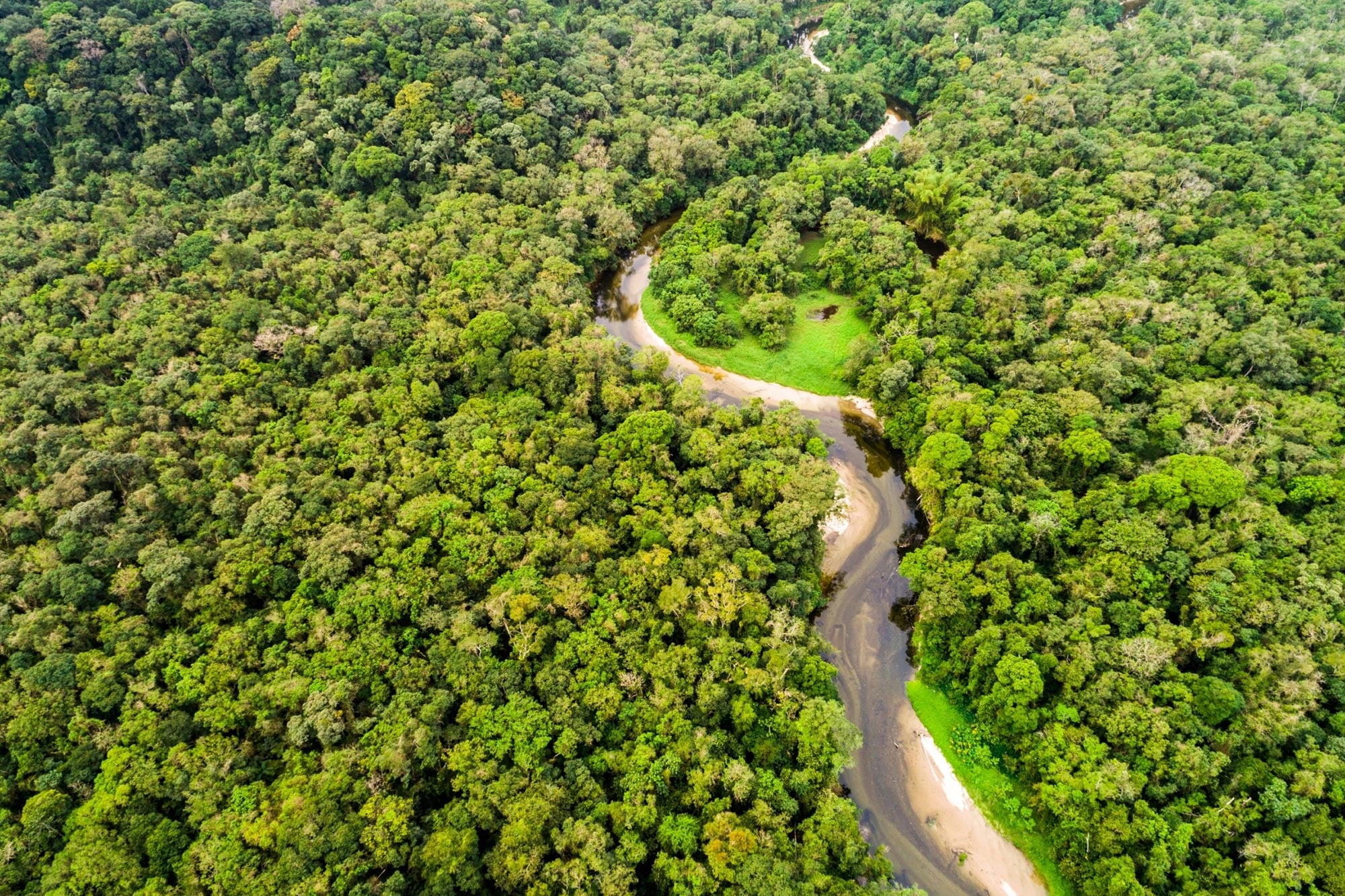
Amazonian regions that have undergone the most extensive deforestation and have the greatest potential for large-scale forest recovery currently have the lowest levels of recovery.
Large-scale forest restoration in the Amazon is an important “nature-based solution” to climate change, a major focus of the UK-hosted UN Climate Change COP26 Conference in November.
Forest recovery, the process of new forest growing on land that has previously been deforested then abandoned from agriculture, can rapidly capture large quantities of the greenhouse gas CO2 from the atmosphere.
It is key to the success of global climate change policies that aim to reduce greenhouse gas concentrations in the atmosphere, and as a way to achieve “net zero” emissions.
However, a new study by an international team of researchers from the UK and Brazil reveals that the regions with the greatest potential for large-scale forest recovery – those that have undergone the most extensive deforestation – currently have the lowest levels of recovery.
These highly deforested Amazonian landscapes also show no sign of recovering even 20 years after the forest was cleared.
The study, published in Environmental Research Letters, shows that less than 10% of carbon emissions from deforestation in the Amazon has been offset by the growth of new forest.
Striking Differences Between Amazonian Countries
There is also a big difference in this carbon offsetting between the nine Amazonian countries. Brazil, which contains more than half of the Amazon forest, is responsible for the majority of deforestation and its associated CO2 emissions. Just one of its states (Pará) has seen more deforestation than the other 8 Amazonian countries combined.
Yet Brazil is also falling behind on forest recovery, with just 25% of previously deforested land occupied by new forest and just 9% of its deforestation CO2 emissions being offset.
Ecuador, on the other hand, is leading the way with almost 60% of its deforested land under recovery. In Guyana, where the recovering forests are older and have recaptured more CO2, nearly a quarter of deforestation emissions have been offset.
Charlotte Smith, a PhD researcher at Lancaster University and lead author of the study, said: “Research in the Amazon typically focuses on Brazil because it holds most of the forest. But there are eight other Amazonian countries. Understanding how forest recovery differs between countries can help us understand which countries’ policies are helping to maintain the forest carbon sink, and which ones aren’t.”
She added: “Data from satellites is crucial for monitoring deforestation across areas as large as Amazonia and is the basis for monitoring the success of countries in achieving their internationally agreed targets for reducing greenhouse gas emissions. This new study is the first comparison of forest loss and recovery between countries across the Amazon. We used high-resolution satellite imagery to map their deforestation, recovery, and carbon stocks from 1986 to 2017.”
Three Key Challenges for Amazon Forests
John Healey, Professor of Forest Sciences at Bangor University and a co-author of the study, commented: “The results of the study highlight three key challenges for the future of Amazon forests, the need to: (1) incentivize large-scale forest restoration in highly deforested regions, (2) protect new forests without disadvantaging the small landowners who depend on the cleared land for farming, and (3) prevent further deforestation.”
He emphasized that: “Meeting all these challenges successfully is essential to ensure that the Amazon achieves its potential in mitigating climate change.”
The researchers predict that as more accurate data become available on the amount of forest loss and recovery, from national to local scales, this will enable better targeting of interventions to protect and restore the remaining Amazonian forests.
Reference: “Old-growth forest loss and secondary forest recovery across Amazonian countries” by Charlotte C. Smith, John Healey, Erika Berenguer, Paul J. Young, Ben Taylor, Fernando Elias, Fernando Espírito-Santo and Jos Barlow, 22 July 2021, Environmental Research Letters.
DOI: 10.1088/1748-9326/ac1701
The paper’s authors are Charlotte Smith (Lancaster University, UK), John Healey (Bangor University, UK), Erika Berenguer (Oxford University, UK), Paul Young (Lancaster University, UK), Ben Taylor (Lancaster University, UK), Fernando Elias (Embrapa Amazônia Oriental, Brazil), Fernando Del Bon Espírito-Santo (University of Leicester, UK), and Jos Barlow (Lancaster University, UK).
Charlotte’s research is a component of the Envision Doctoral Training Partnership of the Natural Environment Research Council between Lancaster, Bangor and Nottingham Universities and three other UK research institutions.
Never miss a breakthrough: Join the SciTechDaily newsletter.
Follow us on Google and Google News.