
Close Menu
    Facebook X (Twitter) Instagram
    SciTechDaily
    • Biology
    • Chemistry
    • Earth
    • Health
    • Physics
    • Science
    • Space
    • Technology
    Facebook X (Twitter) Pinterest YouTube RSS
    SciTechDaily
    Home»Technology»Bionic Tactile Enhancement – Highly Sensitive Sensors Inspired by Spiders Improve Sense of Touch
    Technology

    Bionic Tactile Enhancement – Highly Sensitive Sensors Inspired by Spiders Improve Sense of Touch

    By American Institute of PhysicsFebruary 18, 2020No Comments3 Mins Read
    Facebook Twitter Pinterest Telegram LinkedIn WhatsApp Email Reddit
    Share
    Facebook Twitter LinkedIn Pinterest Telegram Email Reddit
    Visually Aided Tactile Enhancement System
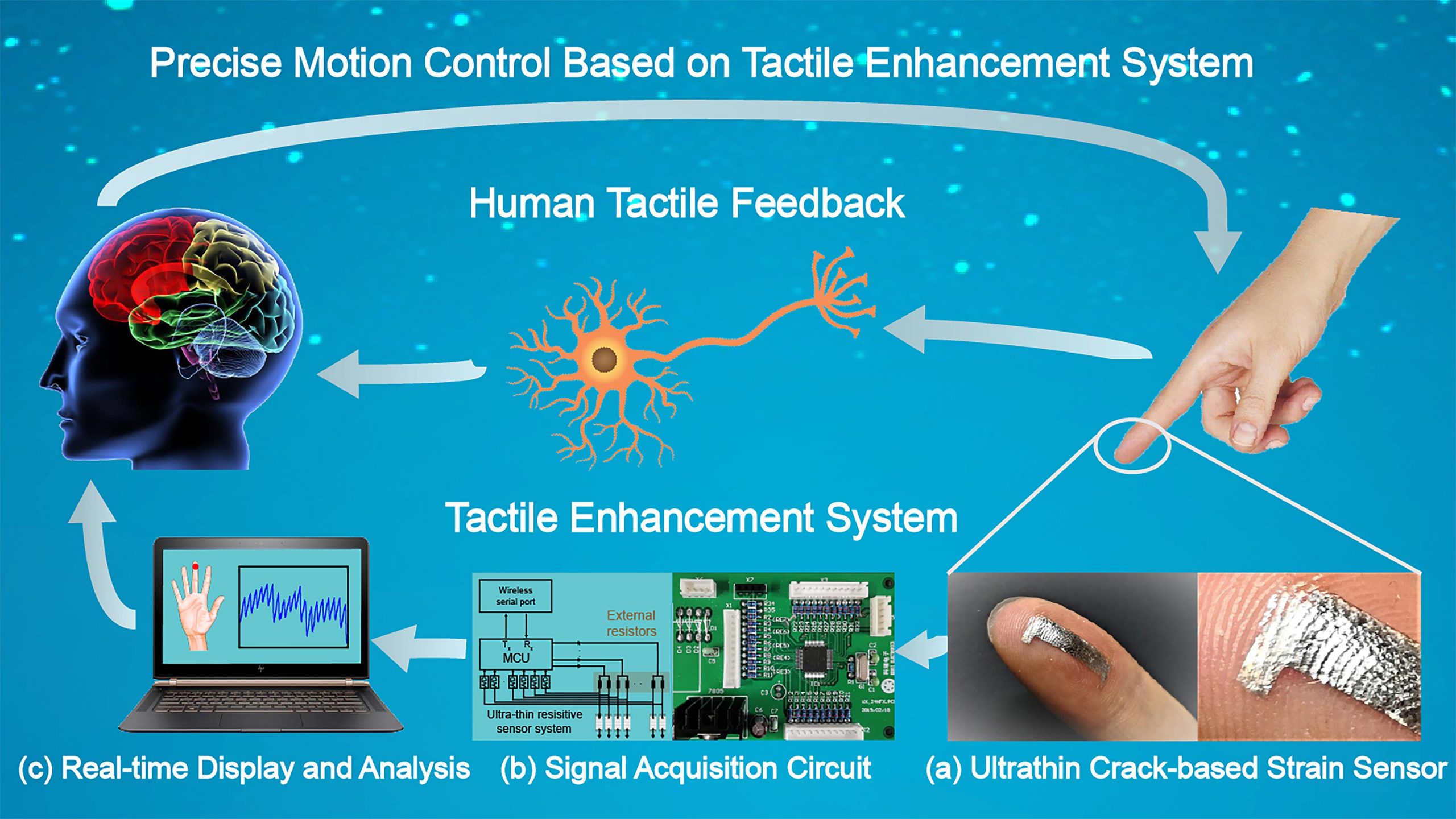
    The visually aided tactile enhancement system, VATES, applied for precise motion control. The ultrathin highly sensitive crack-based sensor, signal acquisition circuit, and real-time display system are used to realize the induction of tiny deformations. Ultrathin sensors exceed human skin sensitivity and do not disturb the human skin’s tactile sensation. A real-time display can be used as a supplement to assist a person’s tactile sensation. Credit: Rongrong Bao

    Ultrathin crack-based sensors operate on a principle similar to a spider’s sense organ and display remarkable sensitivity to movement.

    People rely on a highly tuned sense of touch to manipulate objects, but injuries to the skin and the simple act of wearing gloves can impair this ability. Surgeons, for example, find that gloves decrease their ability to manipulate soft tissues. Astronauts are also hampered by heavy spacesuits and find it difficult to work with equipment while wearing heavy gloves.

    In this week’s issue of Applied Physics Reviews, by AIP Publishing, scientists report the development of a new tactile-enhancement system based on a highly sensitive sensor. The sensor has remarkable sensitivity, allowing the wearer to detect the light brush of a feather, the touch of a flower petal, water droplets falling on a finger and even a wire too small to be seen.

    The crack-based sensor used in this device was inspired by a spider’s slit organ, an idea first proposed by other researchers. This pattern of cracks in the exoskeleton allows the spider to detect small movements. In the same way, the ultrathin crack-based strain sensor, or UCSS, uses cracks formed in a thin layer of electrically conductive silver.

    The UCSS is fabricated from several layers of flexible polymer film coated with silver. The entire system is draped and stretched over a curved surface, causing the silver to crack, and generating parallel channels that conduct electricity and are sensitive to movement.

    The investigators found thinner layers of both the flexible film and the silver yielded sensors with higher sensitivity, while thicker ones exhibited a larger sensing range. To achieve a balance of these two effects, UCSSs with 15-micron thick polymer layers and 37-nanometer thick silver layers were the best choice.

    The investigators also designed a visually aided tactile enhancement system, VATES, by connecting one or more UCSSs to a signal acquisition unit and visual readout device. They attached UCSSs to gloves, either on the fingertips or on the back of the hand, producing a type of electronic skin, or e-skin. Tiny movements, as small as a person’s pulse moving the tip of a finger, could be monitored.

    The investigators suggest UCSSs could be used in a variety of ways: as highly sensitive electronic whiskers, which can be used to map wind flow patterns; as wearable sensors for heartbeat and pulse detection; or as sensors on prosthetics to enhance the sense of touch.

    They also demonstrated their use when applied to various parts of the body. UCSSs were able to detect movement due to smiling, frowning and eye blinking.

    Co-author Caofeng Pan said, “These results demonstrate the wide applications of our ultrathin strain sensor in e-skin and human-machine interfaces.”

    Reference: “Visually aided tactile enhancement system based on ultrathin highly sensitive crack-based strain sensors” by Jing Li, Rongrong Bao, Juan Tao, Ming Dong, Yufei Zhang, Sheng Fu, Dengfeng Peng and Caofeng Pan, 18 February 2020, Applied Physics Reviews.
    DOI: 10.1063/1.5129468

    Never miss a breakthrough: Join the SciTechDaily newsletter.
    Follow us on Google and Google News.

    American Institute of Physics Biomechanics Biomedical Engineering Biotechnology
    Share. Facebook Twitter Pinterest LinkedIn Email Reddit

    Related Articles

    A Simple Brain Scan May Help Restore Movement After Paralysis

    New Synthetic Biomaterial Can Repair Hearts, Muscles, and Vocal Cords

    Scientists Warn of “Bleak Cyborg Future” From Brain-Computer Interfaces

    Fresh 3D-Printing Platform: Advanced Tissue Fabrication Paves Way for Bioprinting Tissues and Organs

    New Method of 3D-Printing Soft Materials Could Jump-Start Creation of Tiny Medical Devices for the Body

    Transforming Nanofiber Membranes Into Complex 3D Shapes for Biomedical Applications

    New Type of Fuel Cell Produces Electricity Directly from Biomass

    Engineers Convert Yeast Cells into Biofuel

    Engineers to Develop a Smart Suit That Improves Physical Endurance

    Leave A Reply Cancel Reply

    • Facebook
    • Twitter
    • Pinterest
    • YouTube

    Don't Miss a Discovery

    Subscribe for the Latest in Science & Tech!

    Trending News

    Scientists May Have Found the Key to Jupiter and Saturn’s Moon Mystery

    Scientists Uncover Brain Changes That Link Pain to Depression

    Saunas May Do More Than Raise Body Temperature – They Activate Your Immune System

    Exercise in a Pill? Metformin Shows Surprising Effects in Cancer Patients

    Hidden Oceans of Magma Could Be Protecting Alien Life

    New Study Challenges Alzheimer’s Theories: It’s Not Just About Plaques

    Artificial Sweeteners May Harm Future Generations, Study Suggests

    Splashdown! NASA Artemis II Returns From Record-Breaking Moon Mission

    Follow SciTechDaily
    • Facebook
    • Twitter
    • YouTube
    • Pinterest
    • Newsletter
    • RSS
    SciTech News
    • Biology News
    • Chemistry News
    • Earth News
    • Health News
    • Physics News
    • Science News
    • Space News
    • Technology News
    Recent Posts
    • This Small Change to Your Exercise Routine Could Be the Secret to Living Longer
    • Physicists Discover a Strange New Kind of One-Dimensional Particle
    • Scientists Discover Unexpected Climate Benefit Hidden in Forest Soils
    • The Grand Canyon’s “Swiss Cheese” Rocks Hold a Critical Secret
    • Scientists Discover 430,000-Year-Old Wooden Tools, Rewriting Human History
    Copyright © 1998 - 2026 SciTechDaily. All Rights Reserved.
    • Science News
    • About
    • Contact
    • Editorial Board
    • Privacy Policy
    • Terms of Use

    Type above and press Enter to search. Press Esc to cancel.