
Researchers expand the quantum mechanical descriptions of nuclear fusion reactions.
Low-energy nuclear fusion reactions are influenced by the migration of neutrons and protons between fusing nuclei and their isospin compositions. Research conducted using high-performance computational models has shown the importance of isospin dynamics and nuclear shapes, particularly in asymmetric, neutron-rich systems, revealing significant implications for nuclear physics and potential energy applications.
Low-Energy Nuclear Fusion
Low-energy nuclear fusion reactions can potentially provide clean energy. In stars, low-energy fusion reactions during the stages of carbon and oxygen burning are critical to stellar evolution. These reactions also offer valuable insights into the exotic processes occurring in the inner crust of neutron stars as they accumulate matter. However, scientists do not fully understand the underlying dynamics governing these reactions.
The key to unlocking the fusion process is understanding how nucleons move between the two fusing nuclei. As the nuclei draw close enough for the nuclear forces to become effective, neutrons and protons can migrate from one nucleus to another. This movement potentially eases the fusion process.
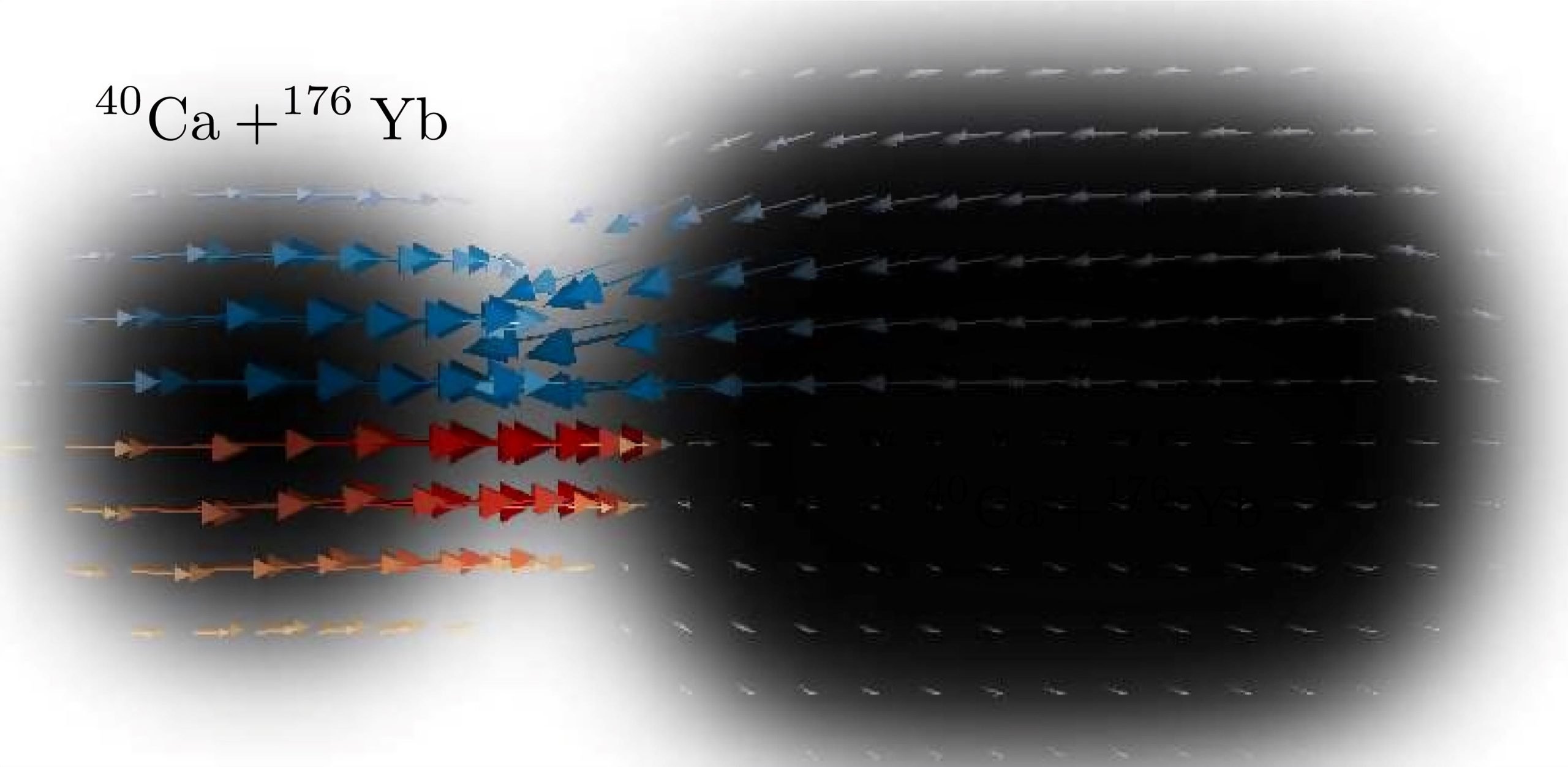
Shaded outlines of calcium-40 and ytterbium-176 nuclei (40Ca+176Yb) as they collide, leading to fusion, with nucleon currents for neutrons in blue and protons in red. The net neutron flow is from 176Yb to 40Ca and the proton flow is the opposite. Credit: Sait Umar
Role of Isospin in Fusion Processes
This study explored the influence on low-energy fusion processes of isospin composition. This is a key nuclear property that differentiates protons from neutrons. The researchers used computational techniques and theoretical modeling to investigate the fusion of different nuclei with varying isospin configurations. The results show that the isospin composition of the nuclei in a fusion reaction plays a crucial role in understanding the reaction.
The findings provide insights into the processes that govern low-energy fusion reactions. This could enhance scientific research on astrophysical processes such as nucleosynthesis, which is critical to our understanding of the universe as a whole.
Investigating Isotopes and Nuclear Shapes
In this study, researchers at Fisk University and Vanderbilt University used high-performance computational and theoretical modeling techniques to conduct a detailed many-body method study of how the dynamics of isospin influence nuclear fusion at low energies across a series of isotopes.
The study also examined how the shape of the nuclei involved affects these dynamics. In systems where the nuclei are not symmetrical, the dynamics of isospin become particularly important, often leading to a lowered fusion barrier, especially in systems rich in neutrons. This phenomenon can be explored using facilities that specialize in the generation of beams composed of exotic, unstable nuclei.
Implications for Nuclear Physics and Energy
The findings provide critical knowledge regarding the fundamental nuclear processes governing these reactions, which have broad implications for fields such as nuclear physics, astrophysics, and, perhaps someday, fusion-based energy.
Reference: “Role of isospin composition in low-energy nuclear fusion” by Richard Gumbel, Christian Ross and A. S. Umar, 14 November 2023, Physical Review C.
DOI: 10.1103/PhysRevC.108.L051602
This research was supported by the Department of Energy Office of Science, Office of Nuclear Physics.
Never miss a breakthrough: Join the SciTechDaily newsletter.
Follow us on Google and Google News.
2 Comments
The study explored the influence on low-energy fusion processes of isospin composition. This is a key nuclear property that differentiates protons from neutrons. The researchers used computational techniques and theoretical modeling to investigate the fusion of different nuclei with varying isospin configurations. The results show that the isospin composition of the nuclei in a fusion reaction plays a crucial role in understanding the reaction.
The findings provide insights into the processes that govern low-energy fusion reactions. This could enhance scientific research on astrophysical processes such as nucleosynthesis, which is critical to our understanding of the universe as a whole.
Very good.
Please ask researchers to think deeply:
1. Is isospin composition related to topological vortices?
2. Is the isospin composition you are observing high-dimensional spacetime matter or low dimensional spacetime matter?
3. Are protons and neutrons high-dimensional spacetime matter or low dimensional spacetime matter?
4. Is topological vortex high-dimensional spacetime matter or low dimensional spacetime matter?
5. Can low dimensional spacetime matter be the understructure of high-dimensional spacetime matter?
and so on.
Scientific research guided by correct theories can help humanity avoid detours, failures, and pomposity. Please witness the exemplary collaboration between theoretical physicists and experimentalists (https://scitechdaily.com/microscope-spacecrafts-most-precise-test-of-key-component-of-the-theory-of-general-relativity/#comment-854286). Is this the children’s story of contemporary physics?
The universe does not do algebra, formulas, or fractions, it is a superposition, deflection, and entanglement of geometric shapes. When physics no longer believes in geometric shapes, it can only believe in God, angels, and even a strange cat. Contemporary physics should not always live in a children’s story world.
Under the manipulation and misleading of Physical Review Letters (PRL), the rigorous and truth-seeking spirit of contemporary physics science no longer exists. The filth, ugliness, and evil in academic activities are already unbearable to behold.