
Firsthand accounts of wolves hunting and successfully capturing a harbor seal, and another instance of a wolf pack preying on and consuming a sea otter along the coast of Katmai, Alaska, have prompted researchers to reconsider assumptions about wolf hunting behavior.
Wolves have previously been observed consuming sea otter carcasses, but how they obtain these and the frequency of scavenging versus hunting marine prey is largely unknown. Scientists at Oregon State University, the National Park Service, and Alaska Department of Fish and Game are beginning to change that with a paper recently published in the journal Ecology.
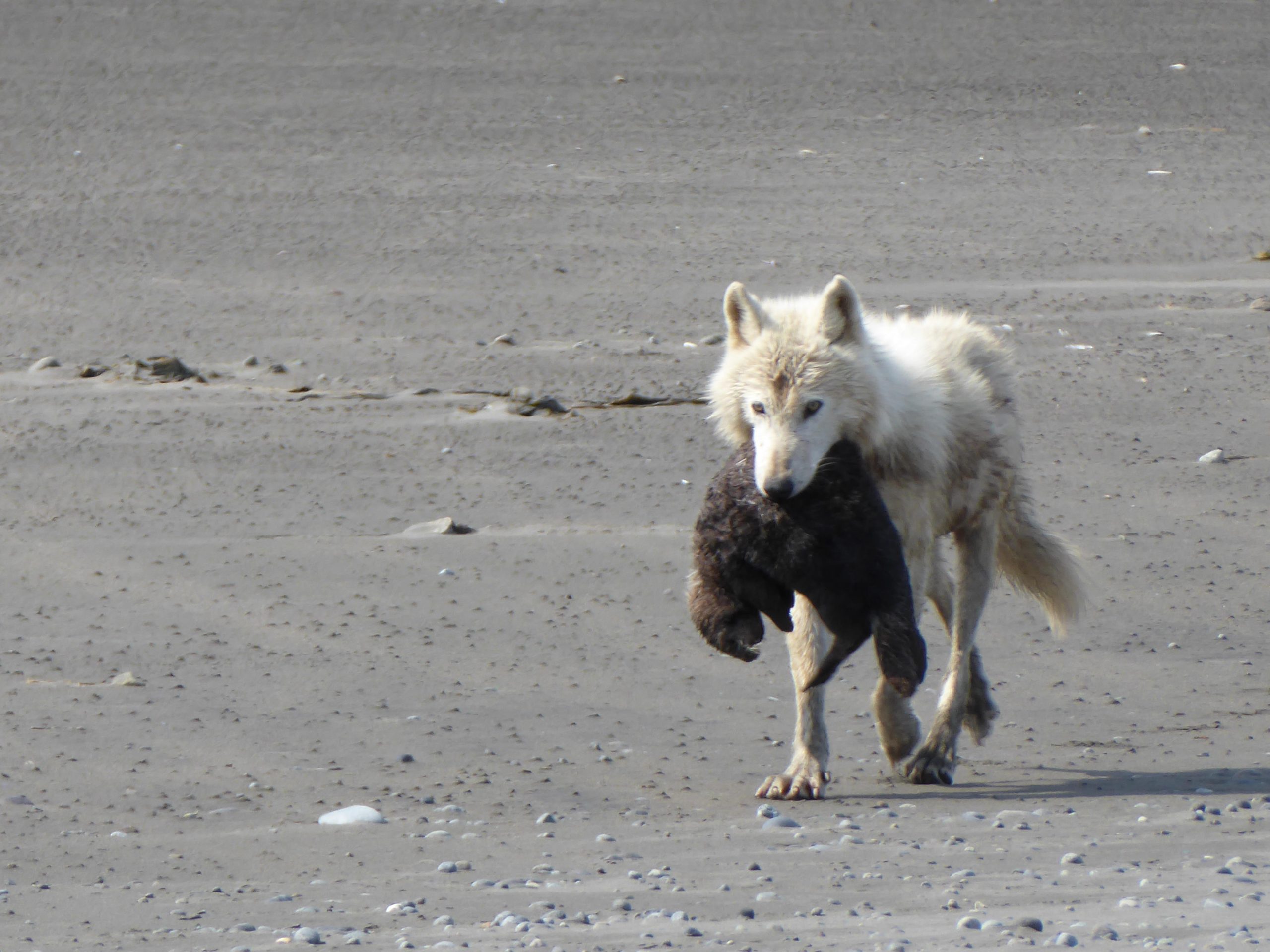
Wolf hunting a seal in Alaska’s Katmai National Park. Credit: Kelsey Griffin, National Park Service
Unprecedented Observations in Wildlife Behavior
In the paper, they describe several incidents they observed involving wolves and marine mammals in Katmai National Park that they believe haven’t been previously documented:
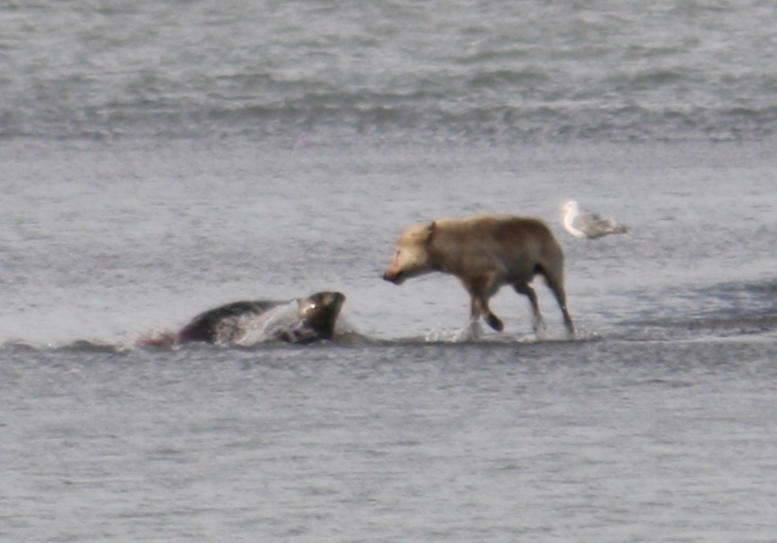
- In 2016 the researchers witnessed a male wolf hunt and kill a harbor seal. The wolf was positioned near the mouth of a creek when it charged into the water, grabbing the tail of the harbor seal. The wolf continued to tear into the flesh of the seal’s tail and after an approximate 30-minute struggle, the seal appeared to tire, straining to lift its head above water. The wolf dragged the seal onto the exposed sandbar and began to tear into the existing wound and consume the tail.
- On three separate days in 2016, 2018, and 2019 the scientists and others observed wolves carrying sea otter carcasses.
- In 2021, the researchers watched three wolves hunt and eat an adult sea otter on an island during a low tide. They watched the wolves travel to the island, then lost sight of them for about one minute, and then saw them reappear carrying a limp sea otter. They fed on the carcass for about 60 minutes. Once the wolves left, the researchers examined the kill site and found an area of concentrated blood where the sea otter was likely killed. The presence of blood indicates the sea otter had been alive when ambushed by the wolves, as opposed to being scavenged, the researchers note.
“This is really exciting documentation of behaviors we believe have never been directly observed by scientists,” said Ellen Dymit, a doctoral student at Oregon State. “It kind of forces us to reconsider the assumptions that underlie a lot of our management decisions and modeling around wolf populations and populations of their prey, which often assume that wolves depend on ungulates, like moose and elk.”
Implications and Initial Discovery
The research project originated in 2016 when Kelsey Griffin, a National Park Service biologist, and some of her colleagues stopped for lunch on the beach during a day of conducting marine debris and bird mortality surveys at Katmai National Park.
“Seemingly out of nowhere, we are sitting there, we just see this white wolf carrying an otter just trotting by,” Griffin said. “What? I was just blown away. I have never seen anything like that before.
“Then I was asking my co-workers: ‘Has anyone seen this before? Do wolves often eat sea otters?’ I was just asking a bunch of questions about the wolves and it just seemed like there was not a whole lot of information about them. That was the initial observation. I just got lucky. Wolves on the Katmai coast have never been studied and our research highlights the unique role wolves play in nearshore ecosystems in Alaska.”
Griffin connected with Gretchen Roffler, a biologist with the Alaska Department of Fish and Game, who introduced Griffin to Taal Levi, a professor at Oregon State and Dymit’s advisor.
The project builds on work by Roffler, Levi, and others on wolves and sea otters on Pleasant Island, an island landscape adjacent to Glacier Bay about 40 miles west of Juneau and hundreds of miles east of Katmai across the Gulf of Alaska.
In a paper published earlier this year, they found wolves on Pleasant Island caused a deer population to plummet and switched to primarily eating sea otters in just a few years. They believe this is the first case of sea otters becoming the primary food source for a land-based predator.
Future papers will include analysis of wolves and sea otters from Lake Clark National Park, Glacier Bay National Park, and Kenai Fjords National Park, in addition to Katmai. The research team plans to look at how sea otter density impacts the diets of wolves and variations of wolf diet on a pack level versus an individual level.
Reference: “Wolves on the Katmai coast hunt sea otters and harbor seals” by Kelsey R. Griffin, Gretchen H. Roffler and Ellen M. Dymit, 3 October 2023, Ecology.
DOI: 10.1002/ecy.4185
Dymit, Griffin and Roffler are all authors of the paper. Dymit and Levi are in the Department of Fisheries, Wildlife, and Conservation Sciences in Oregon State’s College of Agricultural Sciences. Griffin is director of the Ocean Alaska Science and Learning Center in Seward, Alaska. Roffler is based in Douglas, Alaska.
Never miss a breakthrough: Join the SciTechDaily newsletter.
Follow us on Google and Google News.
4 Comments
Interesting
The otters were able to survive extinction from the Russian trappers and now these wolves? Yikes. Couldn’t care less about seals.
While working for the ADF&G, Subsistence Division we conducted research on John Muir’s travels in Alaska. Muir documented what is known today as Traditional Ecological Knowledge (TEK). Travels in Alaska by John Muir, published in 1915
In 1879 John Muir traveled in Southeast Alaska with the missionary S. Hall Young in a Tlingit canoe with a party of Tlingit hunters from Wrangell, Alaska. “When our talk was interrupted by the howling of a wolf . . . Kadachan (Wrangell Tlingit) puzzled the minister (S. Hall Young) with the question, “Have wolves souls?” The Indians believe that they have, giving as a foundation that they are wise creatures who know how to catch seals and salmon by swimming with their heads hidden in a mouth full of grass, . . . hunt deer in company, . . . Inquired how it was that with enemies so wise and powerful the deer were not all killed. Kadachan replied that wolves knew better than to kill all and thus cut off their most important food – supply. He said they were numerous on all the large islands, more so than the mainland, wolves not bears, Indians regard as the masters of the woods, . . .”
Interesting again