
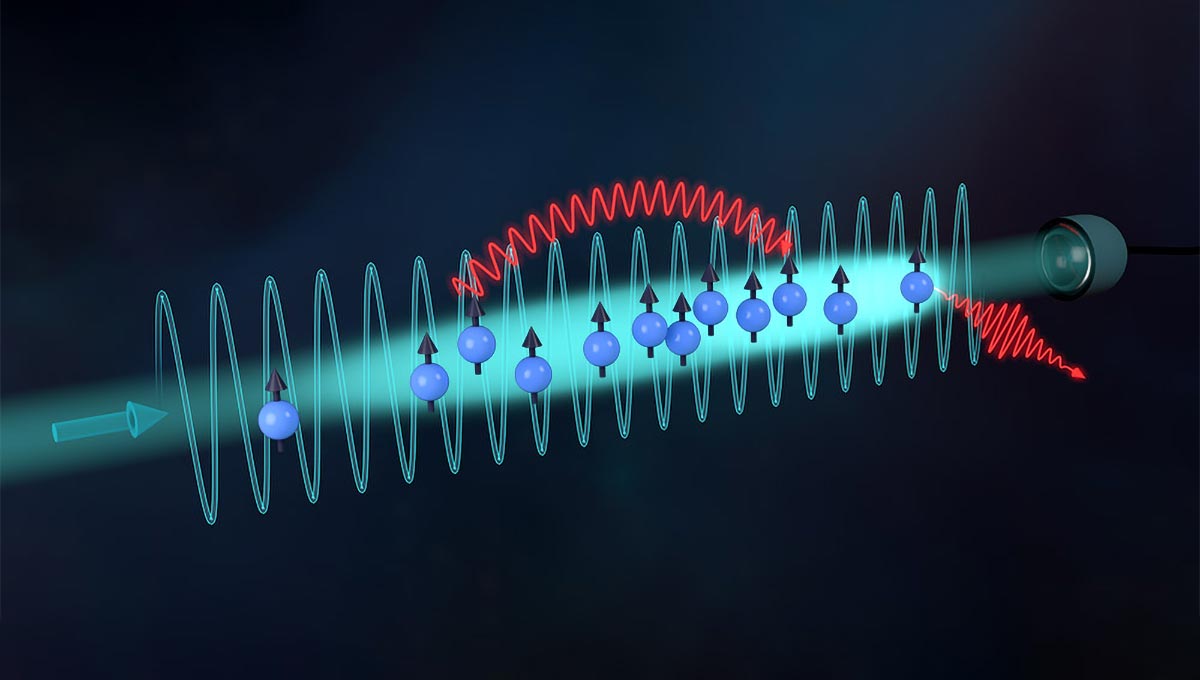
Superradiance in optical cavities involves atoms emitting light collectively when interacting with cavity photons, a phenomenon not yet observed in free space due to synchronization challenges.
Researchers have used theoretical simulations to probe these effects under various conditions, revealing significant differences in behavior between cavity and free-space systems.
Superradiance in Optical Cavities
Isolated atoms in free space emit energy independently at their own pace. In contrast, when placed inside an optical cavity, they interact with photons that bounce between the cavity’s mirrors. This interaction allows the atoms to synchronize their photon emissions, radiating collectively in unison — a phenomenon called superradiance. Remarkably, when a moderate external laser excites these atoms, their light absorption and collective emission can balance, enabling the system to settle into a steady state with a finite level of excitation.
However, if the laser’s energy surpasses a certain threshold, the system’s behavior changes dramatically. The atoms can no longer emit light collectively fast enough to keep up with the incoming laser energy. As a result, they continuously emit and absorb photons without ever reaching a stable state. Although this shift in steady-state behavior was predicted theoretically decades ago, it has yet to be confirmed through experimental observation.
Collaboration and Theoretical Insights
Recent research at the Laboratoire Charles Fabry and the Institut d’Optique in Paris studied a collection of atoms in free space forming an elongated, pencil-shaped cloud and reported the potential observation of this desired phase transition. Yet, the results of this study puzzled other experimentalists since atoms in free space don’t easily synchronize.
To better understand these findings, JILA and NIST Fellow Ana Maria Rey and her theory team collaborated with an international team of experimentalists. The theorists found that atoms in free space can only partially synchronize their emission, suggesting that the free-space experiment did not observe the superradiant phase transition. These results are published in PRX Quantum.
Challenges in Free-Space Synchronization
“While our current simulations were able to reproduce the experimental data, and explained why full synchronization cannot take place under current experimental conditions, a remaining open question is whether the phase transition could happen under different conditions, and at higher densities, where our theoretical methods fail and instead a genuine quantum description is required,” explains Rey.
In physics, solving complex problems often requires the combined efforts of both theorists and experimentalists. Theorists develop mathematical models and simulations to predict how systems should behave. Conversely, experimentalists conduct experiments to test and challenge these predictions. This collaboration helps bridge the gap between abstract ideas and observable phenomena.
Exploring Quantum States in Different Systems
“One of the big questions people are trying to answer is if it’s possible to create entangled states in different atomic systems,” explains Sanaa Agarwal, a graduate student in Rey’s group and the paper’s first author. “In a cavity system, this is enabled by these collective all-to-all interactions [atoms interacting one-to-one], but in free space, that still needs to be clarified.”
A cavity system can be fine-tuned to drive atoms into specific quantum states. In contrast, free-space systems are less controlled.
“In free space, there are many effects to look at, like interaction-induced frequency,” says Agarwal. “You also have emission into all possible directions, not just predominantly into the cavity system. So, these effects are expected to change the physics in the system, and that’s why we started looking into it, and indeed, we found it’s quite different.”
Simulating the Free-Space System
The specific free-space experimental conditions raised the question of whether the observed behaviors were truly superradiant or coincidental.
To answer these questions, the researchers carried out a series of theoretical simulations using a model that accounted for each atom as a dipole, absorbing and emitting photons from the laser and the light emitted by the other atoms.
“This was an interesting challenge, as the number of accessible states increases linearly in the cavity, but in free space, it can increase exponentially with system size,” Rey elaborates. “In many cases, the interactions can be weak enough that simplified treatments are possible, but it was initially not clear if that was going to be the case in this experiment.”
Argawal adds, “We considered a microscopic model, in which every atom acts like a dipole, and used it to study the emergent properties of the entire atomic cloud. The laser beam is a plane wave, imprinting a specific phase pattern on the atoms, which is crucial in determining how the atoms interact.”
The researchers simulated different conditions, including varying laser power and atom density, to see how these factors influenced the system’s behavior.
“Our simulations showed that a “mean-field approximation”, which reduces the complexity greatly by treating the atoms as classical magnets, was enough to reproduce the physics,” Rey notes.
This model was validated with more complex approaches to ensure consistent results.
Confirming Theories with Experimental Data
“When we were comparing the theory with the data, we were unsure if it would agree,” Agarwal says. “Some of the data was fairly easy to compare because there was less ambiguity in the experimental apparatus. So when our findings agreed with those results, it gave us a vote of confidence that what we’re doing makes sense.”
From their simulations, the researchers concluded that while the free-space experiment agreed with the cavity model, within a narrow range of laser intensities and atom densities, the two systems generally behaved very differently. As the laser power increased beyond a certain threshold, the collective effects that gave rise to superradiance in the cavity disappeared into free space, and the atoms acted more like independent emitters rather than a coordinated group.
Advancing Understanding of Quantum Phenomena
These findings open new research avenues in quantum physics and validate the great value of experiment-theory collaborations to gain a better understanding of the underlying physics.
“While our simulations were able to reproduce the experimental observations in the regime where the system is dilute, and the mean-field approximation is valid, it will be very exciting to study new regimes where our current theory models become obsolete and better treatments are required,” Rey adds. “Our group will be looking for ways to improve our calculations and to prepare us for the new exciting measurements coming ahead.”
Reference: “Directional Superradiance in a Driven Ultracold Atomic Gas in Free Space” by Sanaa Agarwal, Edwin Chaparro, Diego Barberena, A. Piñeiro Orioli, G. Ferioli, S. Pancaldi, I. Ferrier-Barbut, A. Browaeys and A.M. Rey, 3 December 2024, PRX Quantum.
DOI: 10.1103/PRXQuantum.5.040335
This work was supported by the JILA Physics Frontier Center (PFC), the U.S. Department of Energy’s Office of Science, the National Quantum Information Science Research Centers’ Quantum Systems Accelerator, and the National Institute of Standards and Technology (NIST).
Never miss a breakthrough: Join the SciTechDaily newsletter.
Follow us on Google and Google News.
1 Comment
B note 241229134 Source 1. Analyzing_【】
1.
Breaking quantum boundaries: [1] Atoms resist synchronization in free space.]
Pencil-shaped ultra-cold gas of frozen two-stage atoms interacting through photon-mediated interactions with elastic and inelastic components. Continuous laser driving excites (excites) atoms upon resonance. The atoms also spontaneously emit photons into free space.
Hyperluminosity within the optical cavity is a phenomenon in which atoms collectively emit light when interacting with a cavity photon, which has not yet been observed in free space due to synchronization problems.
_[1] The situation inside the laser has not yet thought of the existence of free space in the problem of matching and synchronization with the valence co-photon quantum. qpeoms and atomic msqpeo. However, the part and the whole exist on both sides, and matching may not necessarily be an essential issue that must be synchronized and matched to qpeoms because there are parts that have not been met and there are implications of repulsion. Uh-huh.
-Researchers investigated these effects under various conditions using theoretical simulations and found significant differences in behavior between cavity and free space systems.
1-1. Ultra-luminosity of light cavity
[1-1]Isolated atoms in free space emit energy independently at their own speed; on the other hand, when placed inside the optical cavity, they interact with photons reflecting between the mirrors of the cavity.
_[1-1] The atom interacts with the photon only when it exists in the optical cavity? The atom is zone 1 of the mcell. It is the photon qpeoms multi-zone. It seems that mcell is the reason why the atom enters the photon cavity. If A. atom, B.mcell, and C.qpeoms are each individual, does that mean that A must enter B to interact with C? Then what state is A in? Where is A? This is a combination of quarks that have atomic nuclei with protons and neutrons and have electron orbits… This could be the individual mode of the chiral symmetry of the rotator orbit of sms.oms.vix.ain. The electron orbits and the nucleus is at the center, dbr.ain? What is it? Is it an osser? An osser? An osser? An osser?
[1′]This interaction allows atoms to synchronize photon emission and emit them collectively and consistently. This is called superluminance. Surprisingly, when a suitable external laser excites these atoms, light absorption and collective emission are in equilibrium, allowing the system to stabilize in a stable state to a finite level of excitation.
_[1′] It seems that the principle of laser can be explained by the correlation between mass atoms and mcell.msbase, and qpeoms in quantum state. In that sense, msbase.mass’s photon emission superluminance tribute can be a kind of laser phenomenon. Uh-huh. If msbase emits thick laser light, I would like to feel that it is not a supernova pulsar that has synchronized with 1 trillion photons and 1000-meter nk2 total reflection, huh? Huh. Very good. Okay! Hmm.
1-2.
However, when the energy of the laser exceeds a certain threshold, the system’s behavior changes dramatically. [1-2]The atom can no longer emit light collectively fast enough to catch up with the incoming laser energy.]
As a result, it continuously emits and absorbs photons without reaching a stable state. This change in steady-state behavior was theoretically predicted decades ago but has not yet been confirmed by experimental observations.
_[1_2] I’ll write. Mandeuk! I think my sister is going to die. Uh-huh. It’s over. I couldn’t get out of the old town of nk2 where the atom is still enemy. If you go into the coffin, don’t follow me! I’m sleepy! Uh-huh.
If there are no more atoms, there is no continuous laser generation. That’s right. Well, but where do the qpeoms get atoms from so wildly? Dark energy qms.qvixer? That’s right. I kind of understand!
2. Collaboration and theoretical insights
Recent work has studied a set of atoms forming long pencil-shaped clouds in free space and reported potential observations of this desired phase transition. However, the results of this work have perplexed other experimentalists because the atoms in free space are not easily synchronized.
The theorists found that the valence emission of free space can only be partially synchronized, suggesting that free space experiments did not observe superradiant phase transitions.
2-1. Challenges of Free Space Synchronization
While current simulations were able to reproduce experimental data and explain why full synchronization cannot occur under current experimental conditions, it remains questionable whether phase transitions can occur at higher densities and with other conditions where our theoretical method fails and requires real quantum explanation instead.
B
Solving complex problems in physics often requires collaborative efforts of theorists and experimenters.
The theorist develops mathematical models and simulations to predict how the system should work.
Conversely, the experimenter performs experiments to test and challenge these predictions.
These collaborations help bridge the gap between abstract ideas and observable phenomena.
b1.Search for quantum states in various systems
One of the big questions that people are trying to answer is whether it is possible to create entangled states in different atomic systems. This collective whole-to-all interaction [atomic one-to-one interaction] is possible in a common system, but it still needs to be clarified in free space.
_[b1]mcell is a unit of msbase. It is a local entity that exists in a collective state. But it is the same as the number 1 attributed to the common system. 100 has an ordered position with 100 1s. I interpret this as an overlap of 100 1s stacked on the mcell.
b2.
The cavity system can be fine-tuned to direct atoms to certain quantum states; on the other hand, the free space system is less controlled.
In free space, many effects such as interaction induced frequencies can be explored.
It also emits in all possible directions, not primarily in cavity systems.