

Close Menu
    Facebook X (Twitter) Instagram
    SciTechDaily
    • Biology
    • Chemistry
    • Earth
    • Health
    • Physics
    • Science
    • Space
    • Technology
    Facebook X (Twitter) Pinterest YouTube RSS
    SciTechDaily
    Home»Technology»Breakthrough Discovery Could Help Electronic Devices Last Longer
    Technology

    Breakthrough Discovery Could Help Electronic Devices Last Longer

    By University of SydneyApril 22, 20211 Comment3 Mins Read
    Facebook Twitter Pinterest Telegram LinkedIn WhatsApp Email Reddit
    Share
    Facebook Twitter LinkedIn Pinterest Telegram Email Reddit
    Electronic Chip
    Advanced in-situ electron microscopy allowed researchers to observe ferroelectric fatigue in real-time.

    The research could lead to electronics being designed with better endurance.

    University of Sydney researchers have made a significant discovery in the field of materials science, for the first time providing a full picture of how fatigue in ferroelectric materials occurs.

    Ferroelectric materials are used in many devices, including memories, capacitors, actuators, and sensors. These devices are commonly used in both consumer and industrial instruments, such as computers, medical ultrasound equipment, and underwater sonars. 

    Over time, ferroelectric materials are subjected to repeated mechanical and electrical loading, leading to a progressive decrease in their functionality, ultimately resulting in failure. This process is referred to as ‘ferroelectric fatigue’. 

    It is a main cause of the failure of a range of electronic devices, with discarded electronics a leading contributor to e-waste. Globally, tens of millions of tonnes of failed electronic devices go into landfills every year. 
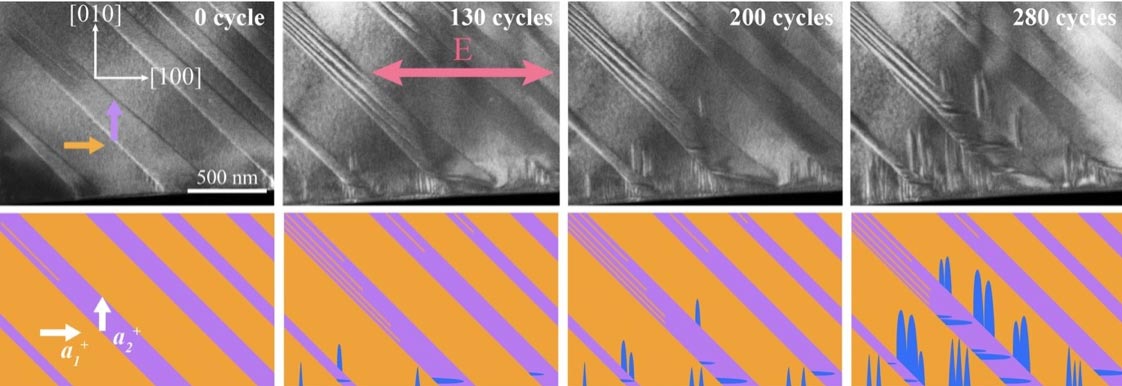
    Electronics Degradation
    Electron microscopy images show the degradation in action. Credit: University of Sydney

    Microscopy Reveals Nanoscale Fatigue in Real Time

    Using advanced in-situ electron microscopy, the School of Aerospace, Mechanical and Mechatronic Engineering researchers were able to observe ferroelectric fatigue as it occurred. This technique uses an advanced microscope to ‘see’, in real-time, down to the nanoscale and atomic levels.

    The researchers hope this new observation, described in a paper published in Nature Communications, will help better inform the future design of ferroelectric nanodevices.

    “Our discovery is a significant scientific breakthrough as it shows a clear picture of how the ferroelectric degradation process is present at the nanoscale,” said co-author Professor Xiaozhou Liao, also from the University of Sydney Nano Institute.

    Dr. Qianwei Huang, the study’s lead researcher, said: “Although it has long been known that ferroelectric fatigue can shorten the lifespan of electronic devices, how it occurs has previously not been well understood, due to a lack of suitable technology to observe it.”

    Co-author Dr. Zibin Chen said: “With this, we hope to better inform the engineering of devices with longer lifespans.” 

    Interfaces Under Scrutiny in Device Longevity

    Nobel laureate Herbert Kroemer once famously asserted “The interface is the device.” The observations by the Sydney researchers could therefore spark a new debate on whether interfaces – which are physical boundaries separating different regions in materials – are a viable solution to the unreliability of next-generation devices.

    “Our discovery has indicated that interfaces could actually speed up ferroelectric degradation. Therefore, better understanding of these processes is needed to achieve the best performance of devices,” Dr. Chen said.

    Reference: “Direct observation of nanoscale dynamics of ferroelectric degradation” by Qianwei Huang, Zibin Chen, Matthew J. Cabral, Feifei Wang, Shujun Zhang, Fei Li, Yulan Li, Simon P. Ringer, Haosu Luo, Yiu-Wing Mai and Xiaozhou Liao, 7 April 2021, Nature Communications.
    DOI: 10.1038/s41467-021-22355-1

    The research was supported by the Australian Research Council for the project, Unravelling the structural origin of cyclic fatigue in ferroelectric materials. It was facilitated by the Australian Centre for Microscopy & Microanalysis at the University of Sydney.

    Never miss a breakthrough: Join the SciTechDaily newsletter.
    Follow us on Google and Google News.

    Electrical Engineering Electromagnetics Materials Science Semiconductors University of Sydney
    Share. Facebook Twitter Pinterest LinkedIn Email Reddit

    Related Articles

    Technology Breakthrough Enables Practical Semiconductor Spintronics

    New Material Breakthrough Could Be the Key to Revolutionary, Transparent Electronics

    Exploring a New Material Class to Help Keep Pace With Moore’s Law

    2D Heterostructures Rolled Like Sushi May Lead to Ultra Miniaturized Electronics

    New Technology Could Dramatically Lower Cost of Electron Sources – For Night Vision, Particle Accelerators and More

    “Mount Everest” of Electronic Materials: Stretching Diamond for Next-Generation Microelectronics

    MIT Discovery Offers New Promise for Nonsilicon Computer Transistors

    Smarter Artificial Intelligence Technology in a New Light-Powered Chip

    Chance Discovery Results in New Type of Transistor for High-Power Electronic Devices

    1 Comment

    1. Mark on April 22, 2021 10:30 pm

      Yeah but then we won’t buy a new one!

      Reply
    Leave A Reply Cancel Reply

    • Facebook
    • Twitter
    • Pinterest
    • YouTube

    Don't Miss a Discovery

    Subscribe for the Latest in Science & Tech!

    Trending News

    289-Million-Year-Old Reptile Mummy Reveals Origin of Human Breathing System

    New Brain Discovery Challenges Long-Held Theory of Teenage Brain Development

    Scientists Discover Plants “Scream” – We Just Couldn’t Hear Them Until Now

    Scientists Discover a Surprising Reason Intermittent Fasting Extends Life

    This Simple Fruit Wash Could Make Produce Safer and Last Days Longer

    Scientists Say Adding This Unusual Seafood to Your Diet Could Reverse Signs of Aging

    Scientists Say a Hidden Structure May Exist Inside Earth’s Core

    Doctors Surprised by the Power of a Simple Drug Against Colon Cancer

    Follow SciTechDaily
    • Facebook
    • Twitter
    • YouTube
    • Pinterest
    • Newsletter
    • RSS
    SciTech News
    • Biology News
    • Chemistry News
    • Earth News
    • Health News
    • Physics News
    • Science News
    • Space News
    • Technology News
    Recent Posts
    • Major Review Finds Alzheimer’s Amyloid Drugs Offer No Real Benefit
    • Could This New Weight-Loss Pill Disrupt the Entire Market? Here’s What You Should Know About Orforglipron
    • Nearly 1 in 5 Gray Whales That Enter San Francisco Bay Die There
    • The Ozone Layer Is Healing, But There’s a Hidden Catch
    • Earth’s Crust Is Tearing Open in Africa, and It Could Form a New Ocean
    Copyright © 1998 - 2026 SciTechDaily. All Rights Reserved.
    • Science News
    • About
    • Contact
    • Editorial Board
    • Privacy Policy
    • Terms of Use

    Type above and press Enter to search. Press Esc to cancel.