
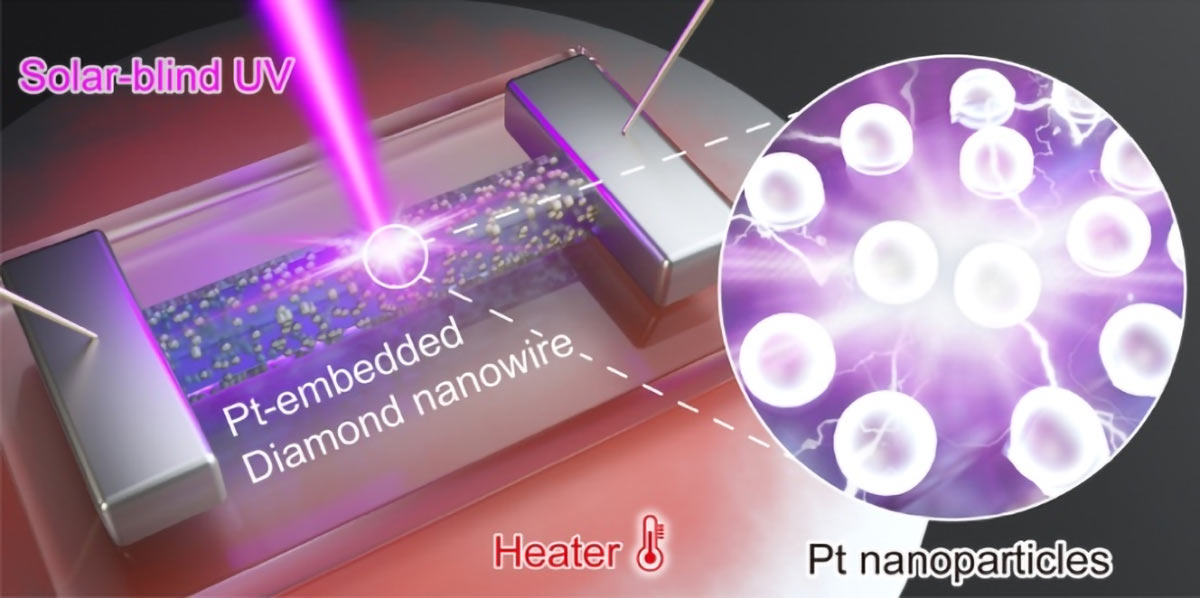
A new photodetector design using platinum-infused diamond nanowires achieves record-breaking UV sensitivity and heat resistance.
Diamond nanowires embedded with platinum nanoparticles could transform high-temperature solar-blind photodetection thanks to their impressive performance and stability. Although diamond is an excellent ultrawide-bandgap semiconductor for UV photodetectors, its effectiveness at high temperatures has been limited by low photoresponsivity caused by surface oxygen termination.
Now, a team of researchers from the University of Science and Technology of China, the Shenyang National Laboratory for Materials Science, and other institutions, led by Professor Dongming Sun, has made a major breakthrough. Their new study introduces a method for creating high-performance photodetectors using single-crystal diamond nanowires embedded with platinum nanoparticles.
Why Platinum-Embedded Diamond Nanowires Matter
- Enhanced responsivity: Platinum-embedded diamond nanowires reach a responsivity of 68.5 A W⁻¹ under 220 nm illumination at room temperature, which is about 2000 times higher than that of oxygen-terminated bulk diamond devices. This responsivity increases significantly with temperature, reaching 3098.7 A W⁻¹ at 275 °C.
- Excellent spectral selectivity: These nanowires maintain strong spectral selectivity, with a UV to visible light rejection ratio of 550 at room temperature and 4303 at 275 °C, making them highly effective for solar-blind UV detection.
- Improved stability: The devices remain stable and reliable even at high temperatures. They continue to perform well after 24 hours of thermal treatment at 275 °C and retain functionality after being stored in the atmosphere for three months.
Innovative Fabrication and Mechanisms
The Pt-embedded diamond nanowires (DNWs) were created using a unique four-step fabrication process designed to ensure structural precision and optimal performance. This process began with the preparation of the original DNWs, followed by the deposition of platinum (Pt) films onto their surfaces.
These films were then thermally dewetted to form uniformly distributed Pt nanoparticles. Finally, diamond homoepitaxial growth was carried out to encapsulate the nanoparticles within the nanowires. This carefully controlled sequence not only guarantees the consistent embedding of Pt nanoparticles but also preserves the single-crystal integrity of the DNWs.
The exceptional performance of these Pt-embedded DNWs arises from a combination of synergistic enhancement mechanisms. The one-dimensional nature of the nanowire architecture enables rapid and directed carrier transport, minimizing scattering and improving conductivity.
Simultaneously, deep-level defects within the diamond lattice contribute to increased carrier generation, expanding the device’s photoresponse. The embedded Pt nanoparticles induce localized surface plasmon resonance (LSPR), significantly boosting light absorption efficiency.
Moreover, the formation of localized Schottky junctions at the Pt/diamond interfaces promotes effective separation of charge carriers, thereby enhancing the overall photovoltaic or photoelectrochemical performance of the material system. Together, these interrelated mechanisms enable the Pt-embedded DNWs to achieve superior functional properties for advanced optoelectronic applications.
Future Outlook
- Optimization and Application: Future research may focus on further optimizing the size and distribution of Pt nanoparticles to maximize performance. The Pt-embedded DNWs hold great potential for practical applications in harsh environments such as aerospace, industrial monitoring, and defense systems, where high-temperature stability and reliable solar-blind UV detection are crucial.
- Material Exploration: Exploring other metal nanoparticles or composite structures could lead to new opportunities for enhancing the performance of diamond-based photodetectors. Additionally, integrating these advanced materials with flexible or wearable technologies could expand their application scope.
Stay tuned for more exciting developments from this research team as they continue to push the boundaries of high-performance photodetection technology!
Reference: “Single-Crystal Diamond Nanowires Embedded with Platinum Nanoparticles for High-Temperature Solar-Blind Photodetector” by Jiaqi Lu, Xinglai Zhang, Shun Feng, Bing Yang, Ming Huang, Yubin Guo, Lingyue Weng, Nan Huang, Lusheng Liu, Xin Jiang, Dongming Sun and Huiming Cheng, 16 April 2025, Nano-Micro Letters.
DOI: 10.1007/s40820-025-01746-9
Never miss a breakthrough: Join the SciTechDaily newsletter.
Follow us on Google and Google News.
2 Comments
Integrating these advanced materials with flexible or wearable technologies could expand their application scope.
VERY GOOD!
Materials science knows no bounds. If the so-called quantum materials are collectively referred to as topological materials. Perhaps it is more conducive for researchers to think and understand. The entanglement and locking of topological vortices can make the proud cat of quantum mechanics forever enter history.
The nature of scientific experiments is simulation. The essence of experimentation is to solve complex things in a simple or controllable way.