
Close Menu
    Facebook X (Twitter) Instagram
    SciTechDaily
    • Biology
    • Chemistry
    • Earth
    • Health
    • Physics
    • Science
    • Space
    • Technology
    Facebook X (Twitter) Pinterest YouTube RSS
    SciTechDaily
    Home»Chemistry»Breakthrough in Supercharging Reactions for Clean Energy Fuel Cells
    Chemistry

    Breakthrough in Supercharging Reactions for Clean Energy Fuel Cells

    By University of Texas at AustinAugust 5, 2021No Comments4 Mins Read
    Facebook Twitter Pinterest Telegram LinkedIn WhatsApp Email Reddit
    Share
    Facebook Twitter LinkedIn Pinterest Telegram Email Reddit
    Fuel Cell Dynamics
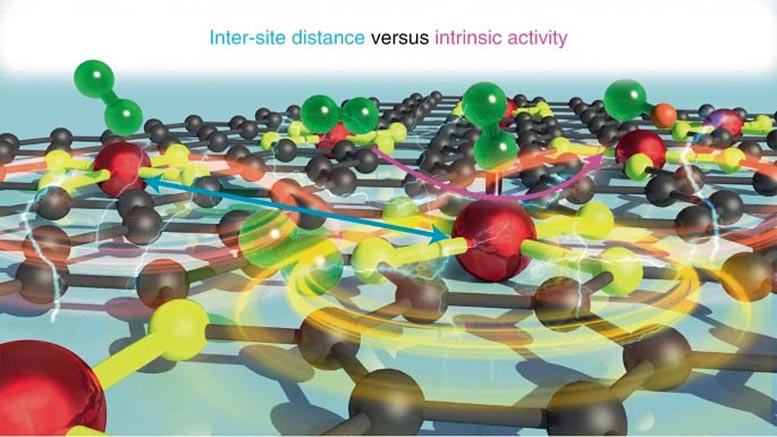
    Figuring out the density and locational dynamics of iron atoms unlocks a level of efficiency in the fuel cell oxidation reaction never before realized. Credit: University of Texas at Austin / Cockrell School of Engineering

    The demand for clean energy has never been higher, and it has created a global race to develop new technologies as alternatives to fossil fuels. Among the most tantalizing of these green energy technologies is fuel cells. They use hydrogen as fuel to cleanly produce electricity and could power everything from long-haul trucks to major industrial processes.

    However, fuel cells are held back by sluggish kinetics in a part of the core chemical reaction that limits efficiency. But, researchers from The University of Texas at Austin have discovered new dynamics that could supercharge this reaction using iron-based single-atom catalysts.

    The Breakthrough

    The researchers developed a new method to improve the oxygen reduction portion of the chemical reaction in fuel cells, in which O2 molecules are split to create water. They did so through a “hydrogel anchoring strategy” that creates densely packed sets of iron atoms held in place by a hydrogel polymer. Finding the right formula for spacing these atoms created interactions that allowed them to morph into catalysts for oxygen reduction.

    Figuring out the density and locational dynamics of these iron atoms unlocks a level of efficiency in this reaction never before realized. The researchers demonstrated these findings in a new paper published recently in Nature Catalysis.

    Why it Matters

    The oxygen reduction reaction is perhaps the greatest impediment to large-scale deployment of fuel cells. The promise of fuel cells lies in the fact that they are nearly limitless in potential applications. They can use a wide range of fuels and feedstocks to provide power for systems as large as a utility power station and as small as a laptop computer.

    Academic researchers around the globe are working to enhance fuel cell capabilities. That includes other engineers at UT Austin who are taking a variety of approaches to solve key problems in fuel cell development.

    What the Researchers Have to Say

    “It is of the utmost importance to replace fossil fuels with clean and renewable energy sources to tackle major problems plaguing our society like climate change and the pollution of the atmosphere,” said Guihua Yu, an associate professor of materials science in the Cockrell School’s Walker Department of Mechanical Engineering. “Fuel cells have been regarded as a highly efficient and sustainable technology to convert chemical to electrical energy; however, they are limited by the sluggish kinetics of the cathodic oxygen reduction reaction. We found that the distance between catalyst atoms is the most important factor in maximizing their efficiency for next-generation fuel cells.”

    What’s Next

    These findings can be applied to anything that includes electrocatalytic reactions. That includes other types of renewable fuels as well as ubiquitous chemical products such as alcohols, oxygenates, syngas, and olefin.

    Reference: “Understanding the inter-site distance effect in single-atom catalysts for oxygen electroreduction” by Zhaoyu Jin, Panpan Li, Yan Meng, Zhiwei Fang, Dan Xiao and Guihua Yu, 19 July 2021, Nature Catalysis.
    DOI: 10.1038/s41929-021-00650-w

    In addition to Yu, authors include Zhaoyu Jin from UT’s Texas Materials Institute and the Department of Chemistry; Panpan Li and Zhiwei Fang from the Texas Materials Institute, and Dan Xiao and Yan Meng from the Department of Chemical Engineering, Sichuan University in China. The team has spent more than two years working on this project, and it was funded by the U.S. Department of Energy, Office of Science, Basic Energy Sciences; the Welch Foundation; and the Camille Dreyfus Teacher-Scholar Award.

    Never miss a breakthrough: Join the SciTechDaily newsletter.
    Follow us on Google and Google News.

    Catalysts Energy Fuel-cell Technology Green Energy University of Texas at Austin
    Share. Facebook Twitter Pinterest LinkedIn Email Reddit

    Related Articles

    Decades in the Making – New Catalyst Could Make Hydrogen Fuel Cells Affordable

    New Theories and Materials Aid the Transition To Clean Energy: Enzyme Catalysis, Electrocatalysis, and Photoelectrosynthesis

    Artificial Photosynthesis Promises Clean, Sustainable Source of Energy

    High-Performance Single-Atom Catalysts Developed for High-Temperature Fuel Cells

    Chemical Research Breakthrough Could Transform Clean Energy Technology

    Artificial Photosynthesis Uses Sunlight to Recycle CO2 Into ‘Green Methane’

    Gasification Goes Green: Low-Temp Photocatalyst Slashes Carbon Footprint for Syngas

    Solving a Riddle That Would Provide the World With Entirely Clean, Renewable Energy

    Stanford Researchers Discover a New Route to Carbon-Neutral Fuels From Carbon Dioxide

    Leave A Reply Cancel Reply

    • Facebook
    • Twitter
    • Pinterest
    • YouTube

    Don't Miss a Discovery

    Subscribe for the Latest in Science & Tech!

    Trending News

    AI Could Detect Early Signs of Alzheimer’s in Under a Minute – Far Before Traditional Tests

    What if Dark Matter Has Two Forms? Bold New Hypothesis Could Explain a Cosmic Mystery

    This Metal Melts in Your Hand – and Scientists Just Discovered Something Strange

    Beef vs. Chicken: Surprising Results From New Prediabetes Study

    Alzheimer’s Breakthrough: Scientists Discover Key Protein May Prevent Toxic Protein Clumps in the Brain

    Quantum Reality Gets Stranger: Physicists Put a Lump of Metal in Two Places at Once

    Scientists May Have Found the Key to Jupiter and Saturn’s Moon Mystery

    Scientists Uncover Brain Changes That Link Pain to Depression

    Follow SciTechDaily
    • Facebook
    • Twitter
    • YouTube
    • Pinterest
    • Newsletter
    • RSS
    SciTech News
    • Biology News
    • Chemistry News
    • Earth News
    • Health News
    • Physics News
    • Science News
    • Space News
    • Technology News
    Recent Posts
    • What if Your Memories Never Happened? Physicists Take a New Look at the Boltzmann Brain Paradox
    • Students Found an Ancient Star That Shouldn’t Be in the Milky Way
    • Astronomers Solve 50-Year Mystery and Reveal Hidden Culprit Behind Strange X-Ray Emissions
    • One of the Universe’s Largest Stars May Be Getting Ready To Explode
    • Scientists Discover Enzyme That Could Supercharge Ozempic-Like Weight Loss Drugs
    Copyright © 1998 - 2026 SciTechDaily. All Rights Reserved.
    • Science News
    • About
    • Contact
    • Editorial Board
    • Privacy Policy
    • Terms of Use

    Type above and press Enter to search. Press Esc to cancel.