
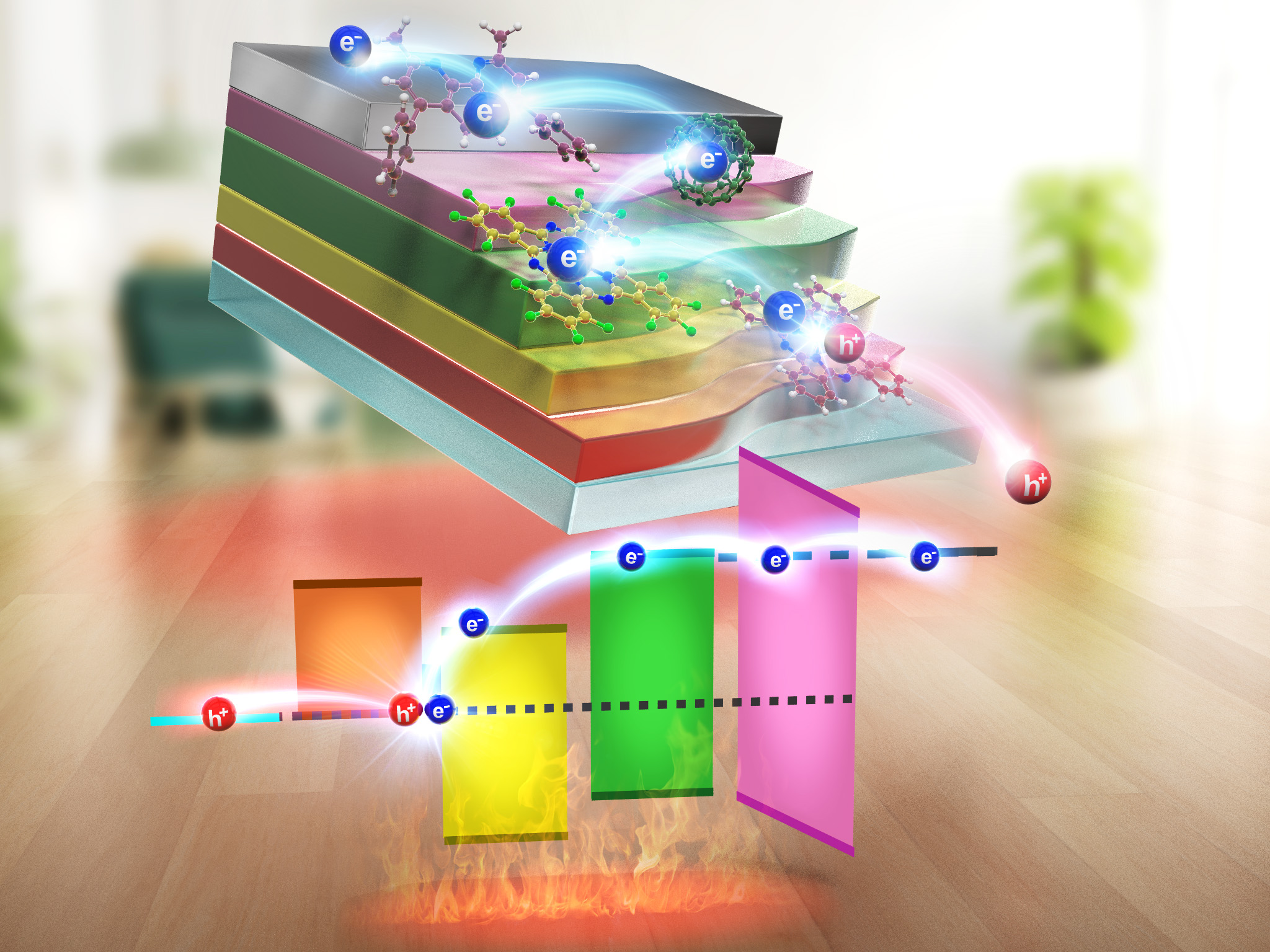
Researchers have successfully developed a framework for generating organic thermoelectric power at ambient temperature, without the need for a temperature gradient.
Researchers have created a new organic thermoelectric device capable of harvesting energy from ambient temperatures. Although thermoelectric devices are already used in various applications, challenges remain that limit their full potential. By leveraging the distinctive properties of organic materials, the team developed a system for generating thermoelectric power at room temperature without requiring a temperature gradient. Their findings were published in Nature Communications.
Thermoelectric devices, or thermoelectric generators, are a series of energy-generating materials that can convert heat into electricity so long as there is a temperature gradient—where one side of the device is hot and the other side is cool. Such devices have been a significant focus of research and development for their potential utility in harvesting waste heat from other energy-generating methods.
Perhaps the most well-known use of thermoelectric generators is in space probes such as the Mars Curiosity rover or the Voyager probe. These machines are powered by radioisotope thermoelectric generators, where the heat generated from radioactive isotopes provides the temperature gradient for the thermoelectric devices to power their instruments. However, due to issues including high production cost, use of hazardous materials, low energy efficiency, and the necessity of relatively high temperatures, thermoelectric devices remain underutilized today.
New Organic Approach
“We were investigating ways to make a thermoelectric device that could harvest energy from ambient temperature. Our lab focuses on the utility and application of organic compounds, and many organic compounds have unique properties where they can easily transfer energy between each other,” explains Professor Chihaya Adachi of Kyushu University’s Center for Organic Photonics and Electronics Research (OPERA) who led the study. “A good example of the power of organic compounds can be found in OLEDs or organic solar cells.”
The key was to find compounds that work well as charge transfer interfaces, meaning that they can easily transfer electrons between each other. After testing various materials, the team found two viable compounds: copper phthalocyanine (CuPc) and copper hexadecafluoro phthalocyanine (F16CuPc).
“To improve the thermoelectric property of this new interface, we also incorporated fullerenes and BCP,” continues Adachi. “These are known to be good facilitators of electron transport. Adding these compounds together significantly enhanced the device’s power. In the end, we had an optimized device with a 180 nm layer of CuPc, 320 nm of F16CuPc, 20 nm of fullerene, and 20 nm of BCP.”
The optimized device had an open-circuit voltage of 384 mV, a short-circuit current density of 1.1 μA/cm2, and a maximum output of 94 nW/cm2. Moreover, all these results were achieved at room temperature without the use of a temperature gradient.
“There have been considerable advances in the development of thermoelectric devices, and our new proposed organic device will certainly help move things forward,” concludes Adachi. “We would like to continue working on this new device and see if we can optimize it further with different materials. We can even likely achieve a higher current density if we increase the device’s area, which is unusual even for organic materials. It just goes to show that organic materials hold amazing potential.”
Reference: “Organic thermoelectric device utilizing charge transfer interface as the charge generation by harvesting thermal energy” by Shun Kondo, Mana Kameyama, Kentaro Imaoka, Yoko Shimoi, Fabrice Mathevet, Takashi Fujihara, Hiroshi Goto, Hajime Nakanotani, Masayuki Yahiro and Chihaya Adachi, 19 September 2024, Nature Communications.
DOI: 10.1038/s41467-024-52047-5
The study was funded by the Japan Science and Technology Agency, the Murata Science Foundation, and the GCE Institute.
Never miss a breakthrough: Join the SciTechDaily newsletter.
Follow us on Google and Google News.
1 Comment
This is revolutionary and it is surprising it is not treated as such. Graphene sheets will also do thiis- University of Arkansas No more windmills, photovoltaic, etc. Thermodynamics has been overthrown