
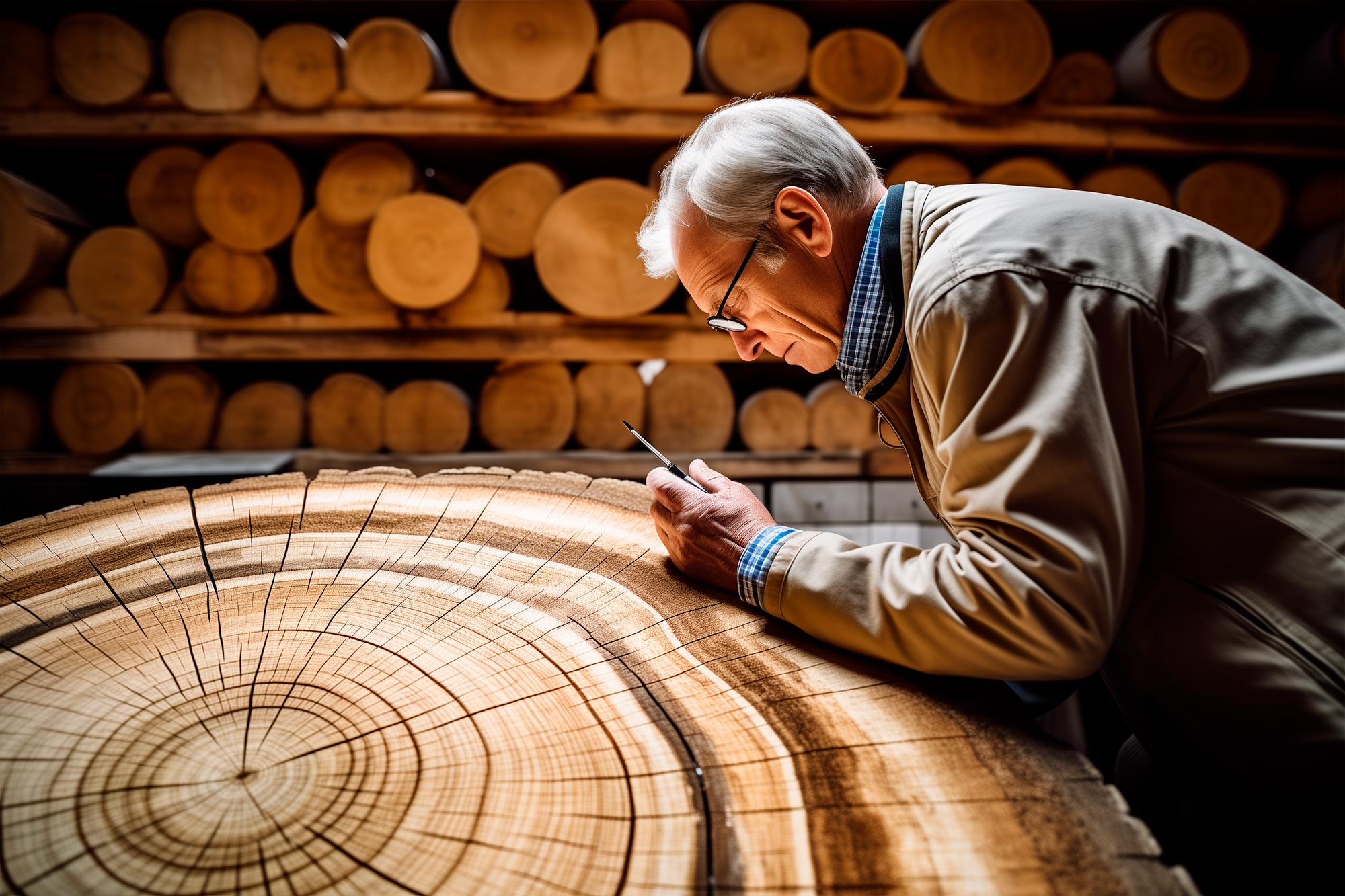
Research on 600 years of tree ring data from California’s San Joaquin Valley shows that historic climate extremes surpass modern records, highlighting the compounded effects of natural variability and climate change on future climatic risks.
The San Joaquin Valley in California has experienced vast variability in climate extremes, with droughts and floods that were more severe and lasted longer than what has been seen in the modern record, according to a new study of 600 years of tree rings from the valley.
The researchers used the tree rings to reconstruct plausible daily records of weather and streamflow scenarios during the 600-year period.
This new approach, combining paleo information with synthetic weather generation, may help policymakers and scientists better understand – and anticipate – California’s flood and drought risks and how they will be compounded by climate change.
The group’s paper was published recently in Earth’s Future, a journal of the American Geophysical Union.
Regional Significance
The San Joaquin Valley sits in the southern part of California’s Central Valley, a major agricultural hub from which much of the nation gets its produce. Over the last few years, the region has seen a wild swing between severe drought and significant atmospheric rivers, which makes the valley a bellwether for the climate hazards that are facing the rest of California and much of the world, according to Patrick Reed, professor of engineering at Cornell University, and co-senior author of the paper.
Climate Change and Natural Variability
The models show how flood and drought extremes have evolved within the San Joaquin Valley and can help clarify how natural variability and climate change can compound each other’s effects.
“Folks typically want to separate out internal variability versus climate change, just to get a sense of the signal change with anthropogenic warming,” Reed said. “But when we’re planning in complex water systems, both are occurring. And we need a sense of what happens when they come together. And what happens is we get extremes we’ve never seen. This opens the envelope of plausible futures in a much wider sense.”
Among the findings:
- A large portion of variability in flood and drought extremes in the San Joaquin Valley can be attributed to natural variability in the short term, but human-driven climate changes are influential at durations longer than 30 years.
- The last 600 years have seen sustained pluvial and drought periods that have lasted decades.
- Estimates of drought occurrence and severity from the last 30 years rival the worst megadrought period in the 600-year reconstruction, but estimates of modern drought duration have been slightly shorter than what is found in the paleo record. Therefore, relying solely on the modern instrumental record can underrepresent hydroclimatic hazards.
- The combination of natural variability and climate change can lead to more frequent, more severe, and longer flood and drought extremes than have ever been experienced over the last 600 years.
Reference: “Understanding the Contributions of Paleo-Informed Natural Variability and Climate Changes to Hydroclimate Extremes in the San Joaquin Valley of California” by Rohini S. Gupta, Scott Steinschneider and Patrick M. Reed, 13 November 2023, Earth’s Future.
DOI: 10.1029/2023EF003909
The research was supported by a National Science Foundation Graduate Research Fellowship.
Never miss a breakthrough: Join the SciTechDaily newsletter.
Follow us on Google and Google News.
1 Comment
“Estimates of drought occurrence and severity from the last 30 years rival the worst megadrought period in the 600-year reconstruction, but estimates of modern drought duration have been slightly shorter than what is found in the paleo record.”
The operative word here is “rival.” It appears that the historical behavior is more severe. Their projections are a conflation of what is known and what is speculated. The problem is, the speculations have known issues that contribute to the reliability, or should I say the un-reliability?
From the Introduction of their research:
In a majority of the climate studies (Hawkins & Sutton, 2009; Knutti et al., 2017; Lehner et al., 2020; Rowell, 2012; Yip et al., 2011) and three hydrologic studies (I.-W. Jung et al., 2011; Kay et al., 2009; Vidal et al., 2015) referenced above, natural variability was determined using multi-member ensembles of GCMs run with different initial conditions. However, the degree to which initial-condition ensembles can represent true natural climate variability is unclear (Deser et al., 2020). For instance, these models poorly represent regional precipitation and drought persistence (Moon et al., 2018; Rocheta et al., 2014) and underestimate AR moisture flux and frequency (Zhou & Kim, 2018); all of which are important for regional planning and management of water systems. While the recent generation of models in CMIP6 better represents key features of natural climate variability (e.g., blocking; major climate modes) compared to older generations, significant biases remain (Schiemann et al., 2020; Tatebe et al., 2019).”
Thus, they are effectively splicing historical data of tree ring proxies with known problems, to synthetic projections based on formal assumptions with even greater known problems. Nowhere in their paper do I see a statement of the uncertainty, let alone a formal analysis of the propagation of error, from the conflation of the two drivers of future weather.